

Stop Guessing: Top 10 Rules for Selecting the Best Whey Protein


Want to build strength to support your running?
Get targeted strength routines and mobility exercises designed specifically for runners directly on-site. Try asking Raye: 'What are 3 key gym exercises to improve running economy?' Get strength tips
The Biological Strategy of Whey Protein: From Industrial Byproduct to Bioactive Asset
The trajectory of whey protein-moving from a discarded industrial effluent to a cornerstone of the global functional food market-represents a paradigm shift in nutritional science. Historically, whey was viewed primarily as a nuisance byproduct of the cheese-making industry. For every kilogram of cheese produced, approximately nine kilograms of liquid whey remained, creating a massive disposal challenge. Today, sophisticated fractionation technologies have transformed this "milk serum" into one of the most physiologically potent dietary tools available to the modern athlete...
Hit the gym and learn at the same time. Hit play below
... For the high-performing individual, treating the body as a high-value asset requires precision. You do not require "fitness motivation"; you require biological strategy. Nutrition is not about comfort; it is about execution. Understanding the biochemistry and application of whey protein allows you to execute a long-term performance plan, ensuring that your physical infrastructure remains robust, resilient, and optimised for the long game. We are not interested in summer aesthetics; we are interested in performing well forever.
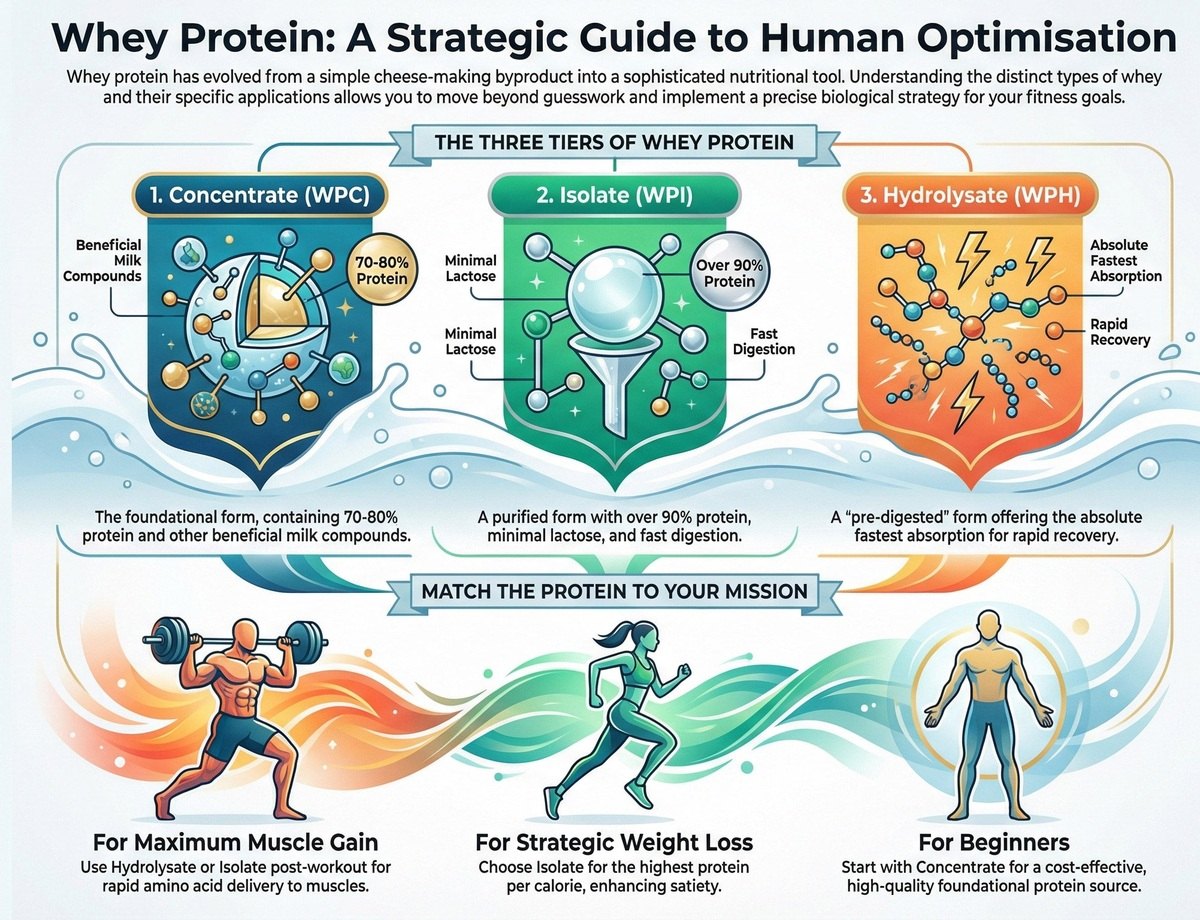
What are the 3 types of whey protein
To utilise whey effectively, one must understand the available tools. The market classifies whey protein into three distinct categories based on the degree of processing, protein concentration, and digestion kinetics. Understanding the technical nuances of each is essential for matching the supplement to your physiological requirements.
1. Whey Protein Concentrate (WPC)
This is the fundamental form of whey. Through ultrafiltration, water, lactose, and minerals are separated from the protein. WPC typically contains between 70% and 80% protein by weight. Crucially, because it undergoes fewer filtration cycles, it retains a significant portion of the bioactive sub-fractions found in the original milk serum, such as lactoferrin and immunoglobulins. It offers a slower digestion rate than isolates but provides a complete amino acid profile sufficient for structural loading.
2. Whey Protein Isolate (WPI)
Isolate represents a higher tier of purification. Through cross-flow microfiltration (CFM) or ion exchange, the vast majority of non-protein constituents (lactose and fats) are removed, yielding a product that is at least 90% protein. This is "macronutrient purity." It is the logical choice for those requiring rapid gastric emptying or those with a low tolerance for lactose. It is precision engineering for your diet, eliminating the variables of unnecessary lipids or sugars.

Have a specific performance goal in mind?
Get direct feedback on your training targets right here on the page—no sign-up or account required. Try asking Raye: 'How should I adjust my weekly mileage for a sub-20 minute 5K?' Ask about your goals
3. Whey protein hydrolysate
Often termed "hydro whey," this is a pre-digested form of protein. It is produced by treating WPC or WPI with proteolytic enzymes that cleave long polypeptide chains into shorter peptides (oligopeptides, dipeptides, and tripeptides).
The primary advantage here is absorption kinetics. Because the peptide bonds are already broken, the body bypasses the initial phases of digestion, leading to the most rapid spike in plasma amino acid levels. It is a tool for precision recovery immediately following intense physical exertion, designed to exploit the body's anabolic response mechanisms with zero latency.

Best types of whey protein powder
Navigating the market requires aligning product characteristics with your specific objectives. There is no single "best" powder, only the most optimised tool for the specific job. The discerning athlete must look past the branding and audit the label for "Amino Spiking"-the addition of cheap, non-essential amino acids like glycine or taurine to artificially inflate the protein count. A high-quality powder will list the protein source (Isolate, Concentrate, or Hydrolysate) as the first ingredient and will ideally carry third-party certification to ensure it is free from contaminants.
Which type of whey protein is best for muscle gain
Recommendation: Whey Protein Hydrolysate or Isolate (Post-Workout)
The Strategy: The primary driver here is the speed of amino acid availability to exploit the recovery window. Hydrolysates initiate Muscle Protein Synthesis (MPS) marginally faster than Isolates. The rapid influx of amino acids creates a hyperaminoacidemia that signals the body to switch from a catabolic state (breakdown) to an anabolic state (building).
Leucine serves as a nutrient trigger, directly activating the mTOR pathway-a central regulator of cell growth. Research indicates that the threshold for maximal stimulation of MPS is approximately 2.5g to 3g of leucine per serving, a dose easily achieved with a standard serving of high-quality whey.
Implementation: Execute a serving of hydrolysate immediately following high-intensity structural loading (resistance training).

Best types of whey for weight loss
Recommendation: Whey Protein Isolate (Mixed with Water)
The Strategy: In a caloric deficit, efficiency is key. WPI offers the highest protein-to-calorie ratio. By removing fats and lactose, a serving of WPI is often 100-110 calories for 25g of protein.
Implementation: Utilise WPI mixed with water rather than milk. This eliminates unnecessary carbohydrate and lipid intake while maximising satiety signalling. Protein is the most thermogenic macronutrient, requiring more energy to digest than fats or carbohydrates, and it stimulates the release of appetite-suppressing hormones such as GLP-1 and CCK.
Which type of whey protein is best for beginners
Recommendation: Whey Protein Concentrate (Blends)
The Strategy: Those new to nutritional supplementation generally do not require the ultra-fast absorption of hydrolysates nor the extreme purity of isolates if they digest dairy well. WPC provides a more palatable, creamier texture and is significantly more cost-effective. It offers a complete amino acid profile sufficient for most initial fitness goals.
Implementation: Use WPC as a daily dietary staple to ensure total protein targets are met. It serves as the foundational layer of your nutritional architecture.
Best types of whey powder
If we must rank them based on utility for the Executive Athlete:
-
The Performance Choice: Hydrolysed Whey Isolate. Unmatched speed and purity for the post-workout window.
-
The Dietary Choice: Grass-Fed Whey Protein Concentrate. Superior bioactive profile for immune support and daily maintenance.
-
The Clean Choice: Unflavoured Isolate. Free from artificial sweeteners and fillers, allowing you to control the flavour profile and chemical input into your system.
Is whey healthy
Safety and efficacy are paramount. While whey protein is generally recognised as safe for the vast majority of the population, a strategic approach requires an honest assessment of physiological data.
Renal Function: A pervasive misunderstanding is that high protein intake damages the kidneys. Current scientific consensus refutes this for healthy individuals; the kidneys are highly adaptable organs capable of handling increased solute loads. However, for those with pre-existing renal dysfunction, medical consultation is mandatory.
Metabolic Impact: Whey protein is insulinotropic, meaning it stimulates beta cells to secrete insulin. This can be advantageous for glycemic control when timed correctly. Studies suggest that consuming whey protein before a meal can blunt post-prandial blood sugar spikes, acting as a nutritional preload to improve insulin sensitivity.
Whey milk benefits
While powdered supplements are efficient, the benefits originate from the liquid fraction of milk itself. Whey milk benefits include the delivery of a dilute solution of lactose, minerals (calcium, phosphorus, potassium), and water-soluble vitamins, particularly B-complex vitamins like riboflavin.
Historically, the consumption of fluid whey dates back to 17th-century European coffee houses where it was consumed for its restorative properties. The "milk serum" contains immunoglobulins (IgGs) which provide passive immunity. In a modern context, incorporating whey fractions helps maintain a positive nitrogen balance, essential for preventing catabolism (muscle breakdown) during periods of caloric restriction or high stress.
Whey food benefits
The utility of whey protein extends far beyond simple hypertrophy. Its complex amino acid profile exerts pleiotropic effects on human physiology, influencing metabolic regulation and immune competence.
Systemic Antioxidant Capacity: One of the primary whey food benefits is its cysteine content. Cysteine is the rate-limiting precursor for the synthesis of glutathione. Glutathione is the body's master intracellular antioxidant, vital for neutralising free radicals and supporting lymphocyte function. For the executive athlete, maintaining high glutathione levels is a strategic move to mitigate the oxidative stress of a high-output lifestyle.
Cardiovascular Health: Bioactive peptides derived from whey, specifically lactokinins, function similarly to pharmacological ACE-inhibitors used to treat hypertension. By inhibiting the Angiotensin-Converting Enzyme (ACE), these peptides promote vasodilation and may assist in reducing blood pressure in hypertensive individuals.
Is whey halal
For nearly two billion consumers globally, the permissibility of whey protein is a critical specification. Because whey is a byproduct of cheese-a process heavily reliant on enzymes-its status is not automatically guaranteed.
The pivotal factor is the source of rennet, the enzyme used to coagulate milk.
-
Animal Rennet: Traditionally derived from the stomach lining of calves. If the animal was not slaughtered according to Zabiha rites, the derivative is non-compliant (Haram).
-
Microbial Rennet: Derived from fungal fermentation (e.g., Mucor miehei). Whey produced via microbial rennet is generally considered Halal.
-
Certification: To ensure compliance, one should look for certification from reputable bodies. The market has responded with dedicated lines, ensuring that the executive athlete does not have to compromise on ethics for performance.
Culinary Integration: The Science of Cooking with Whey
Integrating whey protein into solid food systems requires an understanding of protein chemistry. Whey proteins are heat-labile; they begin to denature at temperatures above 70°C (158°F). This denaturation exposes hydrophobic groups, which can lead to aggregation-culinary failure resulting in a rubbery texture.
Whey food recipes
High-Protein Structural Pancakes One cannot simply replace flour with whey protein at a 1:1 ratio. Whey lacks the gluten network that gives structure to baked goods.
-
The Formula: Replace only 1/4 to 1/3 of the flour volume with protein powder.
-
The Mix: Combine oat flour (1 cup), whey protein (1 scoop/30g), a leavening agent (baking powder), and a binder such as eggs.
-
Execution: Cook on low heat. Whey proteins undergo the Maillard reaction (browning) much faster than wheat flour and will burn if the thermal load is too high.
No-Bake Energy Protocol This is the safest culinary application as it avoids thermal denaturation entirely.
-
The Formula: Mix whey protein with rolled oats, a lipid binder (almond butter), and a liquid sweetener (honey) in a precise ratio to form a dough.
-
Execution: Refrigerate to set. This provides a portable, shelf-stable nutrient source that requires no preparation time during your busy schedule.
Whey cheese
The production of cheese is the origin of whey, but whey can also be used to create cheese, closing the loop on the resource.
-
Ricotta: True Ricotta is produced by heating sweet whey to near boiling (~85°C) and adding an acid coagulant (vinegar or citric acid). The heat and acid denature the residual albumin and globulin proteins, causing them to float to the surface as delicate curds.
-
Gjetost: A Scandinavian specialty made by boiling whey until the water evaporates and the lactose caramelises, resulting in a sweet, brown block that is mineral-dense.
Best whey food
The "best" food is one that serves a specific biological function without unnecessary overhead.
-
Greek Yoghurt (Fortified): Stirring whey protein into Greek yoghurt creates a semi-solid, high-protein matrix that is slow-digesting (due to the casein in yoghurt) and highly satiating. This is an optimal pre-sleep meal to support overnight recovery and prevent nocturnal catabolism.
Whey foods to avoid
Certain combinations result in poor texture or reduced bioavailability.
-
Boiling Liquids: Pouring boiling water directly onto whey powder will cook it instantly, creating insoluble rubbery lumps. Always temper the powder with lukewarm liquid first before adding to hot coffee or soups.
-
High Acid Juice: Mixing whey with citrus juices (orange, grapefruit) often drops the pH to the isoelectric point of the protein (around pH 4.5-5.0), causing it to lose solubility and precipitate out as sludge.
Conclusion
Whey protein is not merely a supplement; it is a bio-industrial triumph and a tool for human optimisation. Whether you are selecting a hydrolysed isolate for post-training recovery or utilising a concentrate for daily nutritional support, the key lies in precision. By understanding the types, the physiological mechanisms, and the correct application, you transform nutrition from a guessing game into a calculated strategy. Focus on the long game. Pain is data. Optimise accordingly.
The Sundried Roundup
You have the data. Now you need the execution strategy. Here is how to apply this research to your specific constraints.
I'm on a budget. How can I increase my consumption?
Strategy: Prioritise Whey Protein Concentrate (WPC). WPC is the most cost-efficient vehicle for amino acid delivery. While it contains slightly more lactose and fat than an isolate, the protein quality remains high. Buy in bulk (2kg+ bags) to reduce the cost per serving. Treat this as your foundational nutritional layer. You are paying for the biological amino acid profile, not the marketing.
I don't want to invest too much, but I am on board. Give me a plan.
Strategy: The Post-Workout Protocol. Purchase a standard Whey Protein Isolate. You do not need to consume this all day. Use it exclusively immediately after your training sessions.
-
The Plan: On training days, consume one 30g serving within 30 minutes of finishing your workout. On rest days, rely on whole foods. This maximises the ROI of the supplement by deploying it only when your body's demand for rapid recovery is highest.
I'm all in. With no budget to worry about, what can I do to maximise this?
Strategy: The Hydrolysate + Casein Ecosystem. You are looking for total biological coverage.
-
Post-Workout: Use Whey Protein Hydrolysate. This provides the fastest possible absorption to spike insulin and initiate repair instantly.
-
Pre-Sleep: Invest in Micellar Casein (often sold alongside whey). While whey is fast, casein is slow. Consuming this before bed ensures a steady stream of amino acids throughout the night, preventing muscle breakdown during your fast.
-
Gut Health: Add a glutamine supplement to your whey shake to support intestinal lining and immune function.
Top 10 Things
Calculate, Don't Guess
Determine your daily protein target (typically 1.6g to 2.2g per kg of lean body mass).
Timing Matters
Prioritise whey consumption in the peri-workout window (before or after training).
Hydrate
Protein metabolism requires water. Increase your fluid intake to support renal processing.
Read the Label
Avoid "proprietary blends" and look for the exact grams of protein per serving.
Check for Leucine
Ensure your chosen whey provides at least 2.5g of leucine per serving to trigger mTOR.
Cycle Your Intake
If you experience bloating, rotate between Isolate and Concentrate or try a plant-based alternative.
Temper Your Cooking
Never add whey to boiling liquids; mix with warm fluids first.
Watch the Fillers
Avoid powders with high amounts of maltodextrin or artificial thickeners.
Whole Foods First
Use whey to hit targets, not to replace meals. Chew your calories where possible.
Consistency is Key
One shake will not change your physiology. Years of consistent structural loading will.


