

Top 10 Protein Shakes to Optimise Muscle Retention and Recovery


Dealing with a nagging injury or tightness?
Get instant recovery guidance, stretching protocols, and rest advice right now without leaving the site. Try asking Raye: 'What are the best stretches to relieve tight calves after a long run?' Get recovery advice
The Executive Protocol: Optimising Biological Capital with Protein Shakes
For the high-performing individual, the approach to physical maintenance must evolve from the brute-force volume of the past to the precision engineering required for long-term sustainability. This is no longer a game of vanity; it is a campaign for cognitive clarity, metabolic dominance, and structural integrity.
The operational motto "Smarter, not softer" serves as our guiding principle. It demands that every caloric input and every piece of hardware serve a distinct physiological or logistical purpose. To maintain the body as a high-value asset, we must move beyond vague fitness motivation and engage in biological strategy.
This report provides an exhaustive analysis of the protein supplementation landscape. We navigate the market to extract the tactical assets relevant to the modern operator, dissecting the physiology of anabolic resistance, the nuances of nutrient timing, and the specific hardware required to execute a seamless nutrition strategy.
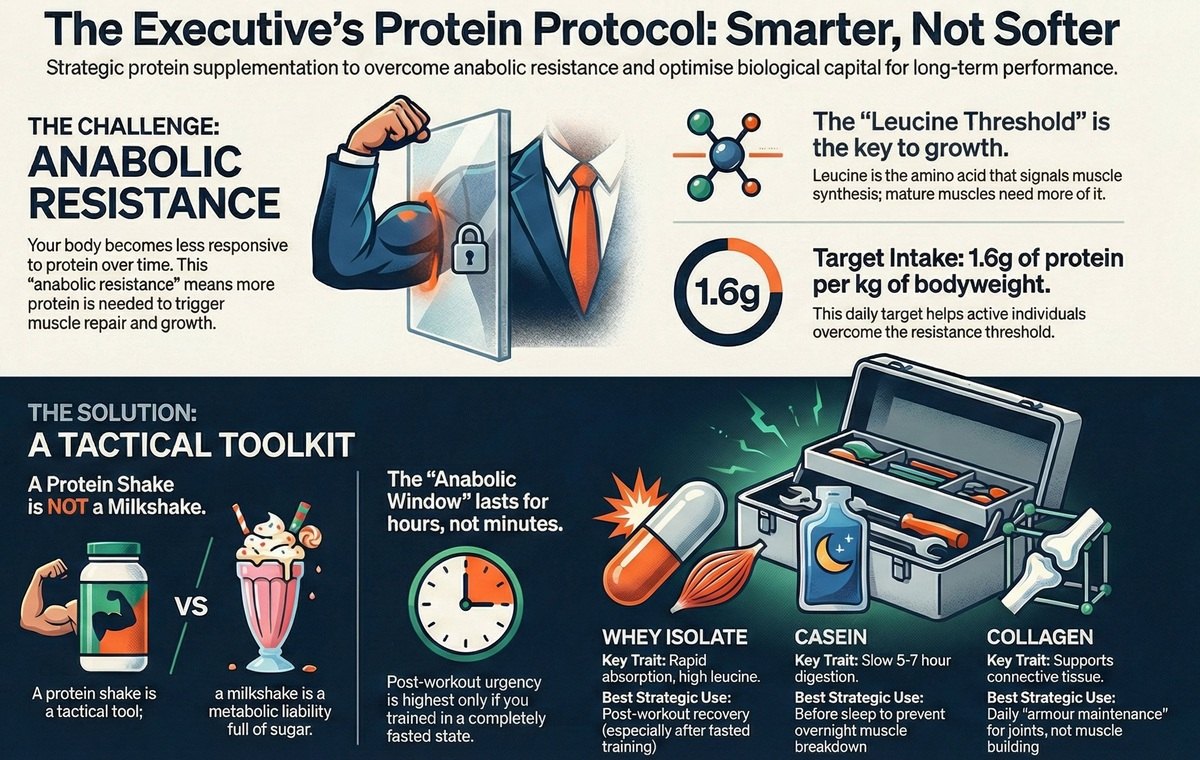
Executive Intelligence: The Physiology of Performance
To understand the necessity of protein supplementation, one must first understand the terrain. As the body matures, it undergoes specific physiological shifts that alter nutritional requirements. We are fighting a war on two fronts: the preservation of lean muscle mass and the management of systemic inflammation.
The Silent Adversary: Anabolic Resistance
The primary operational challenge is "anabolic resistance." This physiological phenomenon describes a reduced sensitivity of muscle tissue to the anabolic signals provided by protein intake and structural loading.
In a standard 20-year-old male, a modest intake of 20 grams of protein might be sufficient to maximally stimulate muscle protein synthesis (MPS). For the Executive Athlete, that same 20-gram dose may fail to cross the "leucine threshold" required to trigger the mTOR pathway-the cellular mechanism that governs muscle repair and growth.
Consequently, the strategy is not simply about "eating enough"; it is about overcoming this resistance threshold. The data suggests that for active individuals engaged in structural loading (resistance training), the requirement shifts to a range of 1.2 to 1.6 grams per kilogram of body weight per day. For a 90kg male, this necessitates between 108g and 144g of high-quality protein daily-a target that is logistically difficult to hit through solid food alone amidst a demanding professional schedule.

Have a quick training or recovery question?
Get fast expert advice right here on the page—no sign-up, account, or app needed. Try asking Raye: 'What's the best way to relieve tight calves after a run?' Ask a question now
The Leucine Threshold
The mechanism of anabolic resistance is intrinsically linked to the amino acid leucine. Leucine acts as the primary signal or "trigger" for synthesis. Mature muscle requires a higher concentration of leucine to activate the mTOR pathway than younger muscle.
This elevates the importance of protein quality over mere quantity. Whey protein, derived from milk, possesses one of the highest leucine contents of any food source, making it a "tactical" supplement. It is not merely a convenience; it is a pharmacological tool designed to bypass anabolic resistance.
Taxonomy of Protein: Formulations and Strategic Utility
The market is saturated with powders and liquids, often obscured by marketing hyperbole. For the analytical consumer, distinguishing between protein sources is paramount to selecting the right tool for the job.
Whey Protein: The Rapid Response Unit
Whey is derived from the liquid byproduct of cheese production. Its dominance in the market is scientifically justified due to its rapid digestion rate and superior leucine profile.
-
Whey Protein Concentrate (WPC): The raw material. It retains biologically active peptides and immunoglobulins which can support immune health. It is a cost-effective daily staple for men with robust digestion.
-
Whey Protein Isolate (WPI): The gold standard. The concentrate undergoes cross-flow microfiltration to remove the vast majority of fat and lactose, yielding a product that is 90-95% protein. It offers the highest protein density per calorie and minimises gastric distress. It is the precise tool for post-workout recovery.
Casein: The Night Watchman
Casein comprises the remaining 80% of milk protein. Unlike whey, it coagulates in the stomach, forming a gel that releases amino acids slowly over a period of 5-7 hours.
While suboptimal for immediate post-workout replenishment, it is the superior choice for overnight recovery. Consuming micellar casein before sleep provides a sustained trickle of amino acids, combatting nocturnal catabolism (muscle breakdown).
Collagen: The Structural Engineer
Often dismissed for its low leucine content, collagen is a critical asset for connective tissues, skin, and bones. While it is not a muscle-building protein, clinical trials indicate that collagen peptide supplementation can support joint health and skin elasticity. View this as "armour maintenance"-taken in addition to whey, not as a substitute.
The Nomenclature of Liquid Nutrition
In the beverage sector, terminology is often deliberately obfuscated. For the efficiency-minded individual, distinguishing between these three categories is vital.
The Milkshake: A Metabolic Liability
A traditional milkshake is a dessert vehicle. Its primary macronutrients are refined sugars and fats. Consumption induces a rapid spike in blood glucose followed by a significant insulin response and a reactive hypoglycemic crash. This is counterproductive to mental acuity. It serves no strategic purpose in the protocol.
The Protein Shake: The Tactical Tool
A functional supplement designed to deliver a specific macronutrient-protein-with minimal interference from fats or carbohydrates. This is the primary weapon in the arsenal to combat anabolic resistance without consuming the excess calories associated with fatty cuts of meat.
The Meal Replacement: The Logistics Solution
A nutritional architecture designed to mimic a complete plate of food in liquid form (e.g., Huel, YFood). It provides sustained energy and satiety, preventing the "emergency vending machine" scenario. However, due to the fat and fibre content slowing digestion, it should not be used as a post-workout isolate substitute.
Strategic Timing: The Anabolic Window Protocol
For decades, gym lore dictated that protein must be consumed within 30 minutes of a workout. Modern research has added significant nuance to this concept.
Deconstructing the Myth
Current evidence suggests the "anabolic window" is more akin to a "barn door," remaining open for 4 to 6 hours around a training session. If a pre-workout meal containing protein was consumed 1-2 hours before training, amino acids are still circulating in the bloodstream, diminishing the urgency of immediate supplementation.
The Fasted Training Exception
However, the Executive Athlete often trains early in the morning to maximise schedule efficiency, frequently in a fasted state. In this specific context, timing is critical. Training in a fasted state elevates cortisol and muscle breakdown rates.
Immediate post-workout consumption of high-quality protein (Whey Isolate) is necessary to rapidly switch metabolic signalling from breakdown (catabolism) to build-up (anabolism). There is no buffer of circulating amino acids from a previous meal.
Market Intelligence: The Top 10 Protein Assets
We have selected the top products based on strict criteria: Protein Density, Ingredient Quality, and Logistics.
Category A: The Ready-To-Drink (RTD) Heavyweights
1. Fairlife Core Power Elite
-
Status: The Import Specialist.
-
The Asset: 42g Protein, ~230 kcal.
-
Analysis: Fairlife uses a patented cold-filtration process on real milk, concentrating protein while filtering out lactose. The result is a texture indistinguishable from high-quality milk with a massive 42g payload.
-
Verdict: The "Special Occasion" asset. Unrivalled protein-to-calorie ratio.
2. UFit 50g High Protein Shake
-
Status: The UK Volume Leader.
-
The Asset: 50g Protein, ~295 kcal.
-
Analysis: Available in almost every UK supermarket. 50g of protein in a single bottle is a massive tactical advantage, clearing nearly half the daily requirement for a 75kg male in one sitting.
-
Verdict: The "Emergency Protocol" for missed meals.
3. Grenade Carb Killa Shake
-
Status: The Palatability King.
-
The Asset: 24-25g Protein, Low Sugar.
-
Analysis: Grenade has mastered the food science of flavour. Variants like "Fudge Brownie" effectively neutralise sugar cravings without breaking dietary discipline. Informed Sport registered.
-
Verdict: The "Morale Booster." Use to replace unhealthy snacks.
4. Barebells Milkshake
-
Status: The Texture Specialist.
-
The Asset: 24g Protein, Lactose-Free.
-
Analysis: Swedish engineering yielding a silky consistency that avoids the "slime" sometimes found in gum-thickened shakes.
-
Verdict: A reliable, moderate-protein daily driver for the office.
5. Alani Nu Protein Shake
-
Status: The Efficiency Option.
-
The Asset: 20g Protein, 140 kcal.
-
Analysis: High flavour profile with a very low caloric load. This makes it an ideal "bridge" snack that doesn't consume your daily caloric budget.
-
Verdict: The "Cut" companion for aggressive body composition phases.
Category B: The Powders (The Daily Drivers)
6. Optimum Nutrition (ON) Gold Standard
-
Status: The Global Benchmark.
-
Analysis: Reliable, mixes without failure, and balances Isolate with Concentrate.
-
Verdict: The staple daily shake.
7. MyProtein Impact Whey Isolate
-
Status: The Value/Purity Leader.
-
Analysis: 90% protein content with near-zero fat/sugar. Superior to concentrate for those watching caloric intake.
-
Verdict: The tactical choice for lean composition.
8. PhD Nutrition Diet Whey
-
Status: The Management Specialist.
-
Analysis: Lower calorie profile including compounds like CLA and Green Tea extract.
-
Verdict: Excellent for "Transformation" phases.
9. ESN Isoclear Whey Isolate
-
Status: The Alternative Texture.
-
Analysis: Uses technology to make whey mix like fruit juice rather than milk. Refreshing post-cardio.
-
Verdict: The solution for "flavour fatigue."
10. Innermost "The Strong" Protein
-
Status: The All-In-One.
-
Analysis: Integrates protein with Creatine and Montmorency Cherry to aid recovery and reduce inflammation.
-
Verdict: The Efficiency Maximiser.
Top 10 Shakes
Fairlife Elite
The "Holy Grail" (Import). 42g Protein (RTD).
UFit 50g
Emergency Meal Replacement. 50g Protein (RTD).
Grenade
Curing Sugar Cravings. 25g Protein (RTD).
Barebells
Daily Office Snack. 24g Protein (RTD).
Alani Nu
Aggressive Cutting Phase. 20g Protein (RTD).
ON Gold Standard
The Daily Staple. 24g Protein (Powder).
MyProtein Isolate
Lactose Intolerance/Purity. 23g Protein (Powder).
PhD Diet Whey
Weight Management. 20g Protein (Powder).
ESN Isoclear
Summer/Cardio Recovery. 25g Protein (Powder).
Innermost Strong
All-in-One Recovery. 34g Protein (Powder).
| Product | Type | Protein | Best Strategic Use |
| Fairlife Elite | RTD | 42g | The "Holy Grail" (Import) |
| UFit 50g | RTD | 50g | Emergency Meal Replacement |
| Grenade | RTD | 25g | Curing Sugar Cravings |
| Barebells | RTD | 24g | Daily Office Snack |
| Alani Nu | RTD | 20g | Aggressive Cutting Phase |
| ON Gold Standard | Powder | 24g | The Daily Staple |
| MyProtein Isolate | Powder | 23g | Lactose Intolerance/Purity |
| PhD Diet Whey | Powder | 20g | Weight Management |
| ESN Isoclear | Powder | 25g | Summer/Cardio Recovery |
| Innermost Strong | Powder | 34g | All-in-One Recovery |
Hardware Intelligence: The Engineering of Mixing
The Executive Athlete does not tolerate leaking lids, retained odours, or clumps of undissolved powder. The hardware must be as reliable as the supplement it carries.
1. ShakeSphere Tumbler: The Physics Solution
This bottle uses a capsule shape with no corners. When shaken, the liquid races around the capsule with zero friction, generating shear forces that obliterate powder without the need for a noisy mixing ball. It wipes clean instantly.
2. Bolde Bottle: The Executive Choice
Premium 304 Stainless Steel construction addresses the "stinky shaker" syndrome. Plastic absorbs odours; steel does not. Sleek, minimalist, and professional, it fits into a boardroom environment.
3. Stanley Activate Shaker
A sophisticated piece of kit featuring a removable strainer and a base storage container (puck) to hold dry powder. Vacuum insulation keeps the liquid cold, making it the best choice for the "Mix Later" strategy.
The Sundried Roundup
I'm on a budget. How can I increase my consumption?
Focus on Whey Protein Concentrate (WPC) in powder form. Bulk purchasing from suppliers like MyProtein or using the standard Optimum Nutrition Gold Standard offers the best price-per-gram ratio. Avoid Ready-To-Drink (RTD) bottles as you are paying a premium for convenience. Stick to the basics: powder, water, and a reliable shaker.
I don't want to invest too much, but I am on board. Give me a plan.
The "Hybrid" Protocol:
-
Home Base: Purchase a bag of MyProtein Impact Whey Isolate. It is purer than concentrate and easier on the stomach. Use this for your daily post-workout nutrition.
-
Hardware: Invest in one BlenderBottle Strada. It is stainless steel (no smell) and affordable.
-
Emergency: Keep a 4-pack of UFit 50g in your car or office drawer. These are only for days when meetings overrun, and you cannot access a proper meal.
I'm all in. With no budget to worry about, what can I do to maximise this?
The "Optimisation" Protocol:
-
Primary Fuel: Import Fairlife Core Power Elite. The 42g protein-to-calorie ratio is unmatched.
-
Recovery Stack: Use Innermost "The Strong" post-workout. The added Creatine and Montmorency cherry handle inflammation and ATP regeneration automatically.
-
Night Ops: Utilise a premium Micellar Casein before bed to prevent muscle breakdown during sleep.
-
Hardware: The Bolde Bottle for the office (aesthetics) and the Stanley Activate for travel (thermal control + powder storage).
Top 10 Things
Know Your Number
Aim for 1.6g of protein per kg of body weight daily.
Prioritise Leucine
Choose Whey Isolate or animal proteins to trigger muscle synthesis.
Respect the Fasted Window
If training fasted in the morning, consume protein immediately after.
Don't Fear the Night
Consuming Casein before bed aids recovery, not fat gain.
Read the Label
If it has >10g of added sugar, it is a milkshake, not a tool.
Upgrade Hardware
Replace plastic shakers every 3 months or switch to steel to avoid bacterial build-up.
Use RTDs Tactically
Keep Ready-To-Drink bottles for emergencies, not as a primary food source.
Hydrate
High protein intake requires increased water consumption for renal efficiency.
Monitor Inflammation
If joints ache, consider adding Collagen or switching to anti-inflammatory blends.
Track Data
Pain is data. Fatigue is data. Adjust your intake based on your recovery metrics.


