

10 Simple Ways to Boost Your Willpower for Weight Loss


Need performance advice right now?
Ask our on-site coach anything about your routines. It's completely free and available immediately right here: 'What are 3 quick exercises for ankle mobility?' Ask Raye for free
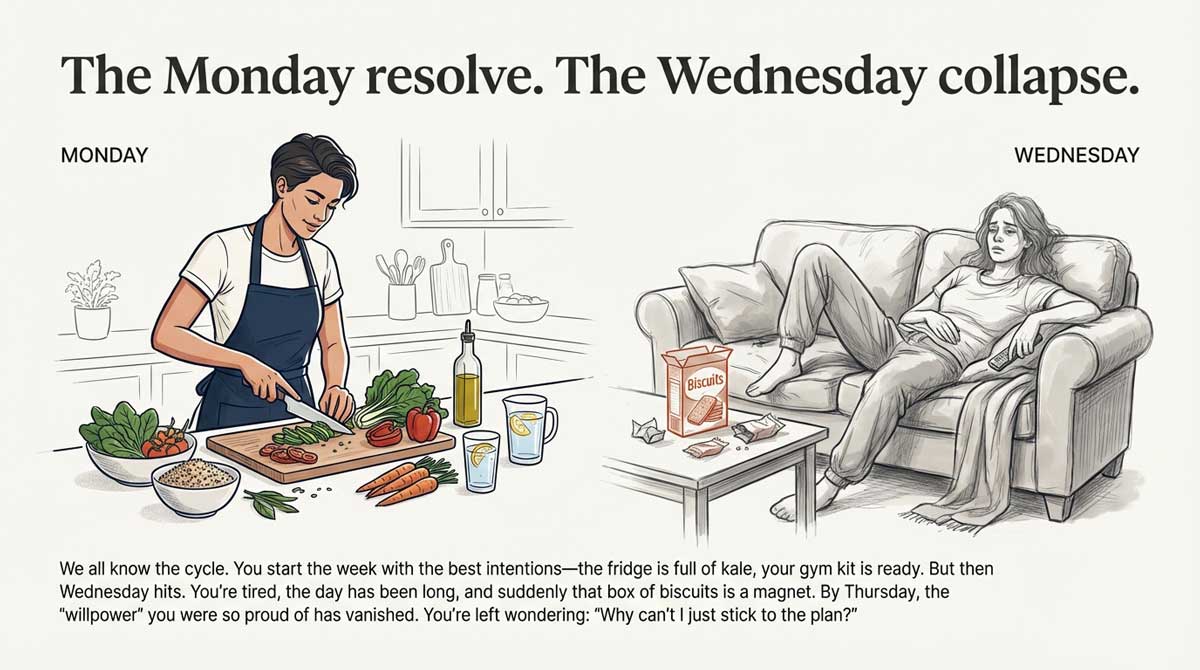
We have all been there. You start the week with the best intentions: the fridge is full of kale, your gym kit is laid out, and you have promised yourself that this time, things will be different. But then Wednesday hits. You are tired, the day has been long, and suddenly that box of biscuits in the staff room isn't just a snack-it is a magnet. By Thursday, the "willpower" you were so proud of on Monday seems to have vanished, leaving you wondering why you just can't seem to "stick to the plan."...
Want to listen to this on the go? Hit please to learn about Willpower
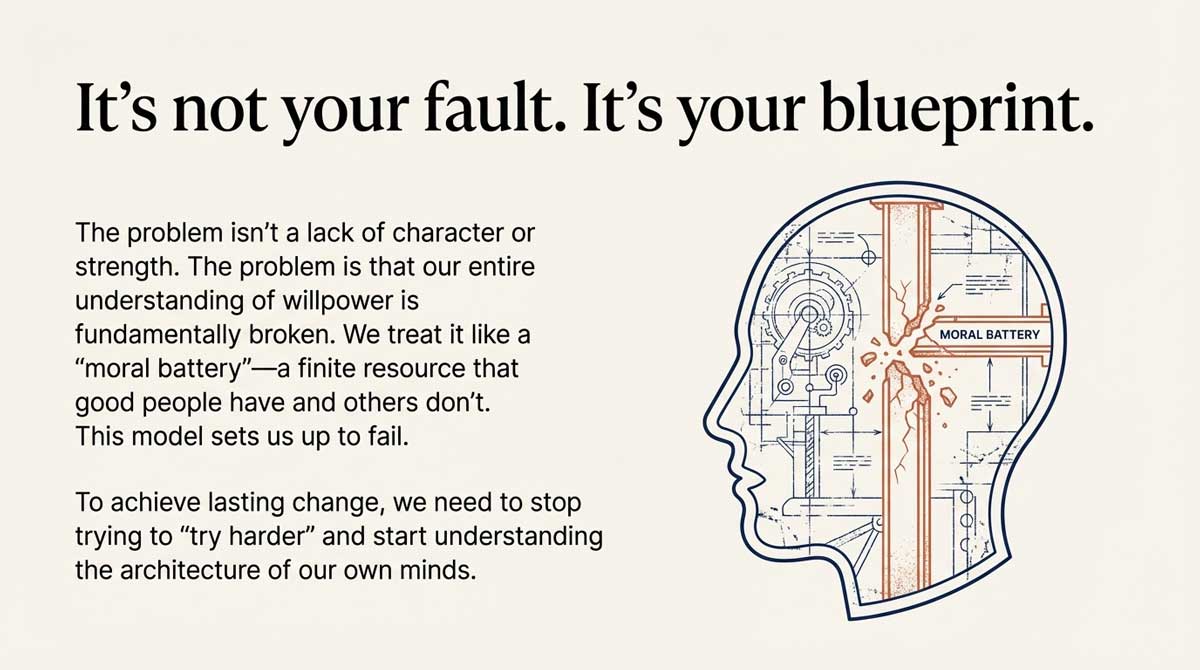
...If this sounds familiar, here is the first thing you need to know: it is not your fault. It isn't a character flaw, and it isn't because you are "weak." In fact, the way we usually talk about willpower is fundamentally broken. We treat it like a moral battery that some people are born with and others aren't. But the reality is far more interesting-and much more helpful for those of us playing the long game.

Free Weight Loss Assessment
Stop guessing. Use our behavioural assessment tool to pinpoint the lifestyle factors behind your weight plateau. Start the 60-Second Quiz.
CLAIM YOUR FREE WILLPOWER BLUEPRINT
Stop the struggle and start seeing results! Download our 100% FREE eBook to discover the "Willpower Hacks" used by pros to silence cravings and melt fat without the mental burnout.
To perform at our best, not just for a holiday or a wedding, but for the rest of our lives, we need to stop relying on "grit" and start understanding the architecture of our own minds.

Need a clear race fuelling strategy?
Get instant, practical advice on hydration and race-day nutrition directly on this page for free. Try asking Raye: 'How many grams of carbs should I take per hour during a half marathon?' Ask for fuelling advice

The Brain's Tug-of-War
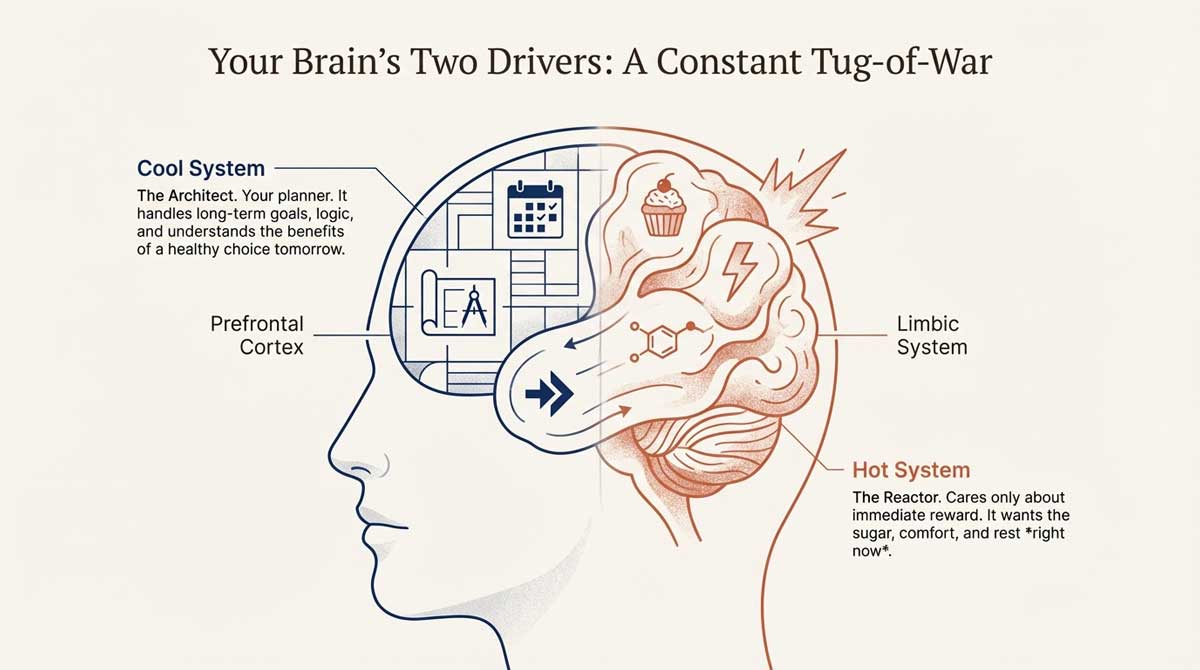
Think of your brain as a high-performance engine with two very different drivers fighting for the steering wheel. On one side, we have what scientists call the "Cool System." This lives in your prefrontal cortex, the part of the brain right behind your forehead. This is the "Athlete" within you. It is responsible for planning, long-term goals, and making logical decisions. It is the part of you that knows a nutritious dinner will make you feel better tomorrow.
On the other side, we have the "Hot System." This is driven by the limbic system, a much older part of the brain that cares about one thing: immediate rewards. It wants the sugar, the rest, and the comfort right now.
When we talk about willpower, what we are actually describing is a neurobiological tug-of-war. Every time you resist a temptation, your prefrontal cortex is trying to dampen the signals coming from your "Hot" reward system. It is a metabolic balancing act. The reason it feels so fragile is that this "Cool System" is the most modern part of the human brain, which also makes it the most sensitive to things like stress, lack of sleep, and-ironically-hunger.

The Myth of the "Empty Tank"
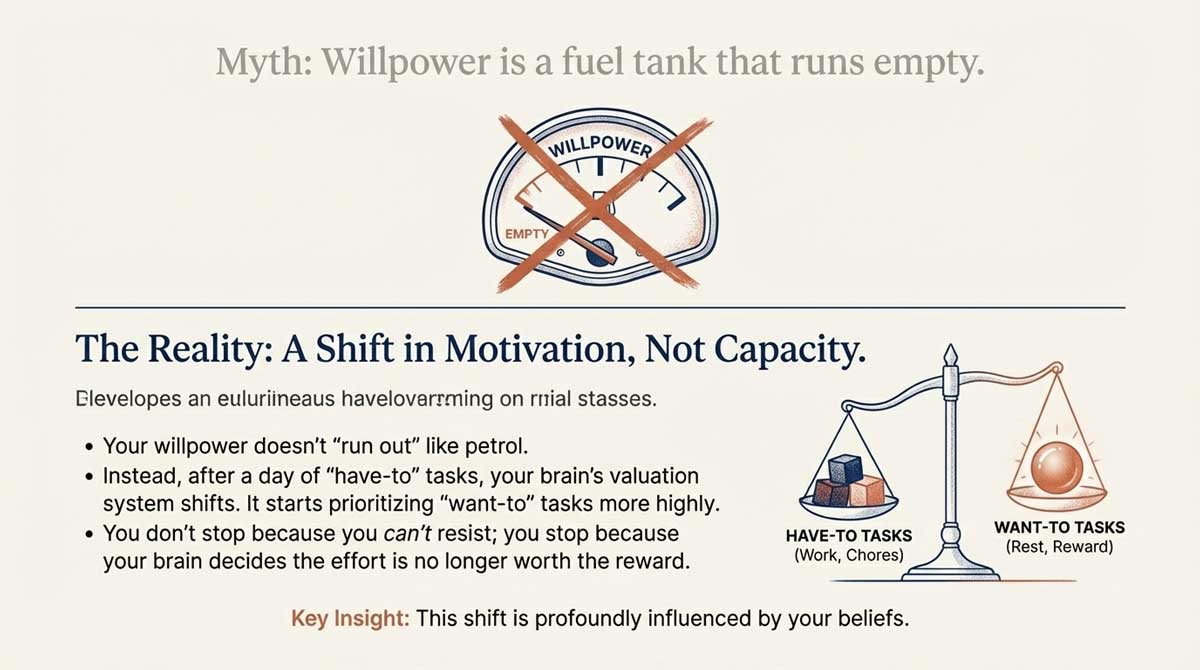
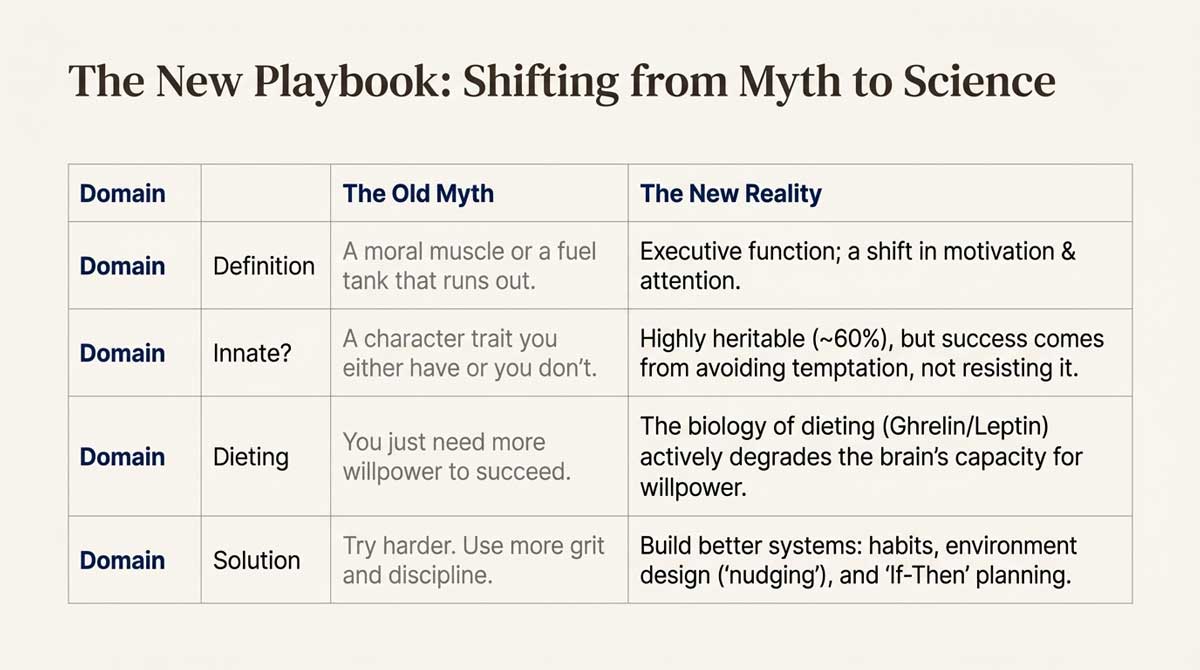
For years, we were told that willpower is like a muscle that gets tired, or a fuel tank that runs dry. This theory, known as "ego depletion," suggested that if you used up your willpower resisting a morning doughnut, you'd have none left to hit the gym in the evening.
However, recent research has turned this on its head. It turns out that our willpower doesn't actually "run out" like petrol. Instead, what happens is a shift in motivation. After a long day of "have-to" tasks (work, chores, traffic), your brain naturally starts to value "want-to" tasks more highly. It isn't that you can't resist the sofa; it's that your brain's internal valuation system has decided the effort is no longer worth the reward.
Interestingly, your beliefs play a huge role here. Athletes who believe that willpower is a limitless, self-renewing resource actually perform better and show less "fatigue" than those who think they only have a fixed amount for the day. Your mindset is the thermostat for your mental energy.
Are Some People Just Born With It?
We have all met that person who seems to have "iron willpower." They never miss a session, they never seem tempted by the cake, and they stay consistent year-round. Is it just in their DNA?
The short answer is: partly. Studies of twins suggest that about 60% of our capacity for self-control is heritable. Some people are simply born with a "Cool System" that is a bit more robust, or a "Hot System" that isn't quite as reactive to sugar or dopamine hits.
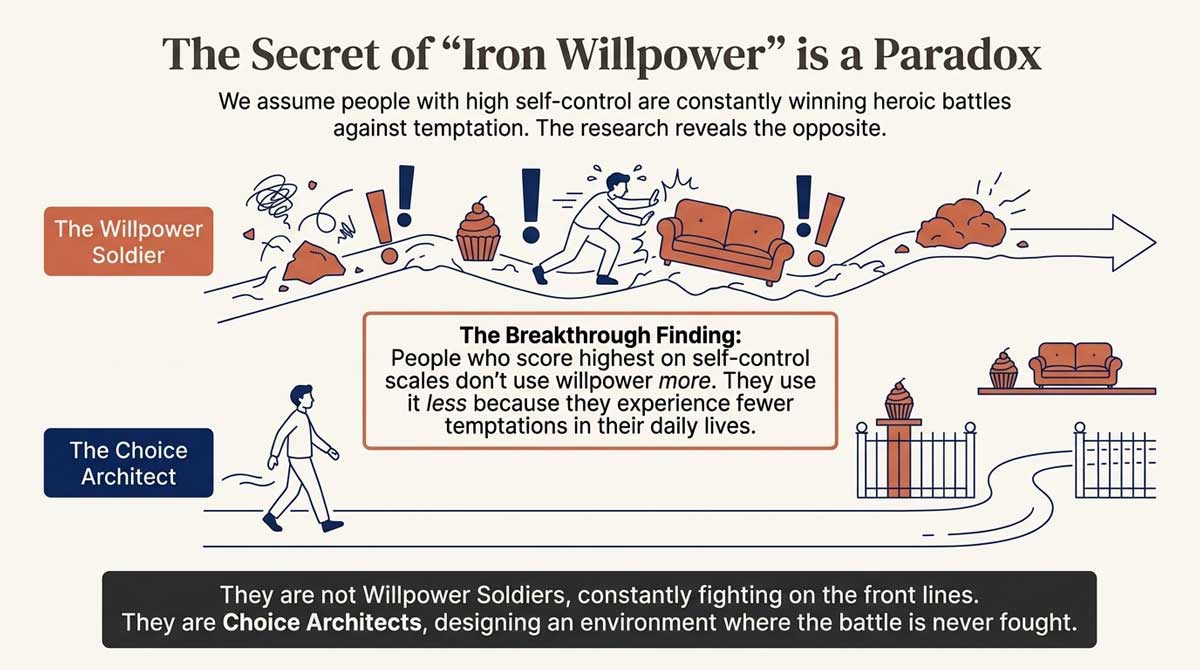
But here is the secret that the most "disciplined" people won't tell you: they don't actually use their willpower nearly as much as you think.
Research shows that people who score highest on self-control scales actually experience fewer temptations in their daily lives. They aren't "crushing" their cravings; they are avoiding them. They use their "Cool System" to design a life where they don't have to fight their "Hot System" every five minutes. They lay out their kit the night before, they don't keep "trigger foods" in the house, and they follow routines that turn healthy choices into automatic habits.

Why Biology Fights Your Weight Loss
This is where things get tricky for anyone looking to lose weight. When you decide to restrict your calories, your body doesn't know you are trying to improve your health. As far as your biology is concerned, you are in a famine.
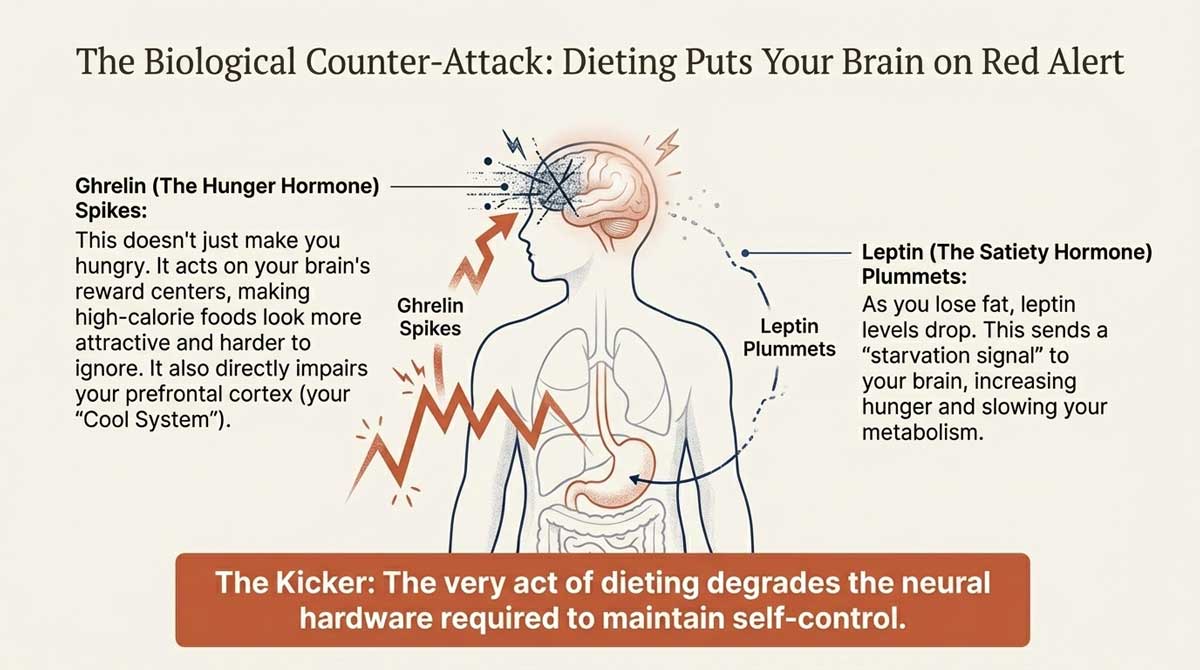
Your body responds by launching a hormonal counter-attack. Two main players lead the charge: Ghrelin and Leptin.
Ghrelin is your "hunger hormone." When you diet, your ghrelin levels spike. This doesn't just make your stomach growl; it actually changes how your brain sees the world. High ghrelin levels make high-calorie foods look more attractive and harder to ignore. Your brain literally turns up the volume on every bakery or pizza shop you pass.
At the same time, Leptin-the hormone that tells you you're full-drops. This sends a "starvation signal" to your brain, which slows down your metabolism and ramps up your drive to find food.
Here is the kicker: these hormones actually impair your prefrontal cortex. The very act of dieting takes your "Cool System" offline and hands the keys to your "Hot System." This is why relying on willpower for long-term weight loss is a losing game. You are trying to use a weakened tool to fight a survival instinct that has been refined over millions of years.
The "White Bear" and the Danger of Forbidden Foods
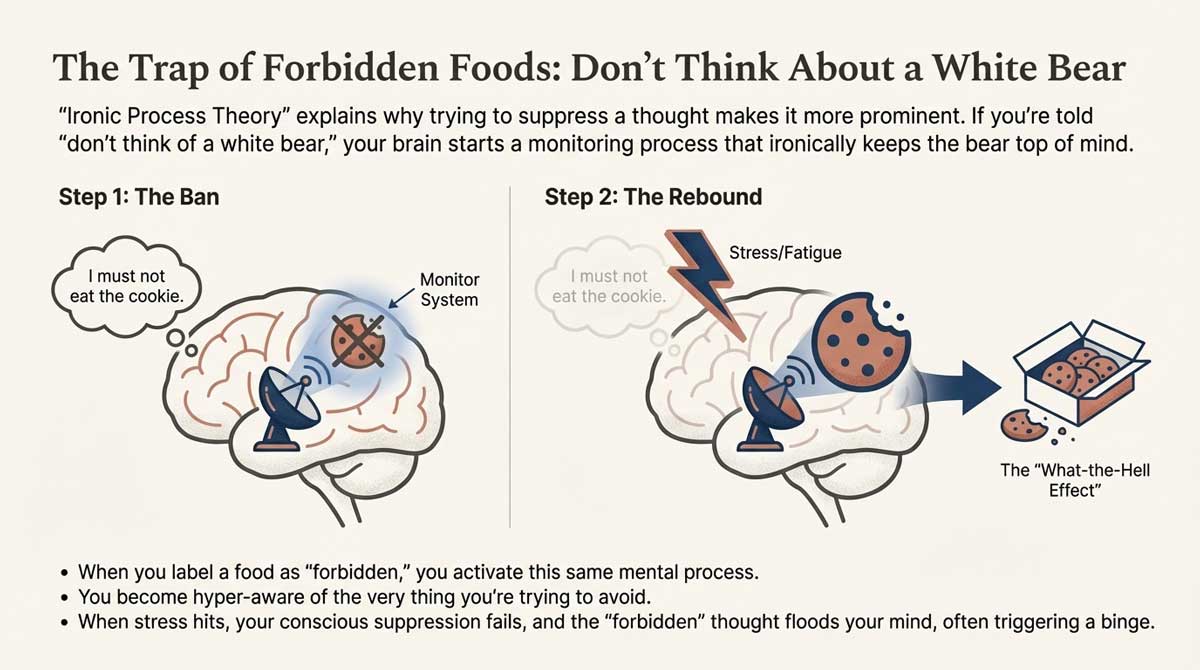
Have you ever tried to not think about something? There is a famous psychological experiment called the "White Bear" effect. If I tell you "do not think about a white bear," your brain immediately starts a background process to check that you aren't thinking about it. Ironically, this constant checking keeps the image of the white bear front and centre in your mind.
The same thing happens with food. When you label a food as "forbidden" or "bad," you trigger this "Ironic Process." You become hyper-aware of the very thing you are trying to avoid. When you eventually get tired or stressed, the "Cool System" fails, the background check stops, and the "forbidden" food floods your consciousness. This often leads to the "What-the-Hell effect"-where one small slip-up leads to a total abandonment of your goals for the rest of the day (or week).

How to Play the Long Game
If willpower is unreliable and biology is working against us, how do we actually make lasting changes? The answer is to stop fighting your brain and start outsmarting it. We want to move the burden of our choices away from our effortful "Cool System" and into our automatic "Habit System."
1. The 66-Day Rule
Habits aren't built overnight. On average, it takes about 66 days for a new behaviour to become automatic. During those first two months, you will need to use some willpower. But the goal isn't to sustain that effort forever. You are just using your "Cool System" as a bridge until your habit-focused brain takes over. Once a behaviour becomes a habit, it requires almost no mental energy to maintain.
2. Design Your Environment (Nudging)
We are all products of our environment. If you want to eat better, make the healthy choice the easiest choice. This is called "Choice Architecture."
-
Proximity: Put the fruit bowl on the counter and the biscuits in a high, opaque cupboard.
-
Friction: Make it hard to do the things you want to avoid. If you want to scroll less on your phone, put it in another room. If you want to eat less takeaway, delete the apps.
-
Pre-commitment: Order your groceries online when you are full. You are using your "Cool System" to make decisions for your "Future Self," bypassing the "Hot System" temptations of the supermarket aisles.
3. If-Then Planning
Vague goals like "I will eat healthier" rarely work because they require constant decision-making. Instead, use "Implementation Intentions." These are simple "If-Then" codes for your brain.
-
"If I feel a craving for a snack at 3 pm, then I will drink a glass of water and go for a five-minute walk."
-
"If I go to a restaurant, then I will look at the menu beforehand and decide what I'm having."
By pre-deciding your response to a situation, you bypass the need for willpower in the moment. You have already programmed the "Then" part of the equation, so your brain can just execute the plan.
Summary
The Athlete who performs well forever is not the one who fights the hardest battles every day. They are the ones who have built a lifestyle where those battles aren't necessary. Willpower is a fantastic tool for getting started, but it is a terrible foundation for a long-term life.
Stop asking yourself for more "strength" and start asking yourself for better systems. When you align your environment, your habits, and your mindset, you don't need "iron willpower"-you just need to keep showing up.
The Sundried Roundup
How can I build this into my life?
Start by looking at your environment rather than your "effort." Instead of trying to resist the treats in your house, simply stop buying them for a few weeks to break the cycle. Focus on "If-Then" planning for your biggest danger zones, like late-night snacking or office lunches. Remember, you are aiming for "automatic," not "difficult."
Pushed for time, how can I keep up?
When time is tight, our "Cool System" is the first thing to suffer. This is when your systems matter most. Use "Choice Architecture" to your advantage: prep your meals when you do have time, or have a "fail-safe" healthy meal that takes five minutes to make. If you can't get to the gym for an hour, do ten minutes. The goal is to keep the habit alive, even if the intensity is lower.
The Big FAQ: Your Willpower Questions Answered
We have covered the heavy lifting of how your brain works, but it is only natural to have a few more questions about how this applies to your day-to-day life. If you have ever felt like you were "losing" at the willpower game, these answers are for you.
Are some people just born with more willpower?
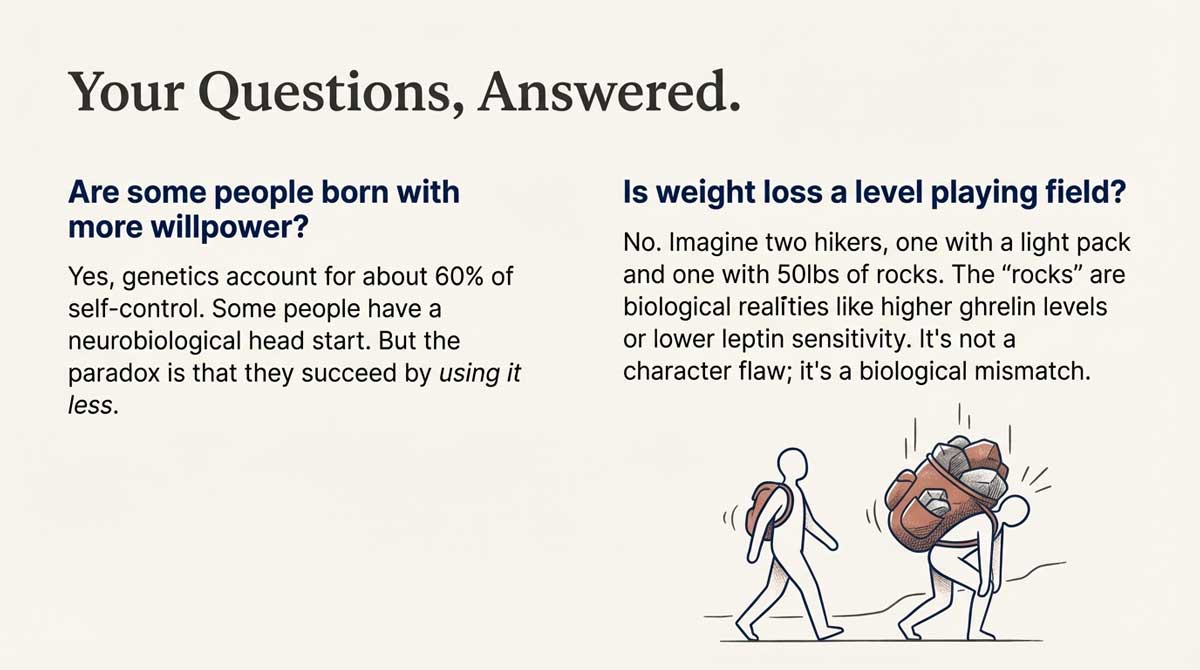
The short answer is yes-but perhaps not in the way you think. Research shows that about 60% of our capacity for self-regulation is down to our genetics. Some Athletes are simply born with a "Cool System" (the prefrontal cortex) that is naturally more robust, or a "Hot System" (the limbic system) that isn't quite as reactive to things like sugar or comfort.
Think of it as the "Willpower Lottery." Some people inherit a neurobiological head start. For example, certain genetic variants can mean a person has fewer dopamine receptors. Their brain is effectively "starving" for a reward signal that others get from a simple piece of fruit, making a high-calorie treat much harder to ignore.
However, the real paradox is that people who score highest for "willpower" actually use it the least. They aren't constantly fighting their biology; they have simply become experts at designing their environment so they don't have to.
Is weight loss a level playing field?
It certainly isn't. When we talk about willpower, we often forget the "Backpack Analogy." Imagine two Athletes hiking up a mountain. One has a light pack; the other is carrying fifty pounds of rocks. If the second Athlete struggles, we don't say they lack willpower-we recognise that their task is physically harder.
In the world of health, those "rocks" are biological realities. Some people have genetic variants that lead to higher levels of ghrelin (the hunger hormone) and lower levels of leptin (the fullness hormone). Their brain is essentially screaming "starvation" even when they have had enough to eat. When you combine that with the "scarcity trap"-where stress from work or life eats up your mental bandwidth-your prefrontal cortex simply has less energy available to say "no." It is not a character flaw; it is a biological mismatch.
How can I stop my willpower from dipping?
The most important thing to realise is that your willpower doesn't "run out" like petrol in a tank. That old "battery" theory has been largely replaced by the understanding that a willpower dip is actually a shift in motivation. Your brain decides that the effort of a "have-to" task is no longer worth the reward, and it starts looking for "want-to" activities.
To prevent this shift:
-
Flip your mindset: Athletes who believe their willpower is a self-renewing resource-rather than a fixed battery-actually perform better. Your belief acts as the thermostat for your mental energy.
-
Prioritise sleep: A tired brain cannot maintain the connection between your control centres and your emotional centres. Without sleep, you are essentially driving a car with no brakes.
-
Don't "ban" foods: Trying to forcefully suppress a thought triggers the "White Bear" effect. Your brain will monitor for that forbidden food constantly, keeping the temptation front and centre until you eventually give in.
What are the best ways to increase my capacity for self-control?
Instead of trying to "try harder," focus on outsmarting your own brain architecture. Here are the most effective ways to build your capacity:
-
Choice Architecture: Be the architect of your own life. Increase "friction" for habits you want to break (like leaving your phone in another room) and decrease it for the ones you want to keep (like having your gym kit ready to go).
-
If-Then Planning: Stop making decisions in the heat of the moment. Use simple codes like, "If I feel a craving at 3 pm, then I will drink a glass of water and walk for five minutes." This offloads the work from your conscious mind to an automatic response.
-
The 66-Day Rule: Recognise that willpower is just a bridge. It takes an average of 66 days for a new behaviour to move from the effortful part of your brain to the automatic part. Commit to the discipline for those first two months, knowing that it will eventually become effortless.
Is willpower actually a myth?
It isn't a myth, but our cultural understanding of it is certainly flawed. Willpower is not a moral virtue or a measure of "grit." It is a measurable neurobiological function called Executive Control.
The real "myth" is the idea of the heroic struggle. We imagine the most disciplined Athletes are constantly winning battles against temptation. In reality, the most successful people are those who have mastered "Choice Architecture" and habits. They don't win the battle; they avoid the battlefield entirely.
How do I make my plan stick for the long game?
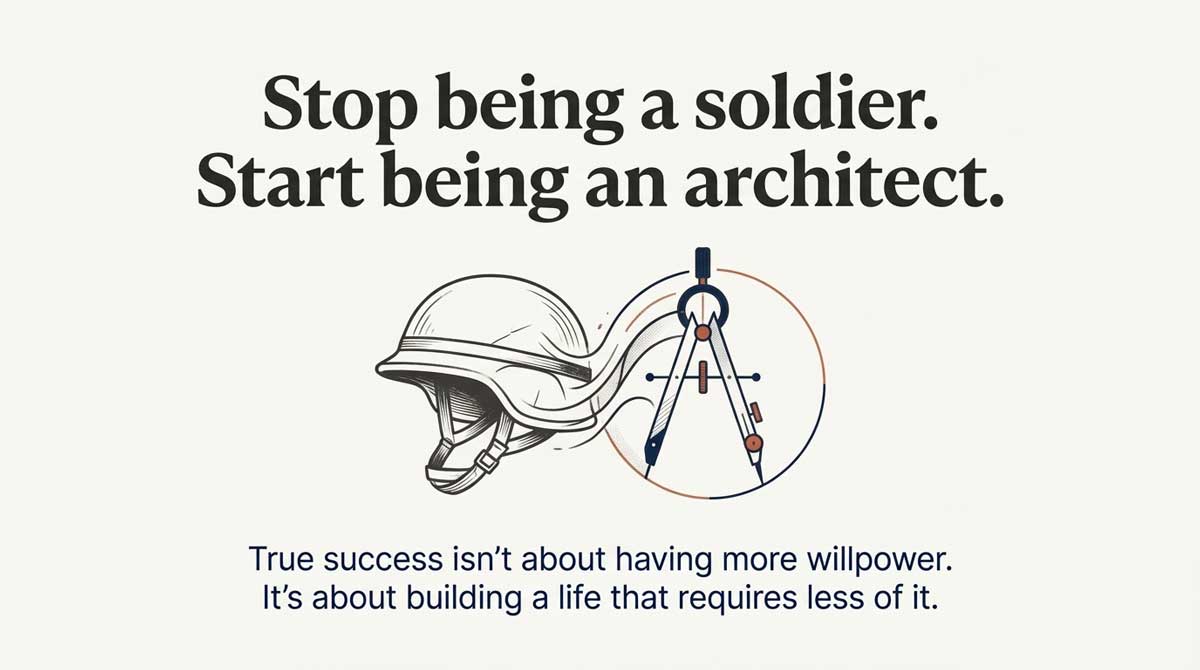
To perform at your best forever, you have to stop being a soldier and start being an architect. If you rely on grit, you will eventually hit a day where you are too tired, too stressed, or too hungry to keep it up.
Sticking to a plan is about biological respect. Manage your sleep, avoid the "White Bear" trap of banning foods, and understand that caloric restriction will naturally make your "Cool System" harder to access. By building systems that don't require you to say "no" a thousand times a day, you allow your brain to focus on the long-term performance that actually matters.
Top 10 Ways
Reframe your mindset
View mental energy as a self-renewing resource, not a draining battery.
Respect the 66-day bridge
Commit to the first 66 days until the habit becomes automatic.
Master "If-Then" scripts
Offload decision-making by using specific pre-written codes for cravings.
Increase friction
Add inconvenience to bad habits (e.g. delete apps) to give your brain time to pause.
Make sleep your secret weapon
Sleep is the foundation of self-control; deprivation breaks your braking system.
Stop "White Bear" thinking
Focus on "crowding out" rather than strict bans to avoid the rebound effect.
Shop when full
Use "Pre-commitment" by shopping online or planning meals when you aren't hungry.
Design for proximity
Use Choice Architecture: keep healthy options visible and treats hidden.
Use smaller plates
Leverage the Delboeuf illusion to signal satiety earlier without counting.
Forgive the slip-ups
Compassion is more effective than criticism. Get back on track immediately.
10 Simple Ways to Boost Your Willpower for Weight Loss

A 60-Second Discovery
Answer 10 simple questions to reveal why the scale isn't moving (and exactly how to address it). Identify Your Profile.
If you want to play the long game and perform at your best forever, you need a toolkit that doesn't rely on brute force. Here are ten ways to work with your brain, not against it.
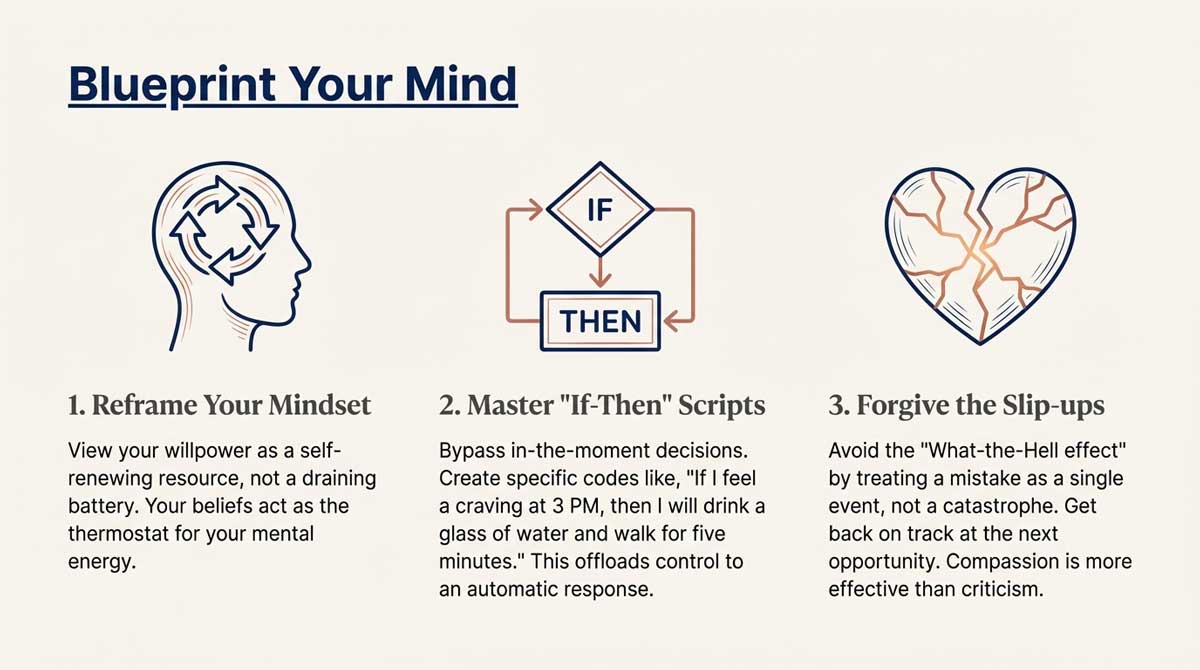
1. Reframe your mindset View your willpower as a self-renewing resource, not a draining battery. For a long time, we were told that willpower is a finite fuel tank that runs dry by lunchtime. But modern research suggests it is more about your beliefs. If you view your mental energy as something that can be refreshed and renewed, you will actually show less fatigue. Think of it as a shift in motivation rather than a loss of ability; staying positive about your capacity keeps your "Cool System" in the driving seat for longer.
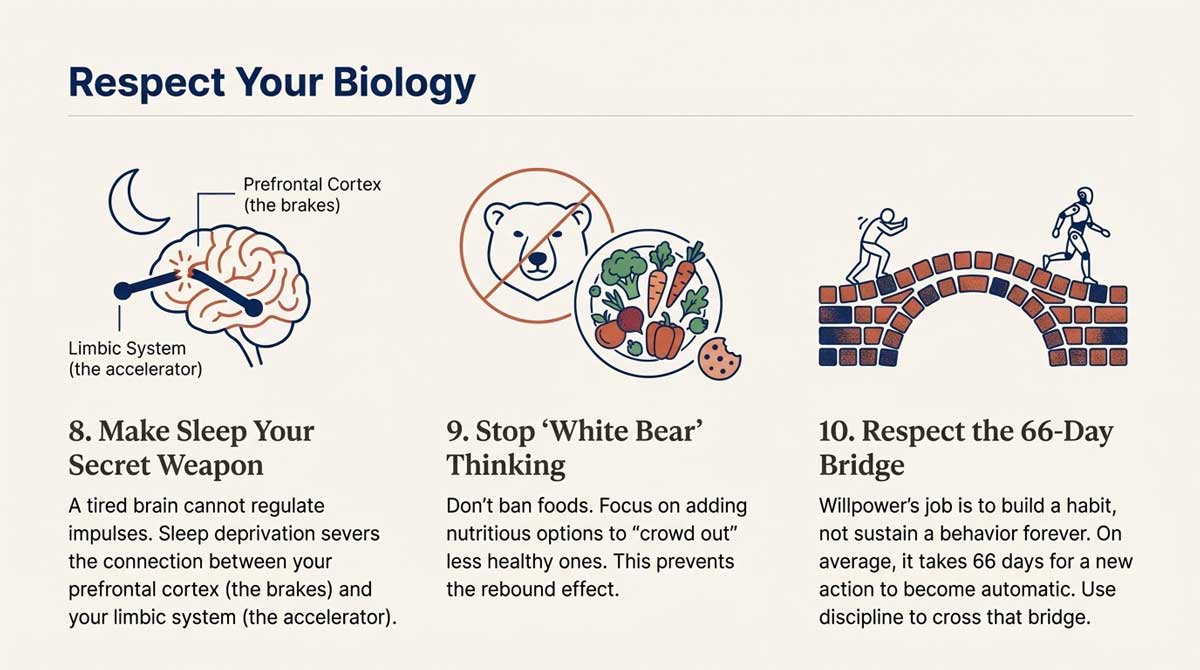
2. Respect the 66-day bridge Use discipline to get through the first two months until the habit takes over. Willpower is metabolically expensive and hard to sustain forever. Its real job is to act as a bridge. It takes, on average, 66 days for a new health behaviour to move from the effortful part of your brain to the automatic part. Commit to being extra diligent for those first nine weeks, knowing that once the habit is "chunked" in your brain, it will eventually require almost no effort to maintain.
3. Master "If-Then" scripts Pre-programme your responses to common temptations. Vague goals like "I will try to be good" are too taxing for the brain. Instead, create a specific script: "If I feel a craving at 3 pm, then I will drink a glass of water and take a five-minute walk." This technique, known as Implementation Intentions, offloads the decision-making from your conscious mind to an environmental cue. You aren't "deciding" not to eat; you are simply following a pre-written code.
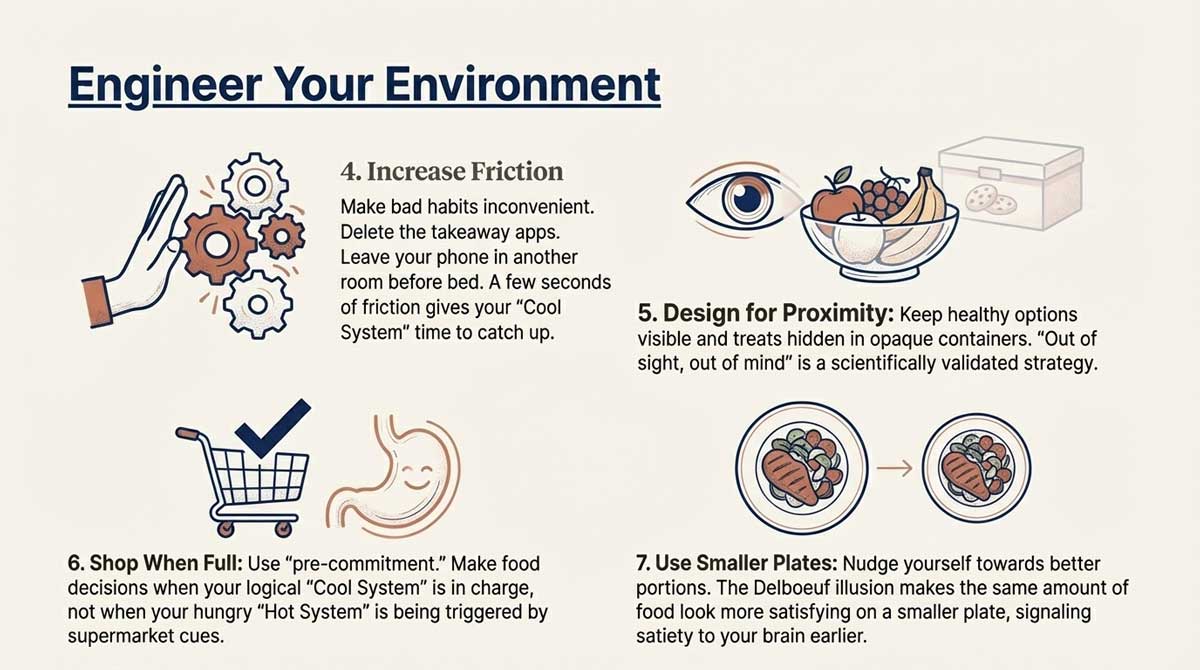
4. Increase friction for distractions Make it harder to do things that don't align with your long-term goals. We tend to follow the path of least resistance. If you want to break a habit, make it inconvenient. Delete the takeaway apps from your phone so you have to manually type in your details every time, or leave your phone in another room an hour before bed. By adding just a few seconds of "friction" to a bad habit, you give your "Cool System" enough time to catch up and step in before you act on impulse.
5. Make sleep your secret weapon Support your brain so it can keep your "braking system" functional. Sleep is the foundation of self-control. When you are sleep-deprived, the functional connection between your prefrontal cortex (the brakes) and your limbic system (the gas pedal) is disrupted. You become more emotionally reactive and biologically less capable of saying no to high-calorie rewards. Prioritising rest isn't a luxury; it is a vital part of keeping your brain's regulatory hardware online.
6. Stop "White Bear" thinking Don't label foods as "forbidden"; it only makes you want them more. When you tell yourself you "must not" have chocolate, your brain creates a monitoring process to check that you aren't thinking about it. This ironically keeps the thought of chocolate at the front of your mind. Instead of strict bans, focus on "crowding out"-prioritise adding nutritious, whole foods to your plate first. When nothing is strictly forbidden, the "rebound effect" that leads to binges loses its power.
7. Only shop and decide when you are full Never make food decisions when your "Hot System" is hungry. When you are hungry, your ghrelin levels spike, which impairs your logic and heightens your reward response. This is when your "Hot System" is most likely to take over. Use "Pre-commitment" by ordering your groceries online or planning your meals right after a satisfying dinner. By making choices when you are calm and full, you "lock in" healthy decisions for your future self.
8. Design for proximity Keep the good stuff visible and the distractions hidden. We are visual creatures. Simply placing a bowl of fruit on the counter and hiding treats in high, opaque cupboards can significantly alter what you consume. This is called Choice Architecture. If the first thing you see when you walk into the kitchen is a healthy option, that is the path your brain is most likely to take. "Out of sight, out of mind" is a scientifically proven strategy for success.
9. Use smaller plates Nudge yourself toward better portion sizes without the effort. Our brains are easily tricked by visual proportions-a phenomenon called the Delboeuf illusion. A normal-sized portion looks small on a large plate, making us feel deprived. The same portion on a smaller plate looks generous, which signals satiety to the brain earlier. It is a simple environmental "nudge" that allows you to manage your intake without needing to constantly monitor or count every bite.
10. Forgive the slip-ups Avoid the "What-the-Hell effect" by being kind to yourself. The biggest threat to the long game is the "all-or-nothing" mindset. Many Athletes fall into the trap of thinking that one slip-up has "ruined" their progress, leading them to abandon their plan for the rest of the day. If you stray from your routine, simply acknowledge it and get back on track at the very next opportunity. Compassion is much more effective for long-term performance than self-criticism.
FREE GIFT: The "Unstoppable Willpower" eBook
Is your mindset holding you back? Get Instant Free Access to our guide on mastering self-control. Learn how to "flip the switch" on your discipline so you can reach your goal weight 10x faster.


