

10 Pounds in 10 Days? The Truth About Quick Fixes and What Your Body Actually Needs


Want to build strength to support your running?
Get targeted strength routines and mobility exercises designed specifically for runners directly on-site. Try asking Raye: 'What are 3 key gym exercises to improve running economy?' Get strength tips
We have all seen the headlines. They jump out from magazine covers at the supermarket or flash across our social media feeds with bright colours and bold promises. "Lose 10 pounds in 10 days!" "The secret 2-week shred!" "Drop a dress size by Friday!" For anyone looking to shift some weight and improve their health, these claims are incredibly tempting. They tap into that very human desire for immediate results...
Like to listen to your content? Hit play below
But usually, the moment we mention "rapid weight loss," the traditional health world wagging its finger at us. We are told that "slow and steady" is the only way, that the tortoise always beats the hare, and that anyone losing weight quickly is destined to gain it all back (and then some) the moment they look at a carb.
FREE: THE "PERMANENT 10" WEIGHT LOSS BLUEPRINT
Stop falling for "Quick Fix" traps! Claim your 100% FREE eBook and discover the science-backed way to lose your first 10 pounds and keep them off forever. No gimmicks—just the truth your body has been waiting for.
However, the latest science is starting to tell a much more interesting story. It turns out the "tortoise vs. hare" analogy might be a bit of an oversimplification. There is a place for speed, but only if you understand the difference between a "crash diet" and a clinical intervention. If we want to perform well forever-not just for a week on the beach-we need to look at what is actually happening under the bonnet of our metabolic engine.

Have a specific performance goal in mind?
Get direct feedback on your training targets right here on the page—no sign-up or account required. Try asking Raye: 'How should I adjust my weekly mileage for a sub-20 minute 5K?' Ask about your goals

Over 35? Your Physical Needs Have Changed.
"Eat less, move more" often stops working in midlife. Find out if Stress, Sleep, or Habits are your hidden barriers. Take the 35+ Assessment.
The Great Weight Loss Debate
For decades, the standard advice has been to aim for a loss of about 1 to 2 lbs (roughly 0.5 to 1kg) per week. This is considered the "gold standard" for safety and sustainability. The logic is that if you go faster, you are just losing water and muscle, ruining your metabolism, and setting yourself up for a massive rebound.
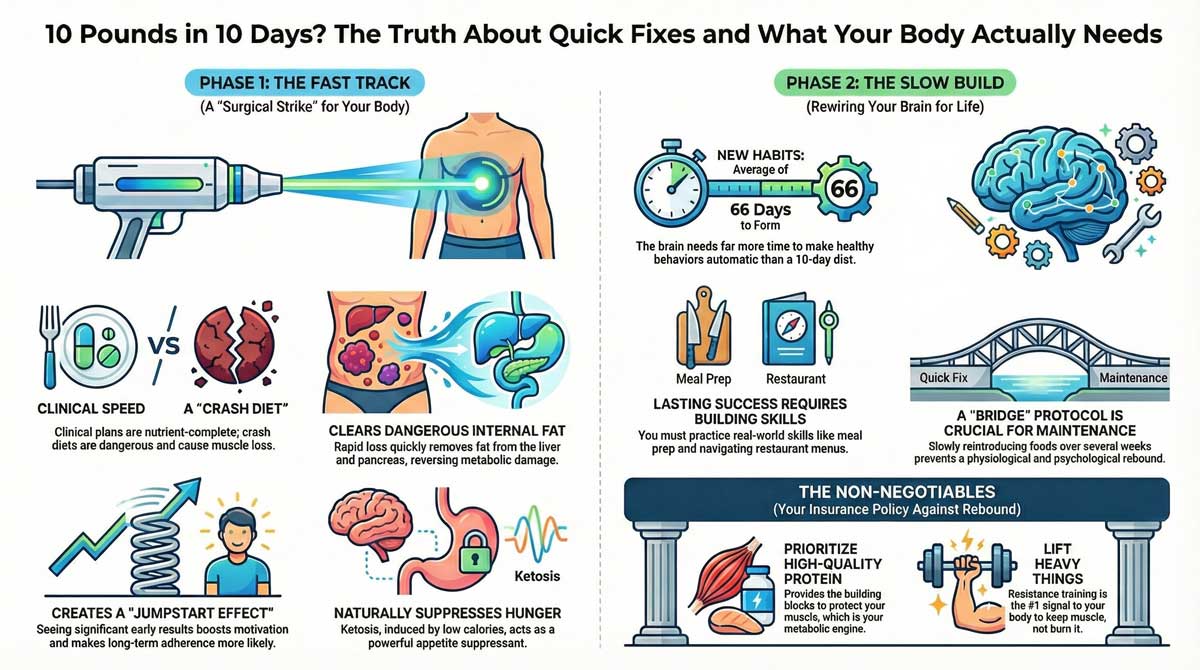
But when we look at large-scale clinical studies, like the famous DiRECT trial or various research into Very Low-Calorie Diets (VLCDs), we see something surprising. Rapid weight loss, when done correctly, isn't just "water weight." In fact, for people dealing with significant weight issues or metabolic struggles like Type 2 diabetes, losing weight quickly can actually be more effective than the slow-and-steady route.
This brings us to what researchers call the "Kinetic Paradox." It is the idea that while your body might actually benefit from a fast "reset" to clear out internal fat and fix its chemistry, your habits and your brain need a much slower, more deliberate approach to change. To win the long game, we have to balance the two.
Clinical Speed vs. The "Crash"
Before we go any further, we need to draw a very clear line in the sand. There is a massive difference between a "crash diet" and a structured, rapid intervention.
A crash diet is usually something you find in a random blog post. It's "The Cabbage Soup Diet" or a "Juice Cleanse" where you just stop eating real food and hope for the best. These are often nutritionally bankrupt. They lack the protein to protect your muscles and the essential fats and minerals your heart needs to keep beating steadily. This is where the horror stories come from: hair loss, extreme fatigue, and that "hollowed out" look.
On the other hand, clinical rapid weight loss (often involving around 800 calories a day) uses specially formulated "Total Diet Replacements." These aren't just random shakes; they are engineered to ensure the body receives 100% of the vitamins and minerals it requires, along with enough protein to shield the muscles. When the body gets what it needs, it allows for a much safer and more effective fat-loss phase.

Why Speed Can Actually Boost Motivation
One of the biggest reasons people give up on their health goals isn't a lack of willpower; it's a lack of visible progress. If you are working your socks off, hitting the gym, and eating salads, but the scale only moves by half a pound every two weeks, it is incredibly demoralising. This is the "effort-reward imbalance."
When you see significant movement on the scale early on, it creates what experts call the "Jumpstart Effect." It validates your hard work. It provides tangible proof that what you are doing is functioning. This creates a psychological momentum that actually makes it more likely you will stick to your programme in the long run.
In one major study, over 50% of people who lost weight quickly managed to keep a significant amount off for 18 months, compared to only about 17% of the "slow and steady" group. Seeing the results early on shifts the mindset from "I'm trying to lose weight" to "I am an Athlete who is successfully managing my health." That shift in identity is worth its weight in gold.
The Surgical Strike: Cleaning the Engine
The most fascinating part of the rapid weight loss science involves our internal organs-specifically the liver and the pancreas. We often think of fat as just the stuff we can pinch around our waist, but the more dangerous fat is "ectopic fat"-the fat stored where it shouldn't be, inside our organs.
When we have excess fat in the liver, it becomes resistant to insulin and starts pumping out too much sugar. This fat then spills over into the pancreas, which is supposed to produce the insulin. This "Twin Cycle" is a primary driver of Type 2 diabetes.
Research has shown that a period of rapid caloric restriction acts like a "surgical strike" against this organ fat. Within just a few days of a very low-calorie approach, liver fat can drop significantly, allowing the liver to respond to insulin properly again. Shortly after, the fat begins to clear from the pancreas, allowing the cells that make insulin to "wake up" and start working again. This is how many people are now achieving remission from Type 2 diabetes-something we used to think was impossible. A slow approach often doesn't create a large enough "energy gap" to force the body to clear this organ fat as efficiently.
The Hunger Paradox: Why 800 Calories Can Feel Easier Than 1500
This sounds counterintuitive, doesn't it? Surely eating 1500 calories is more satisfying than eating 800?
Actually, many people find a moderate deficit (like 1500 calories) feels like "metabolic purgatory." You are eating enough to stay in a "sugar-burning" mode, but not enough to feel full. This can lead to constant, nagging hunger and "food noise" that eventually wears down your resolve.
When calories are restricted more significantly (and carbohydrates are kept low), the body shifts into a state called ketosis. It starts breaking down body fat into "ketones" to use for fuel. These ketones are natural appetite suppressants. Most people find that after the first two or three days of a rapid approach, their hunger actually diminishes. The brain gets a steady supply of energy from fat stores, and the constant "When is lunch?" internal monologue finally goes quiet.

Avoiding the "Skinny Fat" Trap
If speed is the goal, muscle is the insurance policy. The biggest risk of any weight loss-fast or slow-is losing lean tissue. Muscle is our metabolic engine; it's what allows us to burn energy even when we are sitting on the sofa. If you lose weight too quickly without the right support, your body might decide to burn muscle for energy instead of fat.
To prevent this and ensure you remain a high-performing Athlete, two things are non-negotiable:
-
Protein Intake: You must ensure you are consuming enough high-quality protein to provide the building blocks your muscles need.
-
Resistance Training: You have to give your body a reason to keep its muscle. By lifting weights or doing bodyweight resistance exercises, you send a clear signal: "I am using this tissue, don't burn it!"
People who lose weight quickly while strength training end up with a much better body composition-what we call being "lean"-rather than just being a smaller version of their former selves with a slower metabolism.
The Brain is a Slow Learner
This is where the "slow and steady" crowd actually has a point. While you can fix your liver chemistry in a few weeks, you cannot fix your habits that fast.
The human brain is wired for routine. Research suggests that for a new health behaviour to become automatic-to the point where you don't have to use willpower to do it-it takes an average of 66 days. For some people and for more complex habits, it can take up to eight months.
If you use a 10-day or 12-week "shred" to lose the weight but haven't spent any time practicing the skills you need for the "after" period, you are in trouble. This is why so many people yo-yo. They finish the "diet," but their brain is still running the old software that wants to reach for snacks when stressed or order a takeaway when tired.
The weight loss can be fast, but the lifestyle architecture must be built brick by brick. You need to learn how to navigate a restaurant menu, how to meal prep when you're busy, and how to handle a "slip-up" without letting it turn into a week-long binge.

The Bridge to Forever
The most successful approach is what we call a "Biphasic Model." Think of it as a two-stage rocket.
-
Phase One is the rapid intervention: clearing the organ fat, boosting motivation, and resetting the system.
-
Phase Two is the "Bridge": a slow, deliberate reintroduction of food and the intensive building of new habits.
The danger isn't the speed of the loss; it's the lack of a plan for what happens next. If you treat a weight loss phase like a sprint to a finish line, you will stop running the moment you cross it. But if you treat it as the first leg of a lifelong journey of performance, you set yourself up for success.
We want to move away from the "all or nothing" mindset. You aren't either "on a diet" or "off a diet." You are an Athlete in training, sometimes focusing on fat loss, sometimes focusing on strength, but always focused on long-term health.
The Sundried Roundup
How can I build this into my life? Start by looking at your "why." If you have a significant amount of weight to lose or metabolic markers (like blood sugar) that need addressing, a structured, higher-speed approach might be a great tool. However, you must pair it with a commitment to resistance training. Schedule three sessions a week where you challenge your muscles. Simultaneously, pick one small habit-like drinking 2 litres of water or walking 10,000 steps-and commit to doing it every single day for the next two months. This trains your brain while your diet trains your body.
Pushed for time, how can I keep up? If your schedule is packed, the "simplicity" of a structured plan is your best friend. Rapid, clinical protocols often take the "decision fatigue" out of the day because your meals are pre-planned. For the exercise side, focus on high-impact, short-duration movements. Twenty minutes of intense resistance training (like squats, push-ups, and lunges) twice a week is far more effective for maintaining muscle than an hour of low-intensity cardio that you can't find the time for.
Top 10 Tips
Prioritise Protein
Ensure every meal has a solid protein source to protect your metabolic engine.
Lift Something Heavy
Resistance training is the only way to signal your body to keep its muscle during weight loss.
Think "Organ Health"
Remember that fast loss is about cleaning your liver and pancreas, not just fitting into smaller trousers.
Hydrate Properly
Rapid fat loss releases stored water; you need to replenish your fluids and electrolytes constantly.
Track Your Habits
Use a habit tracker to ensure you are building the "mental muscle" needed for the long game.
Beware the "What the Hell" Effect
If you have a slip-up, don't bin the whole day. Just make the next choice a good one.
Get Your Sleep
Lack of sleep spikes hunger hormones and makes any diet feel ten times harder.
Focus on "Non-Scale Victories"
Notice how your energy levels, skin, and sleep improve as you lose organ fat.
Don't Do It Alone
Whether it's a coach, a friend, or a community, having accountability changes everything.
Plan the "Exit"
Have a written plan for how you will slowly transition back to maintenance eating.
GET THE TRUTH (FOR FREE!)
Ready to stop the "Yo-Yo" dieting cycle for good? Download our FREE Fat Loss Mastery Guide. We’re revealing exactly what your body needs to torch fat without destroying your metabolism. Zero cost—Instant access!


