

No Time for the Gym? Unlock the 500-Calorie Burn Hidden in Your Daily Routine


Dealing with a nagging injury or tightness?
Get instant recovery guidance, stretching protocols, and rest advice right now without leaving the site. Try asking Raye: 'What are the best stretches to relieve tight calves after a long run?' Get recovery advice
For so many of us, trying to find time to go down to the gym isn't even an option that you could consider. You may not even have time to think about it, let alone actually get to the gym. Maybe you've had a gym membership in the past, and after a few weeks, that subscription became a payment not getting used.
FREE: THE 500-CALORIE "LAZY BURN" MANUAL
Stop feeling guilty about skipping the gym! Claim your FREE Step-by-Step Guide to unlocking NEAT. Discover the hidden "movement hacks" that torch 500 extra calories a day while you work, shop, and live your life.
So, you may not have heard about NEAT. NEAT stands for Non-Exercise Activity Thermogenesis-basically the energy that your body is burning doing everything that isn't sleeping, eating, or dedicated sports like training and exercise. We all know if you go out on a big run you're gonna be burning calories-maybe you can earn yourself a tiny chocolate bar if that's a trade you want to make-but what if you knew you could fidget yourself into a new weight loss program?
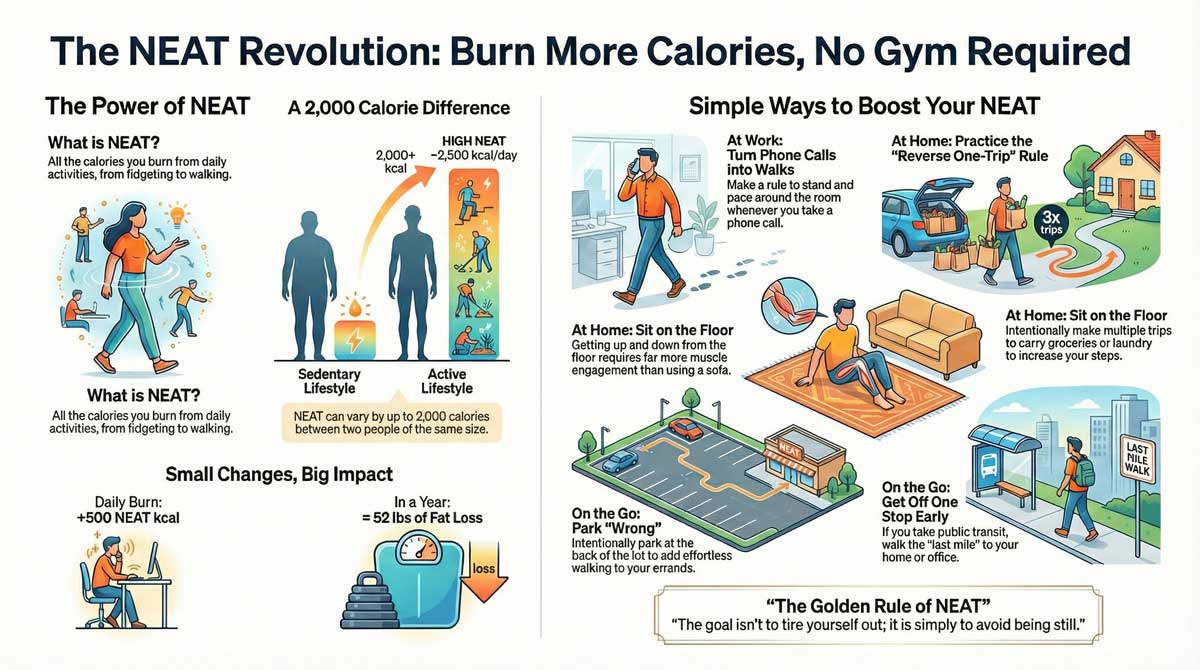
Without adding any training into your typical day, what if you could burn an extra 500 cal? And that's without having to do any runs, any push-ups, any sit-ups, or any subscriptions. That's just 500 cal extra. Just to spell it out for you, that would be over 182,000 cal in a year. The standard diet rule says that 3,500 cal equals 1 lb of fat, so you would lose roughly 52 lbs.
What else could you do with your 500 cal? You could treat yourself to 360 hamburgers at McDonald's or 610 cheeseburgers. Don't fancy a burger, then? How about 541 portions of medium fries or 4,055 chicken nuggets?

Have a quick training or recovery question?
Get fast expert advice right here on the page—no sign-up, account, or app needed. Try asking Raye: 'What's the best way to relieve tight calves after a run?' Ask a question now
Okay, I'm all ears-500 cal a day without adding in any exercise? Tell me more.
NEAT
Non-Exercise Activity Thermogenesis

A 60-Second Discovery
Answer 10 simple questions to reveal why the scale isn't moving (and exactly how to address it). Identify Your Profile.
Think about the last time you felt truly "active." For most of us, that image involves a pair of trainers, a heart rate monitor, and perhaps a bit of a sweat in a brightly lit gym. We've been conditioned to believe that the 45 minutes we spend on a treadmill or in a HIIT class is the only time that "counts." We check our watches, see the calorie burn, and then... we spend the next fifteen hours sitting down.
Here is the secret that the fitness industry doesn't always shout about: the athlete who stays lean and energized forever isn't necessarily the one training the hardest for an hour a day. They are the one moving the most for the other twenty-three.
In the world of science, this is called Non-Exercise Activity Thermogenesis, or NEAT. In the world of real life, let's just call it "the movement of living." It is every fidget, every step to the kettle, every time you stand up to answer the phone, and every bag of groceries you carry. It turns out that this "background noise" of movement is actually the most powerful tool we have for managing our weight and feeling great over the long term.
While a solid workout is brilliant for your heart and muscles, NEAT is what keeps your metabolic furnace burning all day long. Research shows that two people of the same size can have a difference in calorie burn of up to 2,000 calories a day, simply based on how much they move during their normal routine. That is the difference between a small snack and three full meals.
The best part? You don't need a gym membership to master this. You just need to stop being so "efficient."
The Science of Why We Stagnate
Before we get into the "how," let's look at the "why." Our modern world is designed to make us move as little as possible. We have dishwashers, remote controls, lifts, and delivery apps. We have spent decades trying to make life easier, but in doing so, we've accidentally switched off our internal energy-burning systems.
When we sit for hours, a specific enzyme in our body called Lipoprotein Lipase (LPL) essentially goes on strike. Think of LPL as a little vacuum cleaner that pulls fat out of your bloodstream to be used as fuel. When you stay still, that vacuum shuts off. Your blood sugar stays higher, your circulation slows down, and your body enters a sort of "hibernation mode."
The good news is that it doesn't take much to wake it back up. You don't need to do a sprint; you just need to stand up. Low-intensity movement-the kind that doesn't even make you out of breath-is enough to keep those "fat vacuums" running. This isn't about a summer body; it's about keeping your metabolic engine tuned up for life.
The Inefficient Athlete: Living with NEAT
To become an athlete of daily life, we have to start choosing the "harder" way to do things. It sounds counter-intuitive, doesn't it? We are taught to save time and energy. But if we want to stay healthy forever, we need to start spending that energy back.
Here are 20 ways to start reclaiming that lost movement, woven into the fabric of your normal day.
Making Your Home Your Playground
We often view home as the place where we finally get to stop. But by making a few small tweaks, your house becomes a place where you stay active without even thinking about it.
The "Reverse One-Trip" Rule We've all done it-tried to carry twelve grocery bags on one arm just to avoid a second trip to the car. Start doing the opposite. If you have laundry to take upstairs, take it in three small trips instead of one big basket. It feels "inefficient," but those extra steps add up over a week.
The Microwave Pace Two minutes for your porridge to heat up? That is 120 seconds of prime movement time. Don't scroll through your phone. Pace around the kitchen, or do some simple calf raises while you wait for the beep.
Stand While You Fold The sofa is a magnet for sitting. When the clean laundry comes out, stand at the kitchen counter or use an ironing board to fold it. Standing engages your core and your legs far more than sinking into a cushion.
Commercial Break Movement If you're watching a show with ads, make it a rule: no sitting when the commercials are on. Tidy the coffee table, put the kettle on, or just walk around the room. If you're streaming a box set, do a quick lap of the house between episodes.

Cook "Unplugged" We love our gadgets, but using a hand whisk instead of an electric mixer or chopping vegetables by hand rather than using a processor uses real physical effort. It's more satisfying, and it keeps you moving.
Brush and Pace You spend four minutes a day brushing your teeth. Why do it standing still? Walk around the house while you brush. It sounds silly, but it's 28 minutes of extra movement every single week.
Aggressive Cleaning Don't just tidy-clean with some energy. Scrubbing the bath or vacuuming at a brisk pace is a genuine calorie burner. Think of it as a way to get a sparkling home and a metabolic boost at the same time.
Sit on the Floor This is a game-changer. Try sitting on the floor to watch TV or play with your pets. Getting up and down from the floor requires much more mobility and muscle engagement than pushing off the arms of a chair. It keeps your joints limber and your body working.
The Active Office
Most of us spend the bulk of our week at work. If that involves a desk, it is the biggest challenge to our NEAT.
The Email Walk If you need to ask a colleague a question and they are in the same building, stop sending the email. Walk to their desk. You'll get your answer faster, build a better relationship, and get those legs moving.
The Standing Call Make a personal rule: if the phone rings, you stand up. If you have a headset or a mobile, pace while you talk. People often find they think more clearly and sound more confident when they are on their feet, too.
The Small Glass Strategy Trade that giant two-litre water bottle for a small glass. This forces you to get up and walk to the kitchen or the water cooler more often. It keeps you hydrated and keeps the "fat vacuums" (LPL) switched on.
The "Far" Restroom Don't use the nearest toilet. Go to the one on a different floor or at the other end of the building. Use the stairs. It's a tiny bit of extra effort that pays massive dividends over a year.
Walking Meetings If you have a one-on-one catch-up that doesn't require a screen, suggest a "walk and talk." Being outside and moving often leads to more creative solutions and better conversations than sitting in a stuffy meeting room.
Fidget Intentionally It turns out that people who tap their feet, bounce their legs, or shift in their chairs burn significantly more energy than those who sit perfectly still. If you've got a bit of nervous energy, use it!
The Far Printer If you still use a printer, send your documents to the one across the office. It's another "inconvenience" that actually serves your long-term health.
Lifestyle and Errands
Your time outside of the house is the perfect opportunity to act like the athlete you are.
Park "Wrong" Stop hunting for the space right next to the entrance. Park at the very back of the car park. You'll save time looking for a spot and gain a few hundred extra steps in the process.
Basket Over Trolley If you're only picking up a few things, use a hand basket. Carrying that extra weight engages your arms and core. It's a functional "carry" exercise disguised as a trip for milk and bread.
Stand on Public Transport If you take the bus or the train, leave the seats for someone else. Standing on a moving vehicle requires your stabilizer muscles to work constantly to keep you balanced. It's a stealth workout for your core.
Get Off a Stop Early The "last mile" is where the magic happens. Get off the bus or the tube one stop early and walk the rest of the way. It's often the most pleasant part of the commute.
Wait Actively Whether you're waiting for a train, a doctor's appointment, or a friend, avoid the "waiting room slump." Stand or pace slowly. There is no rule that says you have to sit down just because there is a chair available.

Why Small Wins Rule the Long Game
It is easy to look at one of these tips-like pacing while brushing your teeth-and think, "What's the point? That won't change anything."
But health isn't built on one big event; it's built on the accumulation of thousands of tiny ones. If you increase your daily energy burn by just 200 calories through these small habits, that is 1,400 calories a week. Over a year, that is over 70,000 calories. That is the equivalent of running about 25 marathons-all without ever having to put on a race bib or feel like you're "training."
This is how the athlete lives. They don't see movement as a chore to be checked off a list; they see it as a natural part of being a human being. When you start looking for opportunities to move rather than opportunities to sit, your entire relationship with your body changes. You feel less stiff, your energy levels stay more consistent throughout the day, and your weight tends to take care of itself.
The goal isn't to tire yourself out. You shouldn't finish your day feeling exhausted from your NEAT. Instead, you should feel "oiled." Like a machine that has been kept running smoothly rather than left to rust in a garage.
The Sundried Roundup
How can I build this into my life? The key is "habit stacking." Don't try to do all 20 things at once. Pick one thing you already do (like taking a phone call) and attach a movement habit to it (standing up). Once that feels normal, add another. The goal is to make these movements so automatic that you don't even realize you're doing them. You aren't "exercising"; you are just living actively.
Pushed for time, how can I keep up? NEAT is actually the perfect solution for busy people because it doesn't require "extra" time. You're already brushing your teeth, you're already waiting for the microwave, and you're already taking phone calls. You aren't adding new tasks to your day; you are just changing how you perform the tasks you already have. It's the ultimate time-saver for the modern athlete.
Top 10 Tips
Always take the stairs
Never use a lift or escalator if there is a stair option.
The 30-minute rule
If you've been sitting for 30 minutes, stand up and stretch for at least one minute.
Stand on the commute
Give up your seat and engage your core to balance.
Pace while on the phone
Never take a call sitting down if you can help it.
Park at the back
Always choose the furthest parking space available.
Walk and talk
Turn your meetings or catch-ups with friends into strolls.
Choose the basket
Carry your shopping instead of pushing it whenever possible.
The "Active Kitchen"
Do squats or calf raises while the kettle boils or the toaster pops.
Floor sitting
Spend some of your evening relaxation time on the rug rather than the sofa.
The Extra Trip
Intentionally take the long way around the house or office to get what you need.
The NEAT Blueprint: Your 500-Calorie Daily Cheat Sheet
To increase your Non-Exercise Activity Thermogenesis (NEAT), you must fundamentally shift your daily objective from "efficiency" to "inefficiency." By purposefully integrating movement into tasks where you would normally remain sedentary, you can burn an extra 500 calories per day without a single visit to the gym.
1. The "Active Office": Redesigning Your Workspace
For many, the workplace is the primary site of metabolic dormancy. Use these strategies to transform desk time into low-grade activity:
-
The Standing Desk Protocol: Aim for a 1:1 ratio of sitting to standing. Standing engages anti-gravity muscles like the soleus, glutes, and spinal erectors, burning 10-20 more calories per hour than sitting.
-
Seated "Soleus Pushups": If you must sit, keep your toes planted and raise your heels repeatedly. This utilizes blood glucose and elevates local muscle metabolism without causing fatigue.
-
Walking Meetings: For one-on-one catch-ups, walk while you talk. This can burn 200-300 calories per hour-triple the rate of sitting-and often stimulates creative thinking.
-
Environmental Inefficiency: Use a small water glass to force more frequent refill trips and send documents to the "far printer" on a different floor to necessitate a walk.
-
The "Email Walk": Instead of emailing a colleague in the same building, walk to their desk to speak face-to-face.
2. Domestic "Training": Transforming Chores
Turn household tasks into metabolic strategies by increasing the physical effort required to complete them:
-
The "Vacuum Lunge": Perform a deep lunge with every forward push. This engages the glutes and quadriceps, increasing the metabolic cost of the chore by 30-50%.
-
The "Reverse One-Trip" Rule: Intentionally carry fewer bags of groceries or piles of laundry. Forcing multiple trips multiplies your step count.
-
Active Waiting: Do not stand still while waiting for the microwave or kettle. Use these windows to pace, perform calf raises, or do squats.
-
Cook "Unplugged": Whisk, knead, and chop by hand rather than using electric processors to increase arm movement and physical effort.
-
Laundry Calisthenics: Stand at a high counter to fold laundry or use the "Laundry Relay" method to increase trips up and down the stairs.
3. Lifestyle and Transit Micro-Movements
Small changes in how you navigate the world accumulate massive caloric deficits over time:
-
The "Subway Surfer": If safe, stand on public transport without holding the rail. Balancing against the vehicle's momentum engages your core stabilizer muscles.
-
Park "Wrong": Intentionally park at the back of the lot to add effortless steps to your errand.
-
Basket Over Cart: If buying only a few items, carry a hand basket to engage your core and arms.
-
The "Far" Restroom: At work or in public, use the restroom furthest from your location to force a stair climb or longer walk.
-
Toothbrush Wall Sits: Anchor a high-intensity hold to a daily habit by sitting against a wall with thighs parallel to the floor while brushing your teeth.
The Biological Imperative: Why NEAT Matters
Increasing NEAT is about keeping your body's metabolic machinery functioning:
-
LPL Activation: The enzyme Lipoprotein Lipase (LPL) is the "gatekeeper" for fat metabolism. Its activity drops by more than 50% during inactivity. Low-intensity activity (standing/pacing) keeps LPL levels active.
-
Insulin Sensitivity: Breaking up prolonged sitting prevents the "clogging" of metabolic machinery and reduces glucose spikes after eating.
-
The "Active Couch Potato": A one-hour gym session cannot fully compensate for 15 hours of immobility. NEAT ensures your metabolism never "shuts down" for the day.
The Motion-Activated Analogy: > Think of your metabolism like a motion-activated light. The gym is a bright floodlight turned on for one hour; it's intense, but once you leave, the light goes out. NEAT is the constant motion that keeps the hallway light flickering on all day long. By fidgeting, pacing, and standing, you prevent the sensor from timing out, ensuring your metabolic engine never goes dark.
The Math of Micro-Movements: Does It Actually Add Up?
You might be wondering if tapping your foot or doing a few calf raises while the kettle boils is actually doing anything. Is this just "tinkering around the edges," or is it a real strategy for staying lean forever?
To figure this out, we look at something called METs (Metabolic Equivalents). Don't let the name bore you-it's just a way of measuring your "energy currency." Think of 1 MET as the cost of just sitting quietly. Every time you move, you're basically multiplying that number.
-
Sitting: 1.0 MET
-
Fidgeting (while seated): ~1.4 METs
-
Standing: ~1.8 METs
-
Walking (slowly): 2.5 METs
-
Light housework: 3.5 METs
It looks like small change, right? But the magic happens when you multiply these tiny numbers by the 16 hours you're awake.
A Tale of Two Days
Let's look at two versions of the same athlete (weighing about 150 lbs).
Scenario A: The Standard Day You drive to work, sit for 8 hours, drive home, and relax on the sofa. Your "movement burn" for the day hits about 884 calories.
Scenario B: The NEAT-Optimized Day You decide to play the "long game." You stand for half your meetings, pace while on the phone, park at the back of the car park, and do those "microwave squats" we talked about. By the end of the day, your burn is roughly 1,450 calories.
The Result: That's a difference of nearly 600 calories a day.
If you do that five days a week for a year, you've burned through an extra 125,000 calories. In real-world terms, that is the energy equivalent of about 35 lbs of fat. This is why some people seem "naturally" lean; they aren't necessarily doing more at the gym, they are just moving more in the gaps.
The "active couch potato"-the person who trains hard for 45 minutes but stays totally still for the other 23 hours-often burns less total energy than a person who simply refuses to sit still.
Setting Yourself Up for Success
The truth is, moving more is often harder than going to the gym. A gym session takes one burst of willpower. NEAT requires you to be mindful all day. The secret isn't "trying harder"-it's about designing your environment so you don't have to think about it.
1. Rig the Room
Willpower fades, but your environment is permanent.
-
Move the printer: Put it across the room so you have to walk to get your pages.
-
The small glass trick: Use a small water glass. You'll stay hydrated and you'll be forced to walk to the kitchen more often.
-
Dress for movement: It's hard to be an active athlete in restrictive clothes or uncomfortable shoes. Whenever you can, choose gear that lets you take the stairs or walk briskly without a second thought.
2. Navigating the "Social Norms"
We've been conditioned to think that sitting down shows we are "paying attention." If you feel awkward standing in the back of a meeting while everyone else is slumped in chairs, use the "stiff back" alibi. A quick "I'm just stretching my back out" is a socially perfect way to stay on your feet without anyone batting an eyelid.
As you start to move more, you'll likely find others in your office or home start to do the same. Real leadership is making movement the new normal.
The Power of the Cumulative
While we'll always advocate for lifting weights or getting your heart rate up for your long-term health, NEAT is the "unseen furnace" that keeps your metabolism vibrant.
The 20 tips we've covered aren't just "hacks"-they are a way of reclaiming the movement that modern life tried to take away from us. By choosing the "inefficient" path-the stairs, the long walk, the standing call-you aren't just burning calories. You are telling your body to stay "on," keeping your energy levels steady and your metabolic engine tuned up for life.
You don't need a summer deadline when you're playing for the long game. Stop hunting for the "magic pill" and start looking for the nearest staircase. Your future self will thank you.
ACTIVATE YOUR "HIDDEN" METABOLISM (FREE!)
You’re already moving—now learn how to make it count. Download our 100% FREE NEAT Blueprint to turn your daily routine into a fat-burning machine. No gym, no spandex, and zero extra time required!


