

Mastering Bike Handling Skills for Triathletes on TT Bikes


Need performance advice right now?
Ask our on-site coach anything about your routines. It's completely free and available immediately right here: 'What are 3 quick exercises for ankle mobility?' Ask Raye for free
For the modern triathlete, the time trial (TT) bike is a marvel of aerodynamic engineering, designed to slice through the air with minimal resistance. However, the aggressive geometry and low-profile position that make these machines fast also present unique handling challenges. Mastering the art of controlling a TT bike in varied conditions is not merely a matter of comfort; it is a fundamental requirement for safety and competitive performance.
When you are locked into your aerobars, your centre of gravity shifts, and your ability to react to sudden environmental changes is compromised. Developing an intuitive connection with your machine requires a methodical approach to skill acquisition. This guide dissects the technical nuances of handling a TT bike, ensuring you remain stable, efficient, and fast, regardless of the course profile or meteorological conditions.
How can I start out?
The foundation of superior handling begins with stationary practice and slow-speed drills. Before attempting to navigate technical descents or gusty crosswinds, you must familiarise yourself with the steering sensitivity of your aero setup. Start by finding a flat, quiet car park where you can practice figure-of-eight turns. This drill forces you to shift your weight and lean the bike while maintaining a consistent cadence.
Transitioning from the base bars to the aerobars should become a subconscious reflex. Start by performing these transitions whilst riding in a straight line on a smooth surface. Focus on keeping your shoulders relaxed and your core engaged; tension in the upper body is the primary enemy of smooth steering. By practising these transitions repeatedly, you build the muscle memory required to move in and out of the aero position without destabilising the bike.
Next, focus on your braking technique. TT bikes often possess different weight distributions compared to road bikes, meaning your front brake will have significantly more stopping power. Practise progressive braking—applying pressure gradually rather than grabbing the levers—to understand exactly how your bike responds under deceleration. This control is vital when approaching corners or navigating tight transition zones during a race.
Tips for Improving
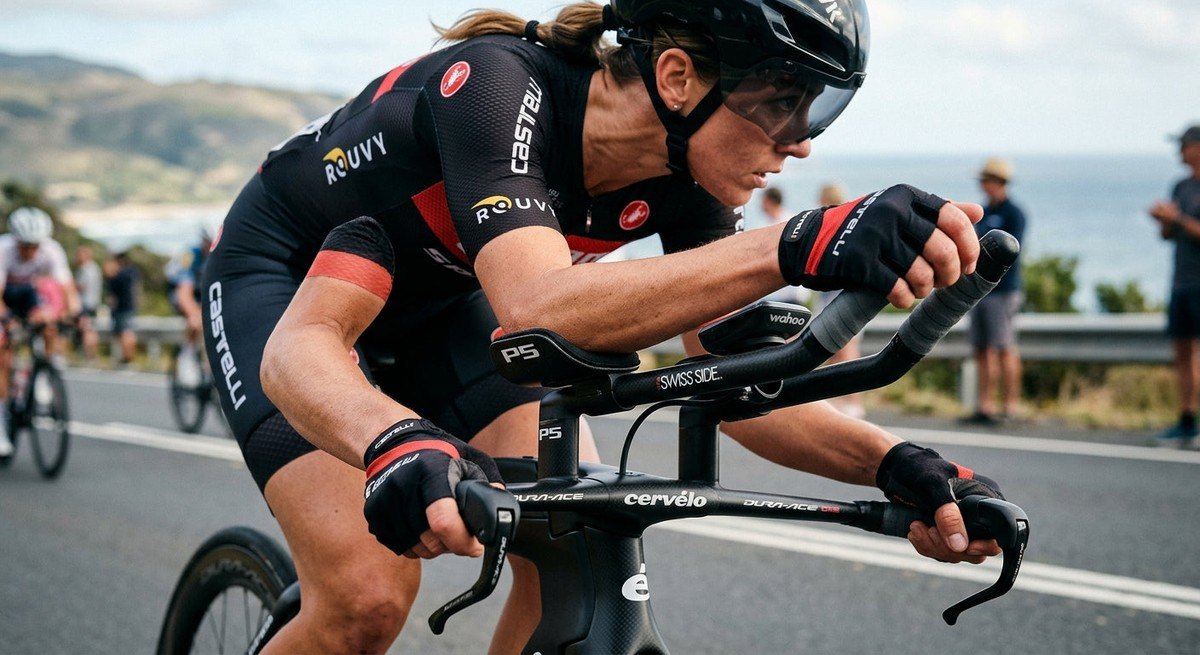
Once you are comfortable with the basics, it is time to address the most daunting aspect of TT riding: crosswinds. When you are positioned low and tight, your bike acts like a sail. Instead of fighting the wind with rigid arms, aim for a 'loose-grip' approach. Keep your elbows slightly bent to act as a natural suspension system, allowing the bike to move slightly beneath you without throwing you off your line.

Need a clear race fuelling strategy?
Get instant, practical advice on hydration and race-day nutrition directly on this page for free. Try asking Raye: 'How many grams of carbs should I take per hour during a half marathon?' Ask for fuelling advice
Prioritise your gaze. Beginners often stare at their front wheel or the immediate road surface, which narrows their field of vision and leads to twitchy steering. Train yourself to look at least 50 metres ahead. By focusing on your exit line in a corner or the road ahead in a crosswind, your body will naturally make the micro-adjustments necessary to track that line smoothly.
Another critical skill is weight distribution. During high-speed descents, avoid the urge to sit bolt upright, as this creates massive drag and alters the handling characteristics of the frame. Instead, stay low, keep your chest near the base bars, and shift your weight slightly back to increase stability. Always ensure your knees are tucked in to maintain an aerodynamic profile, which also helps in keeping the bike planted on the tarmac.
Special Features & Technical Specifications
Material Composition
Modern TT frames are constructed from high-modulus carbon fibre, engineered for lateral stiffness to ensure efficient power transfer. The layup schedule is specifically designed to dampen road vibrations while maintaining the structural integrity required for high-speed stability.
Physical Dimensions and Engineering
The geometry of contemporary TT bikes features steeper seat tube angles, often exceeding 78 degrees, which rotates the rider forward into a more aggressive aero position. This engineering change necessitates a shorter reach to the base bars compared to previous generations, improving weight balance between the wheels.
Weight and Aerodynamic Evolution
Weight has been reduced by approximately 15% across leading models compared to the 2015 generation, largely due to integrated component systems. These integrated cockpits reduce frontal surface area and eliminate external cable drag, resulting in a more predictable handling profile in turbulent air conditions.
Ultimately, the goal is to become an extension of your machine. Regular maintenance of your headset bearings and ensuring your position is professionally fitted will further enhance your handling capabilities. As you refine these skills, you will find that your confidence increases, allowing you to stay in the aero position longer, maintain higher average speeds, and execute your race strategy with clinical precision.


