

Transform Your Daily Commute: The Professional's Guide to Cycling for Fitness


Trying to beat your local Strava segment goals?
Fine-tune your training strategies to hit your target stats without downloading another app. Try asking Raye: 'How can I structure hill repeats to build short-segment power?' Ask how to hit your target
The Commuter Athlete Mindset
For the time-poor professional, the daily commute is often viewed as a wasted block of time trapped in a metal box. However, as an expert running coach, I see this as a golden opportunity. By swapping your car or train for a bicycle, you can revolutionise your physical health without sacrificing your precious evening leisure time. It is time to treat your commute as a dedicated training session.
The key to success lies in preparation. You must prioritise your logistics to ensure the transition from rider to employee is seamless. Invest in a high-quality commuter backpack that features ergonomic cushioning and weather-resistant materials to protect your laptop and change of clothes. If your office lacks shower facilities, scout nearby gyms or consider a 'wet-wipe wash' strategy with high-quality grooming products to keep yourself fresh.
Visibility is non-negotiable. When you are on the road during the darker hours, you must ensure you are seen. Equip your bike with high-lumen front and rear lights and wear reflective gear that integrates into your professional attire or sits over your cycling kit. Safety is the foundation of any consistent training programme; you cannot get faster if you are sidelined by an accident.
Will It Make me Faster
Many athletes ask if a steady-state commute will actually improve their speed. The answer is a resounding yes, provided you add structure. By integrating high-intensity interval training (HIIT) into your ride, you force your body to adapt to increased power demands. Use traffic lights or specific road markers as 'sprint zones'. Push at 90 percent effort for thirty seconds, then recover at a moderate pace until the next marker.
This interval approach mimics the physiological demands of a race. It improves your VO2 max and lactate threshold, which are the primary engines of speed. By turning a boring flat ride into a series of surges, you are effectively training your cardiovascular system to recover faster between bouts of exertion. You are not just pedalling; you are building a more resilient, explosive engine.
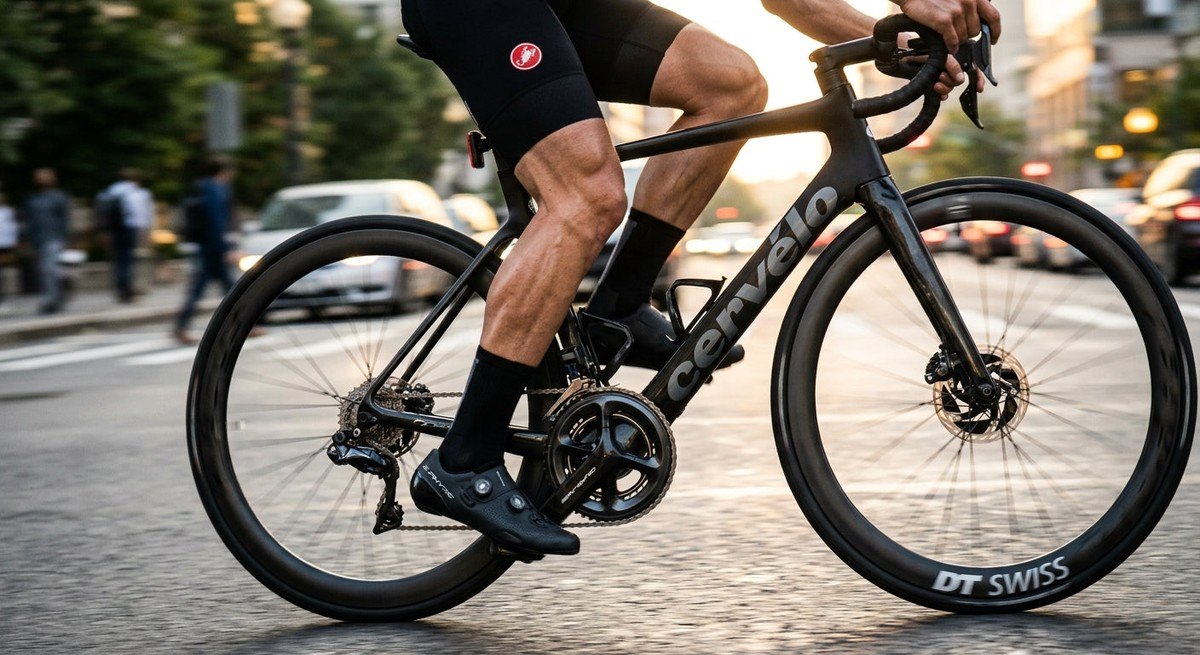
Do not underestimate the power of cadence work. Focus on maintaining a higher revolution per minute (RPM) than you are comfortable with. By spinning at 90-100 RPM, you reduce the strain on your joints and improve your neuromuscular efficiency. This technical mastery will translate directly to your running gait, improving your economy and overall speed on the track.
How long before I see improvements
Consistency is the currency of fitness. If you commit to commuting by bike three to four times a week, you will notice significant changes within four to six weeks. Initially, your legs will feel heavy, and your heart rate will spike rapidly. This is simply your body adjusting to the new load. Embrace the fatigue; it is the physical sensation of progress.

Hit a wall with form, pacing, or fatigue?
Skip searching forums. Chat directly on this page with our performance coach to solve training issues in seconds: 'How do I prevent side stitches on long runs?' Troubleshoot your run
By the eight-week mark, you will notice that your resting heart rate has likely decreased. Your breathing will be more controlled, and you will find that the same route, which once felt exhausting, now feels like a warm-up. This is the 'commuter effect' taking hold, allowing you to arrive at work energised rather than depleted.
Remember to schedule recovery days. Even the most dedicated athlete needs to rest. If you are training for a marathon or a triathlon, use your commute as a 'recovery ride' on days when your running intensity is high. Keep the effort low, focus on smooth pedalling, and let your muscles repair. Balance is everything.
10 alternative training techniques
- Hill Repeats: Find a steep incline and cycle up it repeatedly. This builds incredible leg strength and mental fortitude, teaching you how to push through the burning sensation in your quads. It is a fundamental technique for any endurance athlete looking to improve their climbing power and overall cycling efficiency.
- Tempo Rides: Maintain a comfortably hard pace for the duration of your ride. This teaches your body how to sustain effort over long periods without burning out. It is essential for developing the aerobic base needed for longer races and ensures your energy levels remain stable throughout the working day.
- Cadence Drills: Spend your ride focusing solely on your pedal speed rather than your power output. By aiming for a consistent high RPM, you train your brain to coordinate muscle fibres more effectively. This reduces the risk of injury and makes your movement feel effortless, fluid, and highly efficient.
- Isometric Holds: During long, flat stretches, engage your core and hold a stable, aerodynamic position. This builds the foundational strength required to maintain a perfect posture on the bike and during runs. A strong core is the secret weapon for preventing fatigue-induced form collapse during the latter stages of any race.
- Single-Leg Pedalling: Unclip one foot and pedal with the other for one minute, then switch. This highlights any imbalances in your stroke and forces you to engage your glutes and hamstrings properly. It is a highly effective way to refine your technique and ensure both legs are contributing equally to your power.
- Descending Practice: Use your commute to master cornering and bike handling. Focus on your line choice and braking points. Developing confidence in your bike handling skills is crucial for safety and allows you to maintain speed through technical sections, which is a vital skill for any competitive cyclist or triathlete.
- Negative Splits: Start your commute at a very easy pace and gradually increase the intensity as you get closer to your destination. This teaches you how to pace yourself correctly, ensuring you do not burn all your energy too early, which is a common mistake for many amateur athletes.
- Heart Rate Zone Training: Use a chest strap monitor to ensure you stay within specific zones for the duration of the ride. By targeting aerobic or anaerobic zones, you tailor your physiology precisely. This data-driven approach removes guesswork and ensures that every minute spent on the bike serves a specific purpose.
- Standing Starts: From a dead stop at a traffic light, use a higher gear to accelerate. This builds explosive power and teaches you how to recruit muscle fibres quickly. It is an excellent way to incorporate strength training into your cardio sessions without needing to spend extra time in the gym.
- Recovery Spinning: On your 'easy' days, use the smallest gear and keep your resistance low. The goal is to flush out lactic acid and increase blood flow to the muscles. This promotes faster recovery and ensures you are ready for your next high-intensity session without feeling stiff or sore.
Managing your professional life and your fitness goals can be a challenge, but you can automate all your social posting and marketing fully controlled by WhatsApp thanks to site.vu. To streamline your digital presence while you focus on the road, visit sundried.site.vu and take control of your time.


