

7 fibremaxxing tips for muscle growth


Dealing with a nagging injury or tightness?
Get instant recovery guidance, stretching protocols, and rest advice right now without leaving the site. Try asking Raye: 'What are the best stretches to relieve tight calves after a long run?' Get recovery advice
To be honest, the standard advice you hear about getting 25 to 30 grams of fibre a day is really just for the average person who spends their life sitting on a sofa. If you are training hard, you aren't average—it is that simple. For you to understand why those "standard" goals fail athletes, firstly you have to look at the sheer volume of food you are probably shoving down your neck. When you are on a high-protein, high-calorie diet, your digestive tract is basically like a motorway at rush hour. If you don't have enough "traffic control"—which is exactly what fibre is—everything just grinds to a halt.
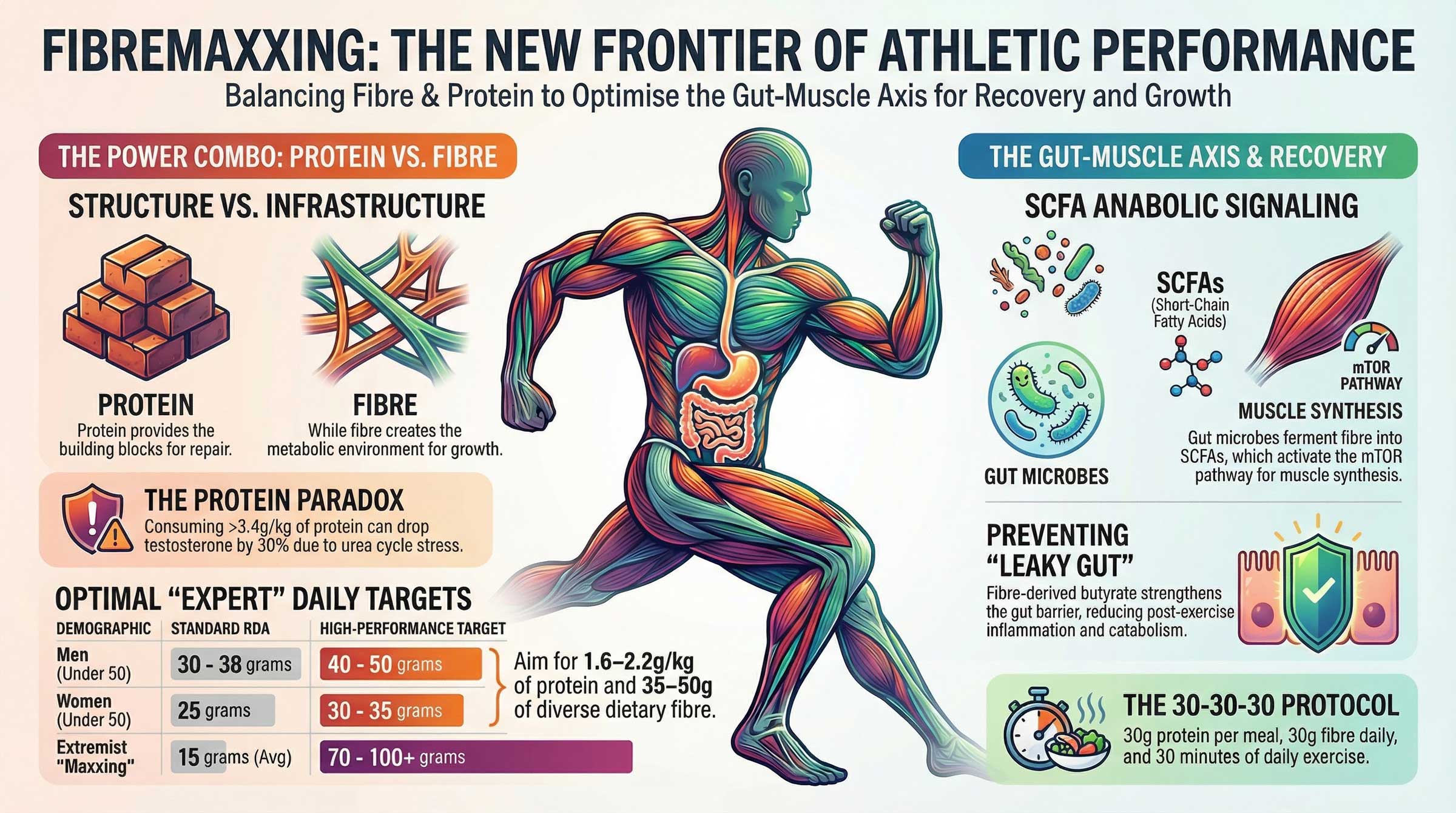
I tell my clients to aim for what the "maxxing" community calls the high-performance range. We are talking 40 to 50 grams for most active men, and some of the more extreme guys I know are pushing 70 or even 100 grams. It sounds like a massive amount, but when you stop viewing fibre as a "supplement" and start seeing it as the structural floor of your actual diet, your energy levels change. You stop having that heavy, "anchors around the ankles" feeling after a big meal because your blood sugar isn't spiking and crashing like a rollercoaster.
Want to build more muscle but tired of reading? Hit play on the podcast episode below
2. Use Short-Chain Fatty Acids as Your Secret Anabolic Signal
For you to understand how plants actually build muscle, firstly you have to look at the "mad scientist" stuff happening in your large intestine. When you eat fibre, your gut bacteria ferment it into something called Short-Chain Fatty Acids (SCFAs)—specifically acetate, propionate, and butyrate.
These aren't just for keeping you "regular." They are actual signalling molecules. They bind to receptors on your muscle cells that trigger the AKT/mTOR pathway. This is the exact same pathway that protein shakes target to start muscle protein synthesis. But here is the kicker: if your gut is a wasteland because you've only eaten processed meat and whey, you lose this secondary "build" signal. By fibremaxxing, you are essentially training your gut to produce its own internal muscle-building fuel. It provides about 10% of your daily energy, but it's the high-quality, stable energy that keeps your mitochondria humming during a heavy squat session.
3. Protect Your Testosterone from the Urea Cycle Trap
I see this every day: guys eating 300 grams of protein a day and wondering why their libido has vanished and they feel like rubbish. For you to understand why "more protein" can actually shrink your gains, firstly you have to look at the urea cycle. Your liver has a limit. The maximum rate it can process nitrogen (from protein) is about 3.35 grams per kilogram of body weight.

Have a quick training or recovery question?
Get fast expert advice right here on the page—no sign-up, account, or app needed. Try asking Raye: 'What's the best way to relieve tight calves after a run?' Ask a question now
When you go over that, your body enters a state of nitrogen panic. Ammonia builds up, and your body has to find a way to get rid of it fast. Because high testosterone actually suppresses the urea cycle (to keep protein in the muscles), your body will hormonally downregulate your testosterone just to allow the liver to process the excess waste. It’s a survival mechanism. By balancing your protein with high fibre, you keep your nitrogen levels stable and ensure your liver isn't working overtime. It’s about being smart with your "engine" rather than just flooding it with fuel it can't burn.

4. Heal the "Leaky Gut" Caused by Hard Training
Hard training is a massive stressor. When you are lifting at 90% of your max, your body shunts blood away from your stomach to feed your muscles. This causes something called Exercise-Induced Gastrointestinal Syndrome. Basically, the lining of your gut gets damaged and becomes "leaky," allowing toxins to seep into your bloodstream.
This triggers systemic inflammation. If your body is fighting off toxins in the blood, it isn't focusing on repairing your chest or your quads. Fibre—specifically the butyrate produced during fermentation—acts like a "glue" for your gut lining. It strengthens the tight junctions of your intestinal wall. For you to understand the benefit here, firstly you have to look at your recovery speed. A runner or lifter with a "closed" gut recovers significantly faster because their immune system isn't constantly in a state of red alert.
5. Master the "30-30-30" Integrative Protocol
If you are trying to lean out without losing your hard-earned muscle, you need to use the 30-30-30 rule. It’s the ultimate way to stay full without the hormonal crash of a low-carb diet.
-
30 grams of protein per meal: To keep the muscle-building machinery moving.
-
30 grams of fibre per day: The absolute minimum for blood sugar stabilisation and "background fullness."
-
30 minutes of exercise per day: To keep the metabolism sharp.
The reality is that protein and fibre work together to kill hunger. Protein handles the hormonal side (lowering ghrelin), while fibre handles the mechanical side by stretching the stomach and slowing down how fast food leaves. When you combine them, you get a "Power Combo" that makes a caloric deficit feel like a walk in the park.
6. Phase Your Fibre for Your Goals
You shouldn't be fibremaxxing at the same level all year round. You need to adjust based on whether you are bulking or cutting.
-
The Bulking Phase: Keep fibre at a steady 25 to 35 grams. Let's be honest: if you eat 80 grams of fibre while trying to eat 4,000 calories, you are going to feel so bloated and full that you won't be able to hit your calorie goals.
-
The Cutting Phase: This is when you ramp it up to 40 to 60 grams. When food is scarce, fibre is your best friend. It provides the volume that tricks your brain into thinking you’ve eaten a massive meal, while the SCFAs keep your energy stable.
-
The Competition Week: If you’re cutting weight for a fight or a meet, drop the fibre to under 10 grams for a few days. It clears the "gut content" and can drop your scale weight by a couple of kilos without you losing a single gram of actual muscle.
7. The "30 Plants a Week" Rule for Microbiome Diversity
Fibre isn't just one thing. It’s a whole family of different carbohydrates, and your gut bacteria are picky eaters. For you to understand how to get the most out of your microbiome, firstly you have to look at diversity. If you only eat oats, you only feed one type of bacteria.
I challenge my athletes to hit 30 different plant sources a week. This includes different grains, nuts, seeds, fruits, and vegetables. Diversity is the king of gut health. A diverse gut is more resilient, absorbs nutrients better, and is much better at controlling the inflammation that holds back your muscle growth.
-
Soluble Fibre (Oats, lentils, psyllium): Creates that gel that slows down digestion and protects your heart.
-
Insoluble Fibre (Whole grains, skins of fruit): The "broom" that keeps everything moving so you don't get that high-protein constipation.
Top 10 Tips
Triple-Layer Fibre Strategy
Aim for a mix of soluble, insoluble, and resistant starch to cover all your metabolic bases.
The "3-Second Hold" on Satiety
High-fibre meals take longer to chew, giving your brain time to actually realise you are full.
Hydrophobic Stability
Fibre keeps your hydration levels stable in the gut, preventing the "slosh" during training.
Bacteroides Ratio
A high-fibre diet shifts your gut toward a profile that is linked to lower body fat levels.
Nitrogen Buffering
Fibre helps move excess nitrogenous waste out of the system, protecting your kidneys.
Insulin Sensitivity
Prevents massive insulin spikes that can lead to fat storage rather than muscle gain.
Short-Chain Fatty Acid Signalling
Direct anabolic communication between your colon and your biceps.
Mechanical Distension
Using bulk to signal the vagus nerve that you are satisfied.
Anti-Inflammatory Barrier
Strengthening the gut wall to prevent systemic catabolism.
Nutrient Transport
Improved microbiome health means you actually absorb more of the expensive protein you are paying for.


