

Cutting Liquid Calories for Faster Weight Loss


Want to build strength to support your running?
Get targeted strength routines and mobility exercises designed specifically for runners directly on-site. Try asking Raye: 'What are 3 key gym exercises to improve running economy?' Get strength tips
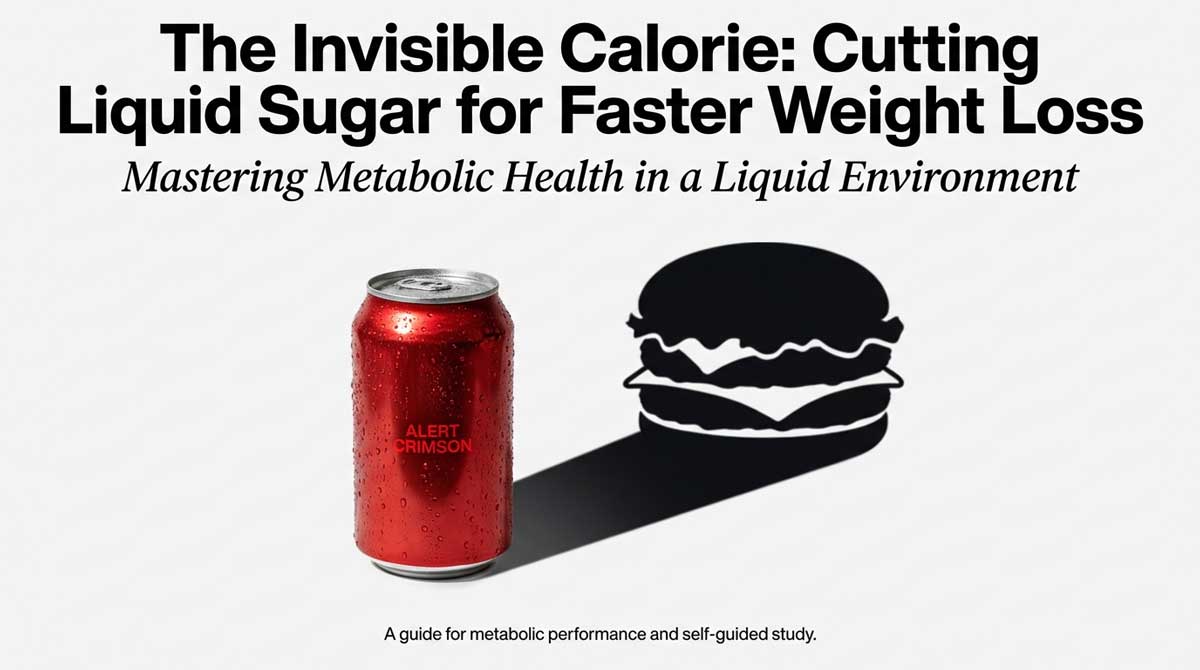
When we think about performance and body composition, we often spend a lot of time agonising over what is on our plate. We weigh our chicken, we count our greens, and we worry about whether we should be eating sweet potatoes or white rice. But there is a silent passenger in our daily routine that often goes completely unnoticed, yet it has a massive impact on how we feel and how we perform over the long term: the calories we drink.
For the modern athlete, the goal isn't just to look good for a few weeks in the summer. It is about building a body that performs at its peak year-round, year after year. To do that, we need to understand how our biology interacts with the modern world. One of the biggest disconnects in our current environment is the "metabolic invisibility" of liquid energy.
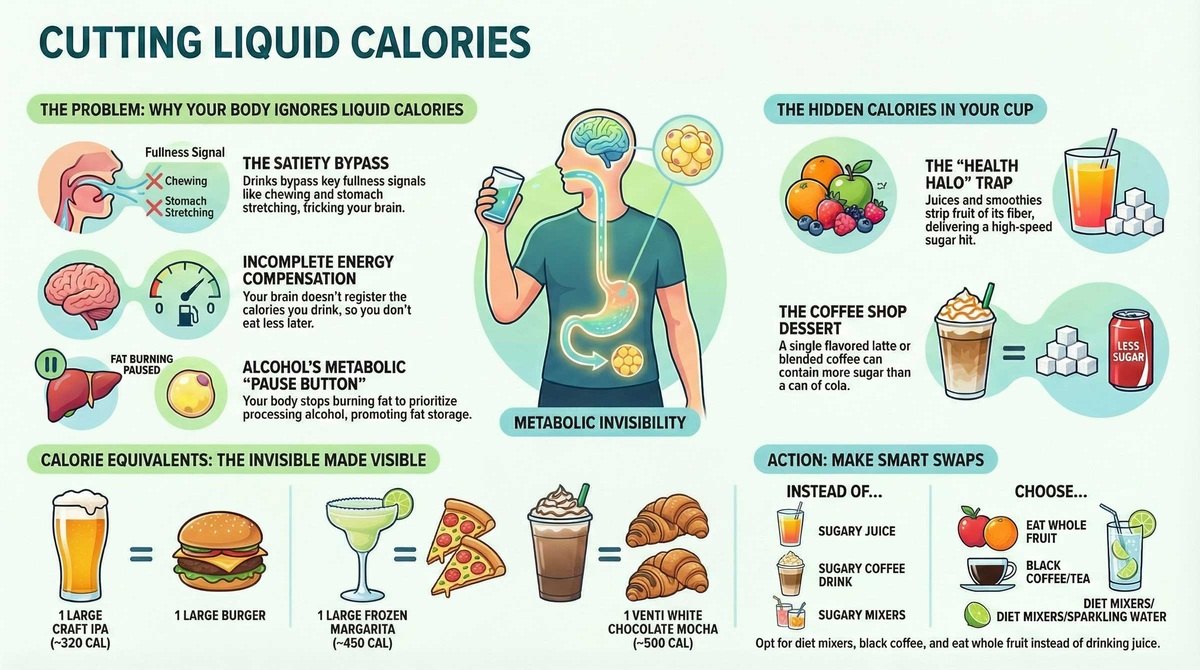
Why our brains don't "see" drinks
Our bodies are incredible machines, but they were designed for a world that looks very different from the one we live in today. For the vast majority of human history, if you wanted energy, you had to chew it. Water was for hydration, and food was for fuel. Because of this, our brains developed a very sophisticated system to tell us when we are full, involving hormones, stomach stretching, and even the act of chewing itself.
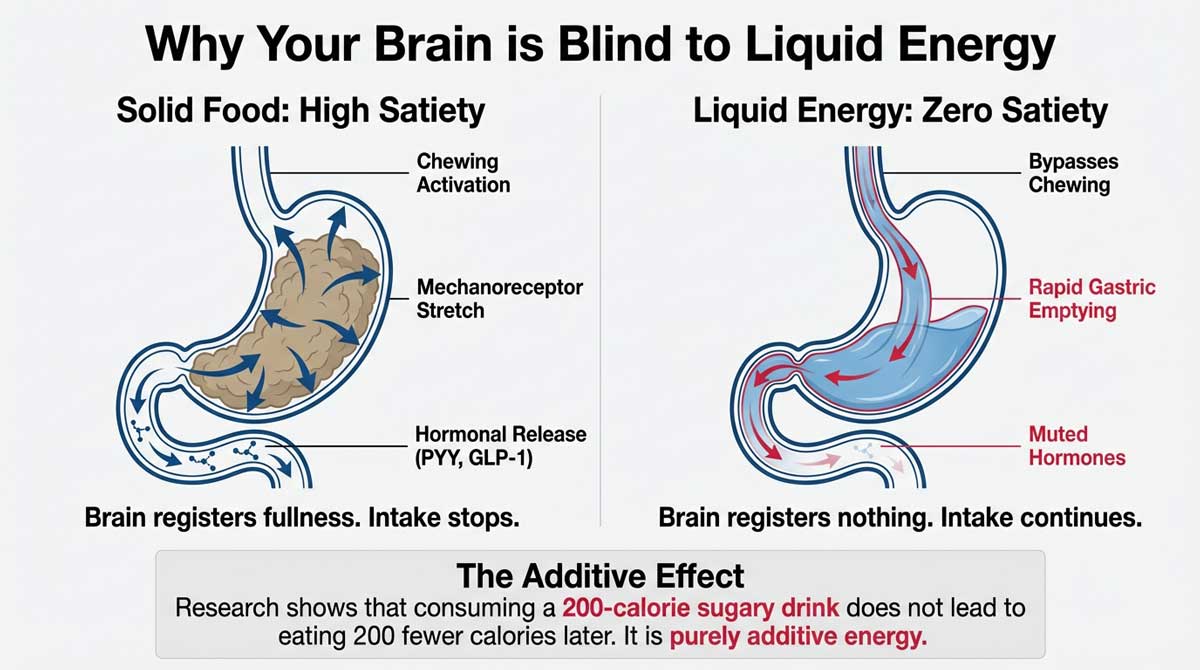
When we eat a solid meal-say, a steak with a large portion of broccoli-our body starts sending signals to the brain. The physical act of chewing tells the brain that food is coming. As the food hits the stomach, it stretches the stomach walls, triggering "fullness" sensors. Finally, as that food is slowly broken down and enters the small intestine, hormones like PYY and GLP-1 are released to tell us to stop eating.
Liquids, however, are the ultimate "stealth" calories. They bypass almost all of these sensors. Because they are liquid, they zip through the stomach in record time. There is no chewing, very little stomach stretching, and the hormonal response is significantly muted.
Stay Healthy... Listen on the move, click play below
This leads to what scientists call "incomplete energy compensation." In plain English, it means that if you drink 200 calories of orange juice, your brain doesn't register that you've "eaten" anything. You won't naturally eat 200 fewer calories at your next meal to make up for it. Those liquid calories are simply added on top of your daily total. Over a year, just one extra sugary drink a day can lead to a significant change in body fat, purely because your brain didn't know it was there.

Have a specific performance goal in mind?
Get direct feedback on your training targets right here on the page—no sign-up or account required. Try asking Raye: 'How should I adjust my weekly mileage for a sub-20 minute 5K?' Ask about your goals
The Glycemic Velocity: Why speed matters

Is Your Weight Stuck In Your Cup?
It’s not just about what is on your plate. Discover if "stealth calories" are bypassing your fullness sensors and identify your unique Weight Loss Profile in 60 seconds. Start the Free Assessment.
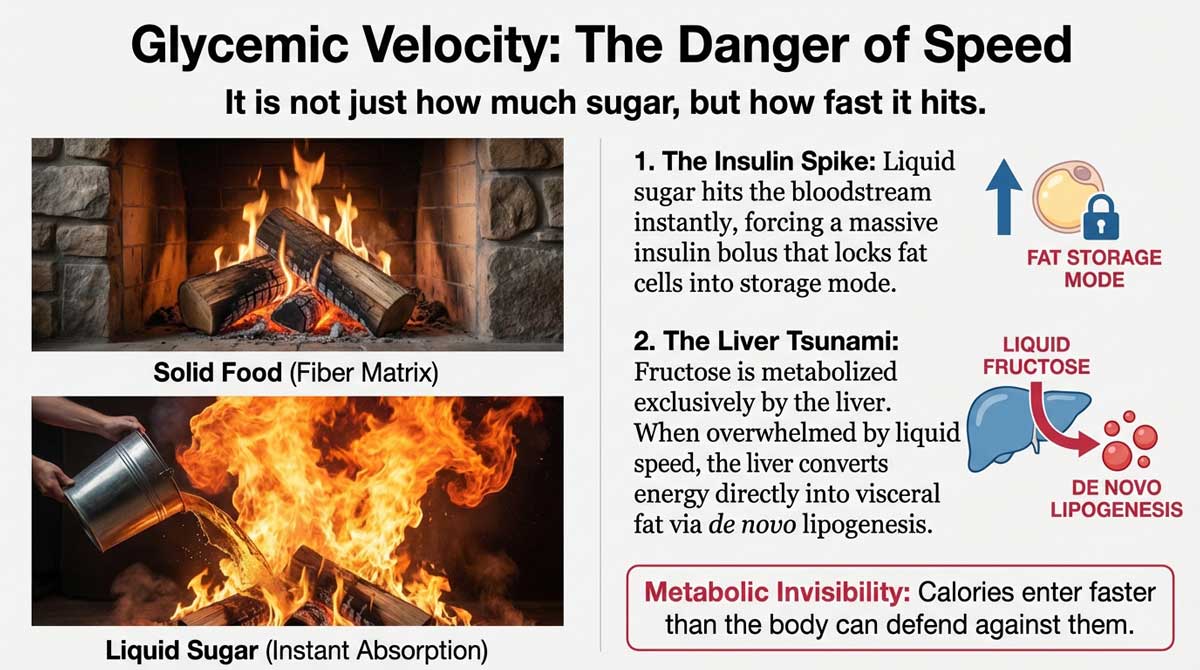
It isn't just about the number of calories; it's about how fast they hit your system. Think of your metabolism like a fireplace. If you put a heavy log on the fire (solid food with fiber, protein, and fat), it burns slowly and steadily for hours. If you throw a cup of petrol on it (liquid sugar), you get a massive, dangerous flash of energy that the fireplace can't handle.
When we drink liquid sugar, it hits the bloodstream almost instantly because there is no fiber or solid structure to slow it down. This causes a massive spike in insulin. High insulin levels are like a "lock and key" for fat cells-they tell the body to stop burning fat and start storing it.
Furthermore, many of these drinks are loaded with fructose. While glucose can be used by your muscles for energy, fructose has to be processed by the liver. When the liver is hit with a "tsunami" of liquid fructose, it gets overwhelmed and starts turning that sugar directly into liver fat and visceral fat (the fat around your organs). This is a disaster for long-term athletic performance and metabolic health.
Navigating the soft drink minefield
We all know that traditional fizzy drinks are high in sugar, but the landscape has changed significantly in recent years. In the UK, we have seen the "Sugar Tax" (the Soft Drinks Industry Levy) change the way many of our favourite drinks are made.
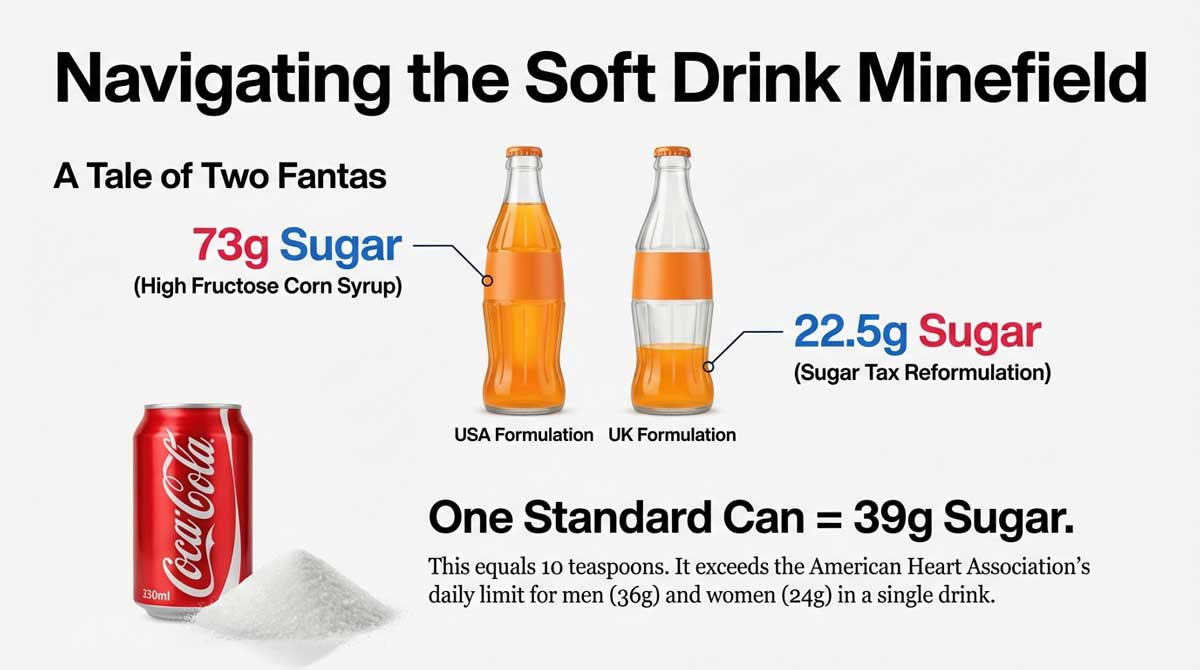
If you travel to the US, a large bottle of Fanta might contain a staggering 73 grams of sugar. Here in the UK, many brands have reformulated to stay below the tax threshold, bringing that down to around 22 grams. While that is a step in the right direction, it is still a significant amount of "invisible" energy hitting your liver all at once.
Even a standard 330ml can of cola contains around 35 to 39 grams of sugar. To put that in perspective, that is nearly ten teaspoons of sugar in one go. For an athlete looking to maintain a lean, high-performing physique, that single can represents a massive hit of "empty" energy that provides no satiety and actively works against your fat-loss goals.
The "Health Halo" of juices and smoothies
This is where things get tricky. Many athletes avoid soda but reach for fruit juices or smoothies, believing they are the "healthy" choice. This is what we call the "Health Halo." Because it comes from fruit, we assume it is good for us.
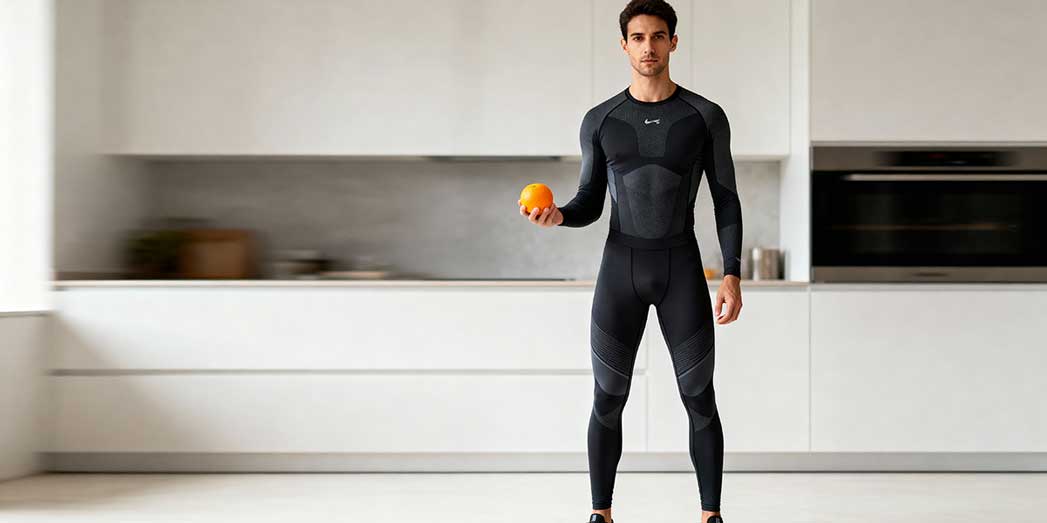
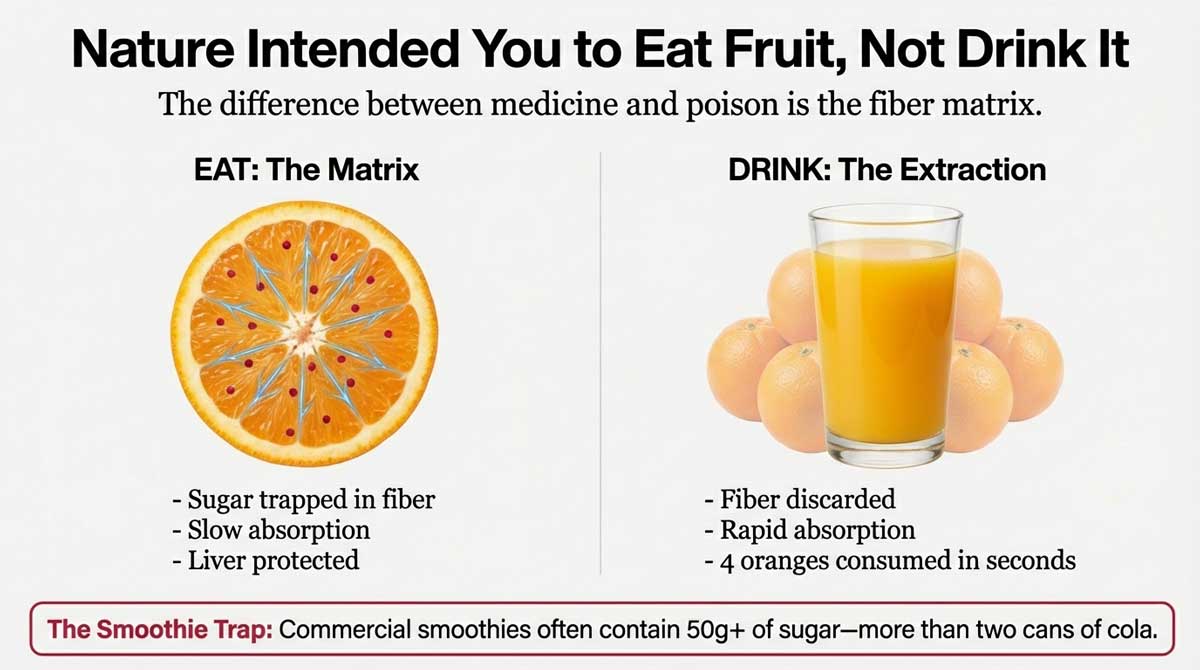
However, nature intended for us to eat fruit, not drink it. The difference between an orange and a glass of orange juice is fiber. When you eat a whole orange, the sugar is trapped inside a fibrous matrix. It takes time to chew, and the fiber slows down the digestion process, giving your liver a chance to keep up.
When you juice that orange, you throw away the fiber and keep only the sugar and water. You are essentially drinking "natural" soda. An 8oz glass of juice contains the sugar of about four oranges, but you can drink it in seconds. You would never sit down and eat four oranges in thirty seconds, but we do it every day with juice.
Commercial smoothies can be even more deceptive. Many are based on fruit juice concentrates and can contain upwards of 50 grams of sugar per bottle. That is more than two cans of cola. If you want the benefits of fruit, eat the fruit. Keep your hydration to water or unsweetened tea.
The Coffee Shop Dessert Economy
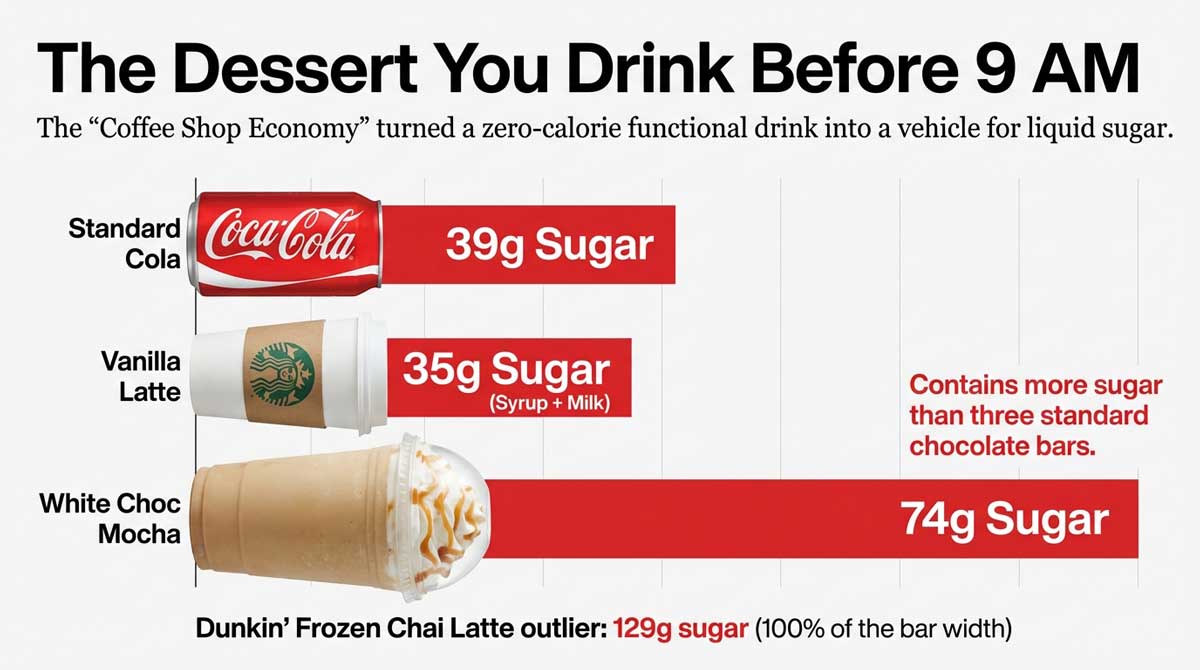
Perhaps the most common source of hidden liquid sugar for the modern professional is the high-street coffee shop. Coffee, in its natural state, is a near-zero-calorie drink that can actually support performance. But the "Coffee Shop Economy" has turned the humble bean into a vehicle for liquid dessert.
-
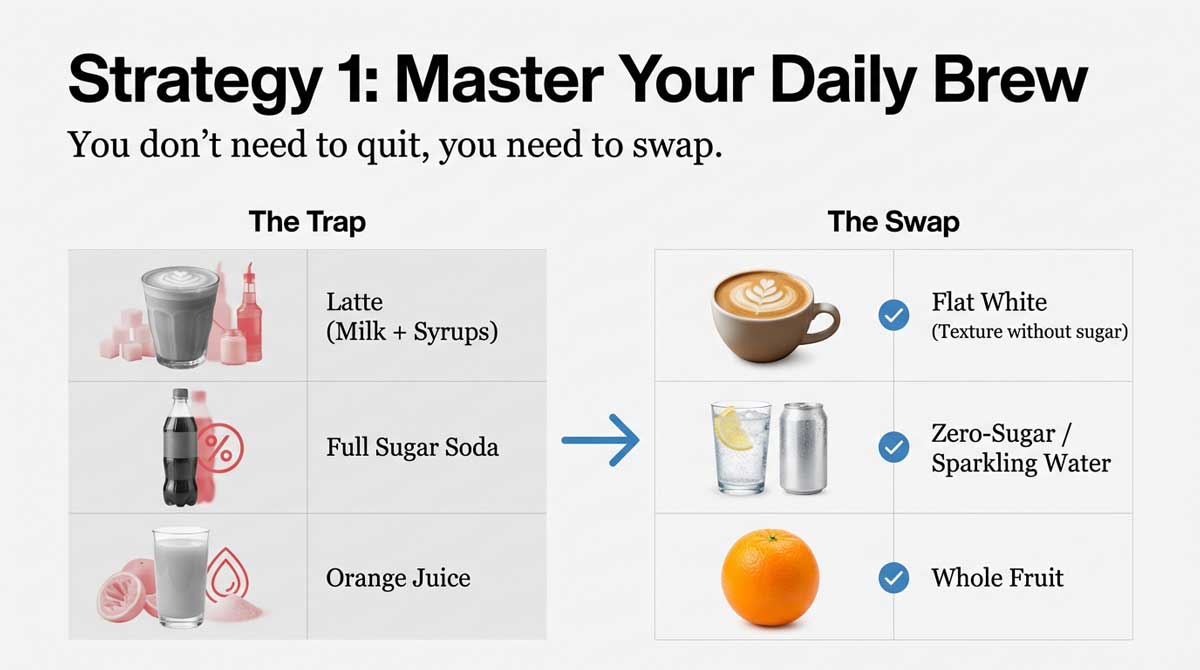
The Latte Trap: A standard latte is mostly milk. While milk contains natural sugars (lactose), many people add flavoured syrups. A vanilla latte can easily contain 35 grams of sugar-the same as a can of cola.
-
The Frappuccino Effect: Blended ice drinks are essentially milkshakes. A large white chocolate mocha with whipped cream can hit 74 grams of sugar and over 500 calories. That is not a drink; that is a meal's worth of energy with none of the nutritional benefits.
If you are an athlete on the go, stick to black coffee, americanos, or a simple flat white without the syrups. You get the caffeine boost without the metabolic crash.
Alcohol: The metabolic "pause button"
Alcohol presents a unique challenge for anyone focused on body composition. It isn't just about the calories in the glass; it's about how alcohol changes your entire metabolism.
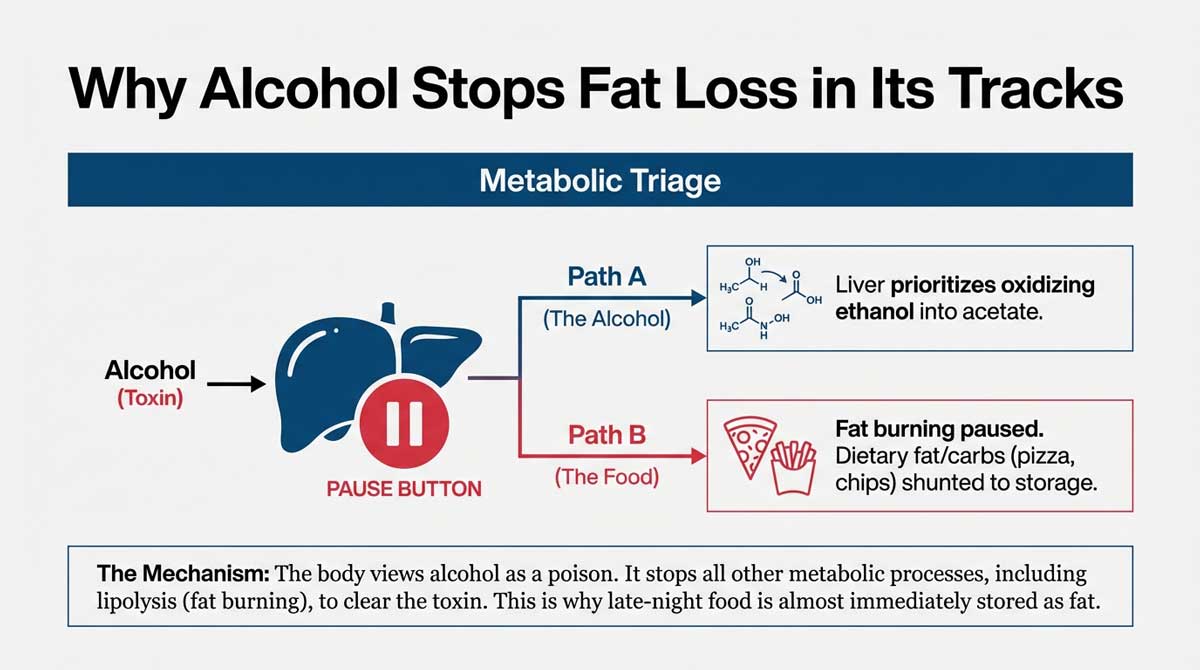
Ethanol (alcohol) is essentially a toxin that the body wants to get rid of as quickly as possible. When you have a drink, your liver stops everything else it is doing-including burning fat-to focus on breaking down the alcohol. This is called "metabolic triage."
While your liver is busy detoxifying, any food you eat alongside that drink (the pizza, the chips, or even a healthy dinner) is much more likely to be stored as fat because your "fat-burning engine" has been paused.
Beer: Liquid Bread
Beer is often called liquid bread for a reason. It is full of fermented grains and residual sugars.
-
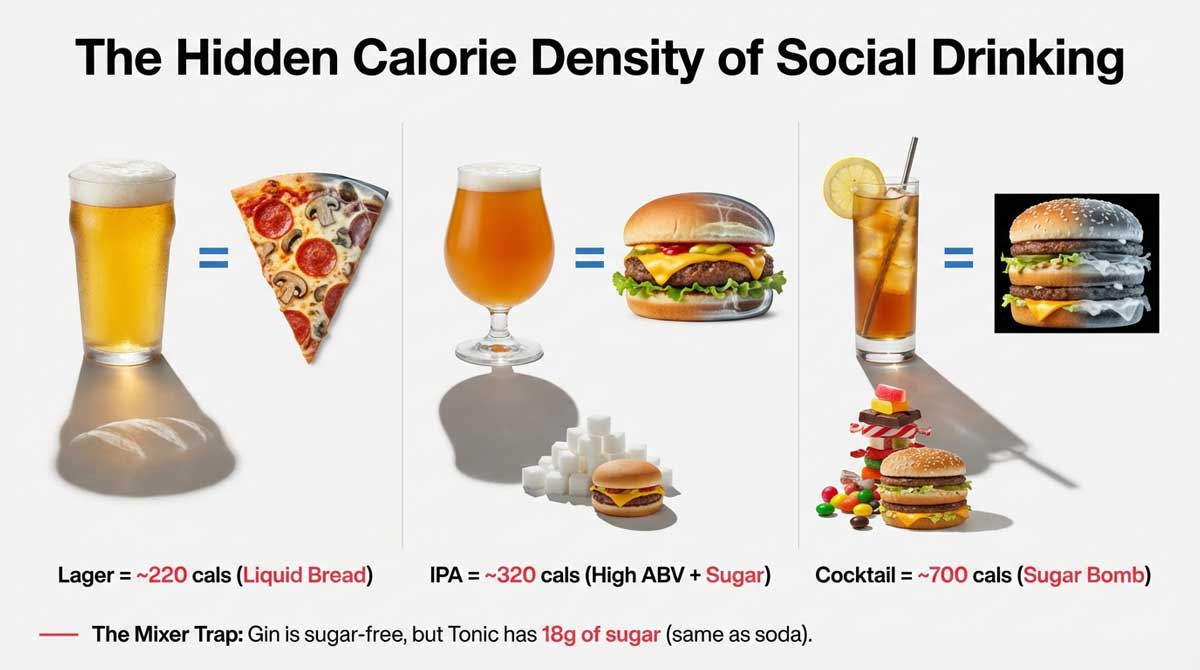
Lagers: A standard pint is roughly 200 calories, similar to a slice of pizza.
-
IPAs: The craft beer movement has brought us delicious but incredibly calorie-dense drinks. A strong Double IPA can exceed 350 calories per pint. If you have three, you've consumed over 1,000 calories before you've even ordered food.
The Mixer Trap
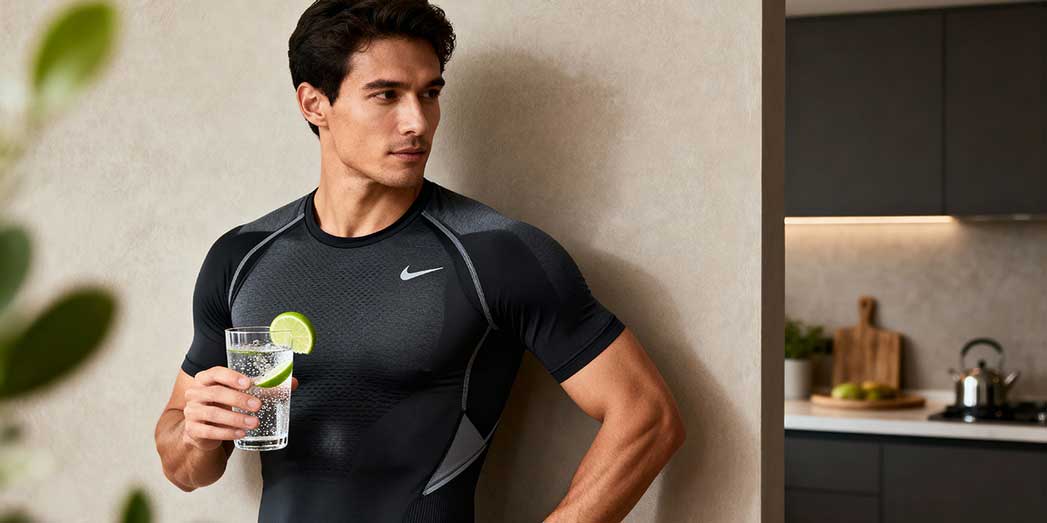
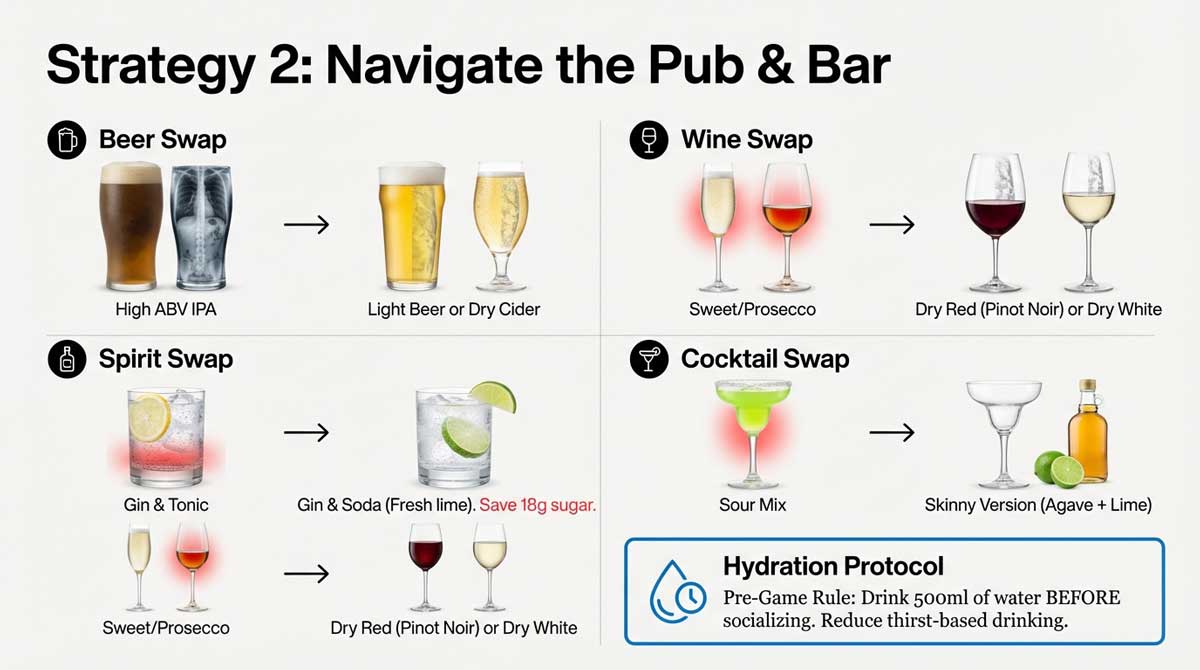
Spirits like vodka or gin are sugar-free on their own, but the mixer is where the danger lies. A standard Gin and Tonic is often seen as a "light" choice, but tonic water contains almost as much sugar as lemonade. Switching to a "slimline" or diet tonic instantly removes that sugar load, making it a much more performance-friendly option.
Cocktails: The Ultimate Calorie Bombs
Cocktails are the heavyweights of the liquid sugar world. A Long Island Iced Tea, with its mix of spirits, cola, and syrup, can top 700 calories. That is more than a Big Mac. A Margarita made with a pre-mixed "sour mix" is essentially a sugar syrup delivery system. If you enjoy a cocktail, look for "skinny" versions that use fresh lime juice and agave instead of processed syrups.
Visualising the Impact
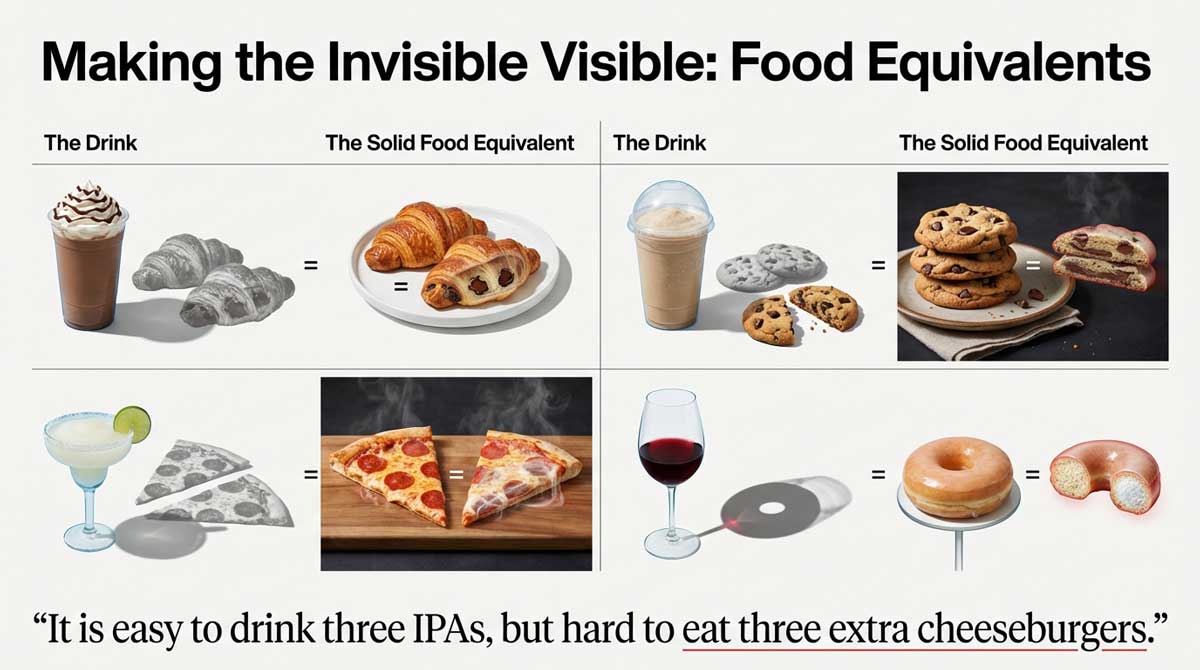
To make this real, we need to stop thinking in "millilitres" and start thinking in "food equivalents." When we see what these drinks actually represent in terms of solid food, it becomes much easier to make better choices.
| Beverage (Standard Serving) | Calories | Sugar (g) | Solid Food Equivalent |
| Pint of Lager | ~220 | 10g | 1 Slice of Pepperoni Pizza |
| Craft IPA Pint | ~320 | 20g | 1 Cheeseburger |
| Large Red Wine (250ml) | ~210 | <2g | 1 Glazed Donut |
| Frozen Margarita | ~450 | 50g | 2 Slices of Cheese Pizza |
| Starbucks Venti White Mocha | ~500 | 74g | 2 Chocolate Croissants |
| Gin & Tonic (Standard) | ~170 | 18g | 1 Cadbury Crème Egg |
| Large Frozen Chai Latte | ~690 | 129g | 3.5 Chocolate Chip Cookies |
When you look at it this way, the "invisible" becomes visible. It is very easy to drink three IPAs in an evening without feeling full, but it is much harder to sit down and eat three cheeseburgers on top of your dinner.
The Sundried Roundup
Cutting liquid sugar isn't about restriction; it's about being strategic so you can perform at your best forever. By making simple swaps, you can significantly reduce your calorie intake without ever feeling like you are on a "diet."
How can I build this into my life?
The easiest way to start is by adopting a "water first" policy. Carry a reusable bottle and ensure you are hydrated before you reach for any other drink. When you do have a coffee or a drink at the pub, make "smart swaps." Swap the latte for a flat white; swap the full-fat cola for the zero-sugar version; swap the pint of cider for a dry white wine or a spirit with a sugar-free mixer. These small changes, performed consistently, lead to massive results over time.
Pushed for time, how can I keep up?
If you are constantly on the move, the coffee shop and the "grab-and-go" juice bar are your biggest hurdles. Preparedness is key. Keep a high-quality protein shaker or a water bottle with you so you aren't forced to buy a sugary "functional" drink when you are thirsty. If you must use a coffee shop, learn the menu. A black Americano or an espresso is instant, calorie-free, and requires no "customisation" that adds sugar.
Top 10 Tips
-
Prioritise Whole Fruit: Eat the orange; don't drink the juice. You need the fiber to protect your liver.
-
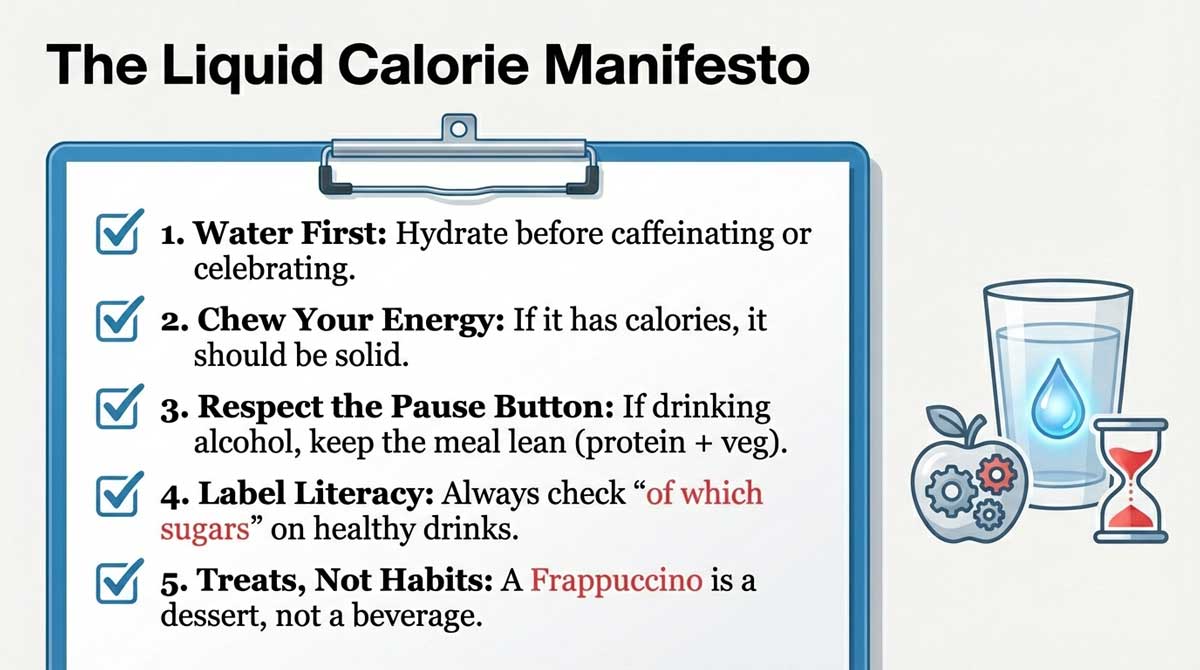
Master the Coffee Order: Avoid syrups and blended "frappe" style drinks. Stick to the basics.
-
Watch the Mixers: Use slimline tonic, soda water, or fresh lime instead of sugary sodas in your spirits.
-
Embrace "Zero" Versions: While water is best, zero-sugar fizzy drinks are a useful tool for transitioning away from high-sugar versions.
-
Understand the "Pause Button": Remember that alcohol stops fat burning. If you are drinking, try to keep your meal that night lean and high in protein.
-
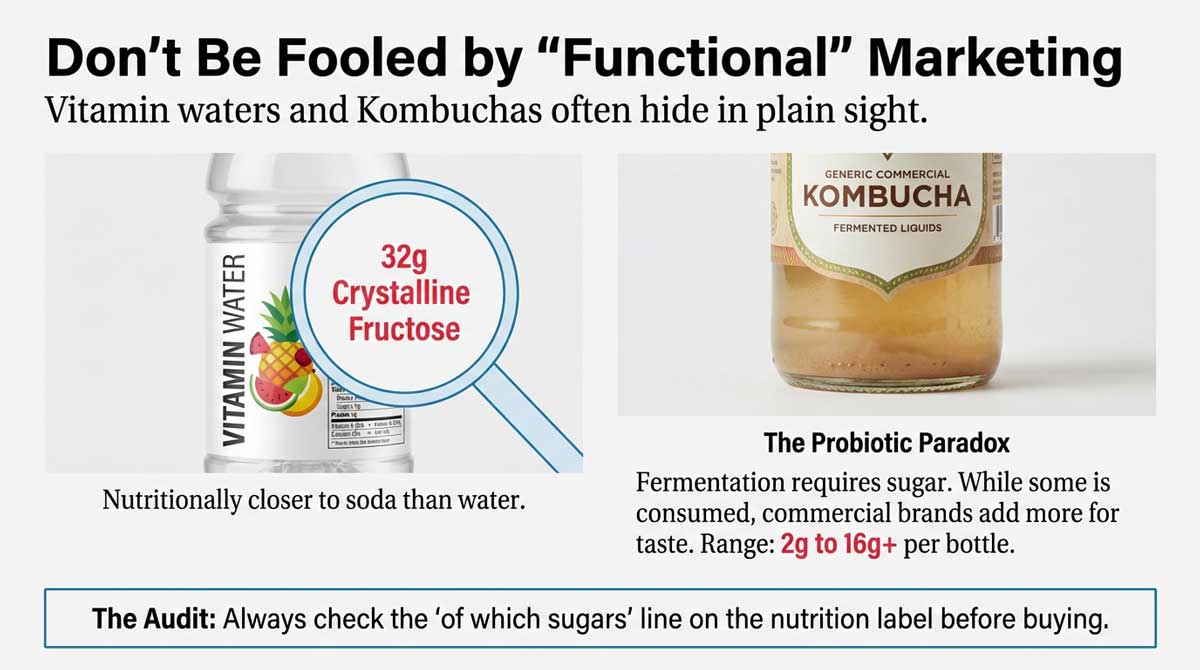
Read the Labels: "Healthy" smoothies and vitamin waters are often just soda in disguise. Check the "of which sugars" section on the back.
-
Choose Dry Wines: If you enjoy wine, stick to dry reds or whites (like Pinot Grigio or Malbec) rather than dessert wines or sweet Prosecco.
-
Beware of the Pint: A couple of craft beers can equal the calories of an entire extra meal. Treat them as a "liquid treat," not just a way to hydrate.
-
Hydrate Before You Socialise: Often we drink alcohol or soda because we are actually thirsty. Drink 500ml of water before you go out, and you'll likely drink less of the sugary stuff.
-
Think Long-Term: Don't view this as a "six-week shred." View it as becoming the type of athlete who respects their metabolism and chooses high-quality fuel.
Top 10 Tips
Prioritise Whole Fruit
Eat the orange; don't drink the juice. You need the fiber to protect your liver.
Master the Coffee Order
Avoid syrups and blended "frappe" style drinks. Stick to the basics.
Watch the Mixers
Use slimline tonic, soda water, or fresh lime instead of sugary sodas.
Embrace "Zero" Versions
Zero-sugar fizzy drinks are a useful tool for transitioning away from high-sugar versions.
Understand the "Pause Button"
Alcohol stops fat burning. Keep your meal that night lean and high in protein.
Read the Labels
"Healthy" smoothies are often just soda in disguise. Check the sugars.
Choose Dry Wines
Stick to dry reds or whites (like Pinot Grigio or Malbec) rather than dessert wines.
Beware of the Pint
Craft beers can equal a meal. Treat them as a "liquid treat," not just hydration.
Hydrate Before You Socialise
Drink 500ml of water before you go out, and you'll likely drink less of the sugary stuff.
Think Long-Term
Become the type of athlete who respects their metabolism and chooses high-quality fuel.
Frequently Asked Questions
Frequently Asked Questions
What is the easiest way to cut 200 calories without feeling hungry?
If you want to create a calorie deficit without your stomach constantly grumbling, the most effective strategy is to target what you drink rather than what you eat. This works because of the way your biology processes liquids compared to solids.
When you eat a meal, your body uses several "fullness sensors" to tell your brain to stop eating. First, the act of chewing sends an early signal that fuel is on the way. Then, as solid food fills your stomach, it physically stretches the stomach walls, which triggers sensors that say, "We're full." Finally, as that food is broken down, your system releases specific hormones like PYY and GLP-1 to sustain that feeling of satisfaction.
Drinks, however, are essentially invisible to these sensors. They zip through your stomach at a high velocity, meaning they don't stretch the stomach walls or trigger that hormonal "stop" signal. This leads to incomplete energy compensation. If you eat a 200-calorie snack, you'll naturally eat about 200 calories less at dinner. But if you drink a 200-calorie soda, your brain doesn't register it, so you end up eating your full dinner anyway. By cutting out that drink, you remove 200 calories that your appetite won't even miss.
Think of your metabolism like a fireplace. Solid food with fiber and protein is like a heavy oak log; it burns steadily for hours, providing constant heat. Liquid sugar is like throwing a cup of petrol on the fire. You get a massive, brief flash of energy that burns out instantly, leaving the fire (and your appetite) craving more fuel immediately.
What are the best low-calorie swaps for coffee shop drinks?
The trick to navigating the coffee shop is moving away from "liquid desserts" and back toward the actual coffee. Many popular orders are essentially milkshakes in disguise.
-
The Latte Swap: A standard flavoured latte is often a sugar trap. A large vanilla latte can contain around 35 grams of sugar-the same as a can of cola. Swap this for a Flat White or a Cappuccino. A Flat White uses less milk, reducing the energy load while keeping the texture, while a Cappuccino has roughly 140 calories and only the natural sugars found in milk.
-
The Frappuccino Swap: These blended drinks are the heavyweights of the menu. A large white chocolate mocha with whipped cream can hit 500 calories and 74 grams of sugar (about 18 teaspoons!). Instead, go for an Iced Americano or a Cold Brew. You get the same caffeine kick with almost zero calories. If you want it creamy, add a splash of milk yourself so you are in control of the portion.
-
The Syrup Swap: Instead of sugar-laden pumps of caramel or pumpkin spice, head to the dusting station. Adding cinnamon, nutmeg, or cocoa powder provides flavour without the "glycemic velocity" (the speed at which sugar hits your blood) of liquid syrups.
To put it in perspective, swapping a large blended mocha for a black coffee is the metabolic equivalent of removing two chocolate croissants from your day.
How do sugar-free fizzy drinks affect my fat loss goals?
Sugar-free or "zero" drinks are a useful tool for anyone transitioning away from a high-sugar diet. Their primary benefit is that they eliminate the "invisible" energy that usually leads to fat storage.
A standard can of cola has nearly 10 teaspoons of sugar, which causes a massive spike in insulin. High insulin levels essentially act as a lock on your fat cells, telling your body to stop burning fat and start storing it. By choosing a sugar-free version, you avoid this insulin spike, allowing your body to stay in a state where it can actually utilise stored energy.
They are also a much more performance-friendly mixer. A standard Gin and Tonic has about 18 grams of sugar-almost as much as lemonade. Switching to a slimline or diet tonic removes that sugar load instantly, reducing the metabolic impact of your evening. While water is always the gold standard for an athlete, zero-sugar drinks are a great bridge to support your long-term consistency.
How many calories and how much sugar are actually in a can?
It depends on what you are drinking and, interestingly, where you bought it.
-
The Global "Fanta Gap": Due to the UK Sugar Tax, a 600ml bottle of Fanta Orange here has about 22.5 grams of sugar. In the US, the same size bottle contains a staggering 73 grams. That is a massive difference for the exact same brand.
-
The Usual Suspects: A standard 330ml can of cola usually packs 35 to 39 grams of sugar (nearly 10 teaspoons). Tonic water, which many think is "healthy," still has about 18 grams per small bottle.
-
The "Health" Halo: Don't let the branding fool you. An 8oz glass of orange juice has about 24 grams of sugar-the same as about four whole oranges, but without the fiber to protect your liver. Some "healthy" smoothies can pack up to 50 grams of sugar, which is more than two cans of cola.
-
Alcoholic Cans: A standard beer is often "liquid bread." A pint of lager is about 220 calories (a slice of pizza), but a high-strength craft IPA can easily top 350 calories per serving (a cheeseburger). Guinness is a surprisingly lighter choice at around 125 calories, while "light" beers usually sit around 100 calories with very few carbs.


