

Optical Heart Rate vs Chest Straps in 2026: Has Wrist-Based Sensor Accuracy Closed the Gap?


Dealing with a nagging injury or tightness?
Get instant recovery guidance, stretching protocols, and rest advice right now without leaving the site. Try asking Raye: 'What are the best stretches to relieve tight calves after a long run?' Get recovery advice
What are the press saying?
In 2026, the debate surrounding heart rate tracking has reached a fever pitch. Industry analysts and sports technology journalists are noting a significant shift in sentiment. While early optical sensors were once dismissed as 'leisure-only' tools, the latest multi-channel PPG (photoplethysmography) arrays are receiving glowing reviews. Critics argue that for the average runner, the gap has narrowed to a negligible margin, though elite athletes remain staunch defenders of the traditional chest strap.
The consensus among professional testers is that while optical sensors excel in steady-state aerobic efforts, they still struggle with the rapid fluctuations seen in high-intensity interval training (HIIT). Tech publications have highlighted that while wrist-based sensors are more convenient, they are inherently susceptible to motion artefacts caused by the violent limb movements typical of sprinting or explosive lifting.
Comfort & Fit
Comfort remains the primary catalyst for the widespread adoption of optical sensors. The ability to simply tighten a watch strap and begin a workout is a stark contrast to the ritual of wetting electrodes and adjusting a chest strap. For many, the chest strap is viewed as a bulky, irritating piece of kit that can cause chafing during long-distance efforts, particularly in humid conditions.
However, fit is the Achilles' heel of the optical sensor. If the watch is not positioned correctly—usually two finger-widths above the wrist bone—or if it is too loose, 'cadence lock' becomes a genuine risk. This occurs when the sensor mistakenly tracks the rhythmic movement of the runner's stride rather than the heartbeat. Conversely, a chest strap, when properly fitted, remains remarkably stable regardless of the intensity of the exercise.
Features to Look out For
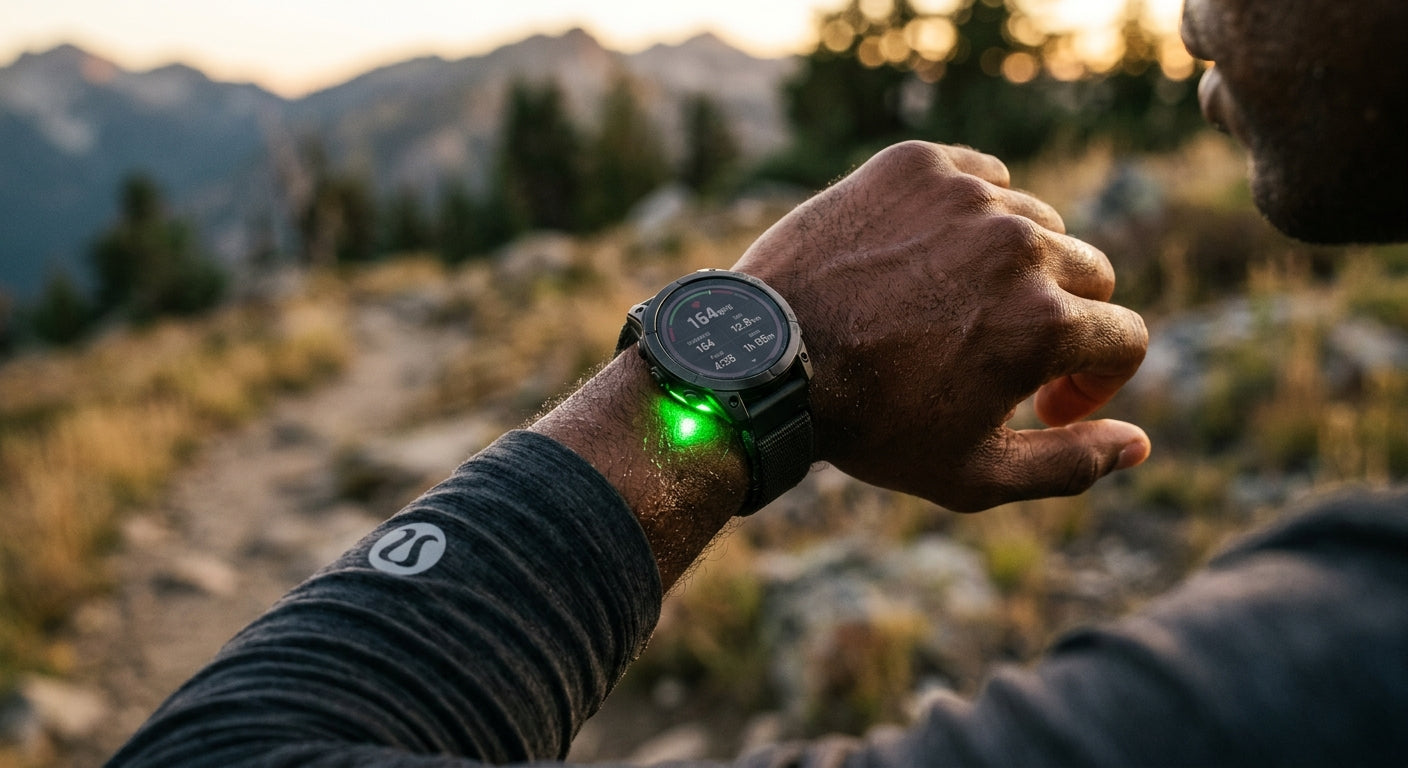
When selecting a monitoring device in 2026, users should prioritise multi-channel PPG arrays. These systems use multiple light wavelengths to penetrate the skin and map blood flow more accurately. If you are a cyclist, look for devices that offer Bluetooth and ANT+ connectivity, as this ensures compatibility with a wide array of head units and indoor training software.
For those who refuse to compromise on data integrity, dual-band chest straps are the gold standard. Look for models that incorporate ECG (electrocardiogram) sensors, which measure the electrical activity of the heart directly. These devices are far less affected by cold weather, which can often cause peripheral vasoconstriction and lead to inaccurate readings in wrist-based hardware.

Have a quick training or recovery question?
Get fast expert advice right here on the page—no sign-up, account, or app needed. Try asking Raye: 'What's the best way to relieve tight calves after a run?' Ask a question now
Evolution and History
The evolution of heart rate monitoring has transitioned from clinical, hospital-grade equipment to the compact wearables we see today. In the early 2010s, optical sensors were rudimentary, often failing to track heart rate at all during strenuous exercise. The mid-2020s marked a turning point with the integration of AI-driven signal processing, which allows sensors to filter out noise and motion more effectively than ever before.
Historically, the chest strap has been the undisputed king of accuracy. Developed for medical and athletic research, it relies on the same technology as an ECG machine. While the technology has remained largely consistent in its core function, modern straps have become lighter, more breathable, and more resistant to the corrosive effects of sweat, keeping them relevant despite the encroachment of wrist-based tech.
Special Features & Technical Specifications
Material Composition and Engineering
Modern chest straps utilise conductive polymer electrodes that require minimal moisture to initiate a signal. In contrast, wrist-based optical sensors are now encased in sapphire crystal or high-grade polycarbonate, shielding the LED arrays from damage. The internal circuitry has been miniaturised, allowing for larger battery capacities without increasing the overall weight of the watch.

Physical Dimensions and Weight
The average premium sports watch in 2026 weighs between 45g and 60g, with a thickness of roughly 12mm. Chest straps have seen a reduction in transmitter size, with most now measuring less than 30mm in width and weighing under 40g including the strap, ensuring they remain virtually unnoticeable during long-distance endurance events.
What to Expect in the future?
The future of heart rate monitoring lies in sensor fusion. We are likely to see the emergence of hybrid systems that combine optical wrist data with micro-sensors embedded in apparel. This would theoretically provide the ease of use of a watch with the clinical precision of a chest strap. Furthermore, as battery technology improves, we may see continuous, non-invasive blood pressure monitoring integrated alongside heart rate data.
Ultimately, the choice between wrist and chest depends on your specific training goals. If you are a casual fitness enthusiast, the modern optical sensor is more than sufficient. However, if you are training for a competitive edge where every beat per minute matters, the chest strap remains an essential tool in your kit bag.


