

Apple Watch Ultra 3 vs. Garmin Epix Pro: 2026 Endurance Showdown


Want to build strength to support your running?
Get targeted strength routines and mobility exercises designed specifically for runners directly on-site. Try asking Raye: 'What are 3 key gym exercises to improve running economy?' Get strength tips
What are the press saying?
The tech and fitness press have reached a consensus: we have arrived at the pinnacle of wrist-worn performance. The Apple Watch Ultra 3 is being hailed as the most intuitive ecosystem device ever crafted, while the Garmin Epix Pro remains the gold standard for data-driven athletes who refuse to compromise on battery longevity. Critics note that while Apple excels at day-to-day integration, Garmin continues to dominate in granular physiological metrics, leaving the choice down to whether you prioritise lifestyle convenience or raw athletic utility.
Comfort & Fit
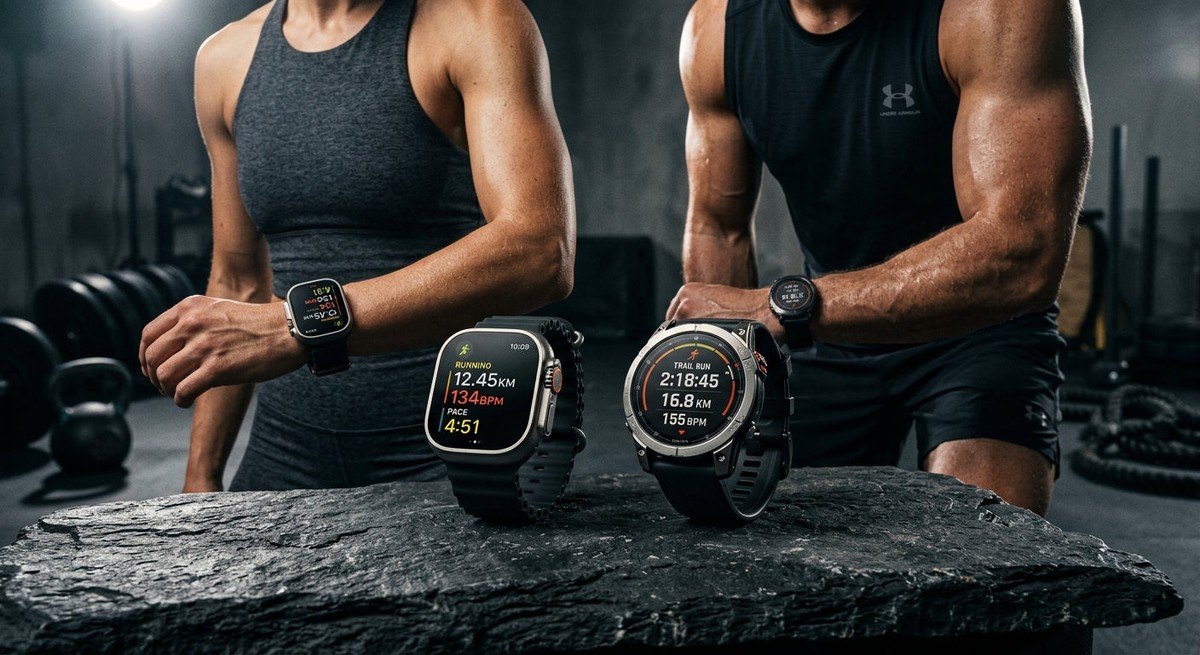
When considering ergonomics, both manufacturers have refined their design language for the 2026 season. The Apple Watch Ultra 3 maintains its rugged, industrial aesthetic, yet it sits surprisingly flush against the wrist, reducing snagging during technical trail runs. Its titanium chassis feels light despite its formidable size, catering well to those who prefer a premium, solid feel without the bulk.
Conversely, the Garmin Epix Pro offers multiple case sizes, allowing for a more bespoke fit. The silicone straps are supple yet durable, designed to maintain a consistent heart rate reading even during high-intensity interval training. While the Apple Watch leans towards a modern, sleek profile, the Garmin feels like a traditional instrument, built for those who appreciate a classic, tactile sports watch presence.
Features to Look out For
For the Apple user, the Ultra 3 introduces hyper-accurate dual-frequency GPS and a redesigned Action Button that integrates seamlessly with third-party training platforms. Its display luminosity reaches new heights, ensuring readability under the harshest midday glare. It is the ultimate companion for the fitness enthusiast who demands a device that functions as an extension of their smartphone.
Garmin’s Epix Pro, however, remains peerless in its depth of data. The inclusion of advanced endurance scores and real-time stamina tracking provides a level of insight that can genuinely alter a training session on the fly. Its offline mapping capabilities are arguably the best in the industry, offering peace of mind to ultra-runners and backcountry hikers who venture far beyond the reach of cellular signal.

Evolution and History
The journey to this 2026 showdown has been defined by rapid iteration. Apple transitioned from a smartwatch that could track fitness to a dedicated endurance tool, effectively bridging the gap between Silicon Valley software and mountaineering hardware. Each generation has seen a drastic improvement in power efficiency and sensor accuracy.

Have a specific performance goal in mind?
Get direct feedback on your training targets right here on the page—no sign-up or account required. Try asking Raye: 'How should I adjust my weekly mileage for a sub-20 minute 5K?' Ask about your goals
Garmin’s trajectory has been more evolutionary. By taking their proven Fenix line and injecting it with vibrant, high-resolution AMOLED displays, they successfully answered the consumer demand for beauty without sacrificing the rugged, utilitarian roots that defined their brand for decades. The Epix Pro is the culmination of years of feedback from professional athletes.
What to Expect in the future?
The horizon looks promising for the wearable sector. We expect the next generation to focus heavily on non-invasive metabolic monitoring, potentially including continuous glucose tracking and advanced hydration analysis. Both Apple and Garmin are racing to integrate AI-driven coaching that moves beyond mere suggestions, offering bespoke, dynamic training plans that adjust in real-time to your sleep, recovery, and stress levels.
Special Features & Technical Specifications
Material Composition
The Apple Watch Ultra 3 utilises aerospace-grade titanium with a sapphire crystal lens, ensuring maximum scratch resistance. The Garmin Epix Pro employs a fibre-reinforced polymer case with a titanium bezel and a scratch-resistant sapphire lens, prioritising structural integrity under extreme physical stress.
Physical Dimensions and Weight
The Ultra 3 measures 49mm, weighing in at approximately 61 grams. Garmin offers the Epix Pro in 42mm, 47mm, and 51mm variants, with weights ranging from 60 grams to 88 grams depending on the case size and band configuration, providing significantly more customisation for the user.
Engineering Changes
Apple has overhauled its S-series chip for improved efficiency, allowing for 72-hour battery life in low-power modes. Garmin has introduced the Gen 5 Elevate heart rate sensor, which features a wider array of LEDs to improve signal-to-noise ratios during chaotic, high-movement exercise, representing a significant leap in sensor fidelity over previous iterations.
Final Category Verdict
Choosing between these two titans is a matter of philosophy. If you are an athlete who lives within the Apple ecosystem and values seamless connectivity, health alerts, and a stunning interface, the Apple Watch Ultra 3 is the superior choice. If you are a performance-obsessed athlete who demands multi-week battery life, offline topographical superiority, and the most comprehensive training analytics available, the Garmin Epix Pro remains the undisputed champion of the endurance world.


