

Runners recovery habits for evening

The Ultimate Recovery Routine: How to Turn Sleep Into a Performance Weapon
For you to understand why your evening routine is actually your most important training session, firstly you have to look at the physiological transition from "active" to "repair." Most athletes treat sleep like a light switch—they expect to flip from 100% intensity to deep recovery the second their head hits the pillow.
The reality is, your body is more like a massive industrial factory. You can’t just cut the power and walk away; you need a proper "shutdown sequence" to ensure the machines aren't damaged and the maintenance crew can actually get to work. If you’ve been trashing your body in the gym but spending your evening scrolling through your phone and eating junk, you’re essentially building a high-performance engine on a cardboard chassis.
Fed up of being injured but want to listen to our content? Hit play on the podcast episode below
The Science of the Night Shift
For you to understand the necessity of this routine, firstly you have to look at your hormones. Sleep isn’t a passive state; it’s a high-stakes hormonal theatre.

Why Do You Keep Getting Injured?
It might not be bad luck. It could be your "Load Architecture." Discover your injury risk score and how to fix your training volume. Start the Free Assessment.
-
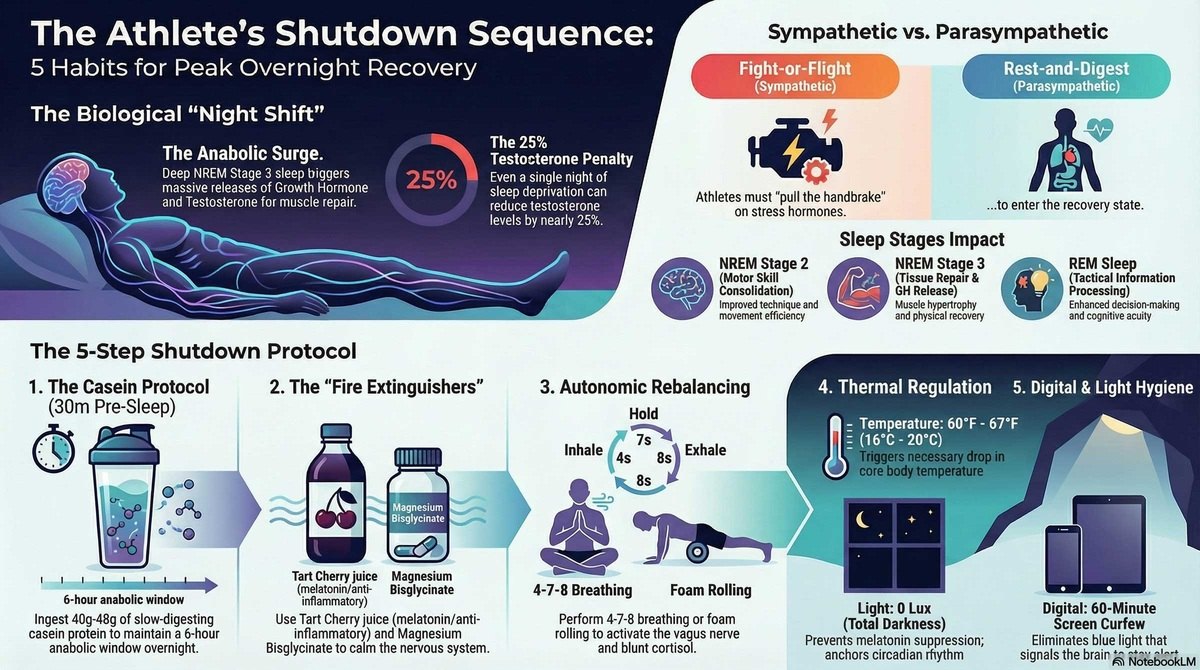
The Anabolic Surge: During deep sleep (NREM Stage 3), your body releases a massive wave of Growth Hormone (GH) and Testosterone. These are the "construction workers" that repair your muscle fibres and build strength.
-
The Cortisol Threat: If your sleep is fragmented, your body stays in a state of "catabolic dominance." This means Cortisol—the stress hormone—starts breaking down your hard-earned muscle for energy. Let’s be honest: one bad night of sleep can tank your testosterone by 25%.
| Sleep Stage | Primary Function | Impact on You |
| NREM Stage 2 | Motor Skill Consolidation | Improved technique and movement. |
| NREM Stage 3 | Physical Repair (GH Release) | Muscle hypertrophy and tissue repair. |
| REM Sleep | Cognitive Strategy | Better decision-making and tactical sharpness. |
Habit 1: The Casein Protocol (Slow-Burn Fuel)

For you to understand why casein is the gold standard for pre-sleep fuel, firstly you have to look at how it behaves in your stomach. Most people finish dinner at 7pm and don't eat again until 7am. That is a 12-hour fast where your body is looking for fuel and often finding it by breaking down your own muscle tissue.
The reality is, you need a slow-release "drip" of amino acids to stay anabolic all night. Casein protein is unique because it forms a "clot" in the stomach, slowing down digestion and providing a steady stream of fuel for up to 6 hours. It’s like putting a slow-burning log on the fire instead of a pile of dry kindling.
-
The Dose: Aim for 40g to 48g of Micellar Casein or a high-protein whole food like cottage cheese about 30 minutes before bed.
-
The Kicker: This bolus of protein can even increase your next-morning metabolic rate by 4%.

Habit 2: The Fire Extinguishers (Magnesium & Tart Cherry)
If you're training hard, your body is essentially on fire with inflammation. For you to understand how to put that fire out, firstly you have to look at your micronutrients.
-
Tart Cherry Juice: This is your natural melatonin anchor. It increases total sleep time by an average of 84 minutes and acts as a natural anti-inflammatory by inhibiting the COX-1 and COX-2 enzymes. It’s a "precovery" tool that helps you regain baseline strength 24% faster.
-
Magnesium Bisglycinate: Don't just grab the cheap stuff from the supermarket that gives you an upset stomach. Bisglycinate is bound to glycine, which calms the central nervous system. It acts as a natural calcium channel blocker, allowing your muscle fibres to finally relax.
Habit 3 & 4: Pulling the Autonomic Handbrake
If you've been training in the evening, you’re likely suffering from a "sympathetic hangover." Your heart rate is up, your core temperature is high, and your nervous system is still in fight-or-flight mode. You need to pull the handbrake.
-
Physical Down-Regulation: Spend 10 minutes on a foam roller. We’re not "breaking up knots"—we’re talking to the nervous system. Slow, deliberate rolling signals the brain to lower neuromuscular tension.
-
The 4-7-8 Breath: This is the fastest way to activate the vagus nerve. Inhale for 4, hold for 7, and exhale for 8. The long exhale is a physiological "stop" sign for your stress response.
Habit 5: The "Cave" Architecture
If you're still doing your evening emails in bed, you're living in the past. Your brain’s internal clock is incredibly sensitive to light and temperature.
-
The Cooling Imperative: Your core temperature must drop to initiate sleep. Keep your room between 16C and 20C.
-
The Warm Bath Paradox: A warm shower 90 minutes before bed actually cools you down. It draws the heat from your core to your skin, where it dissipates once you step out.
-
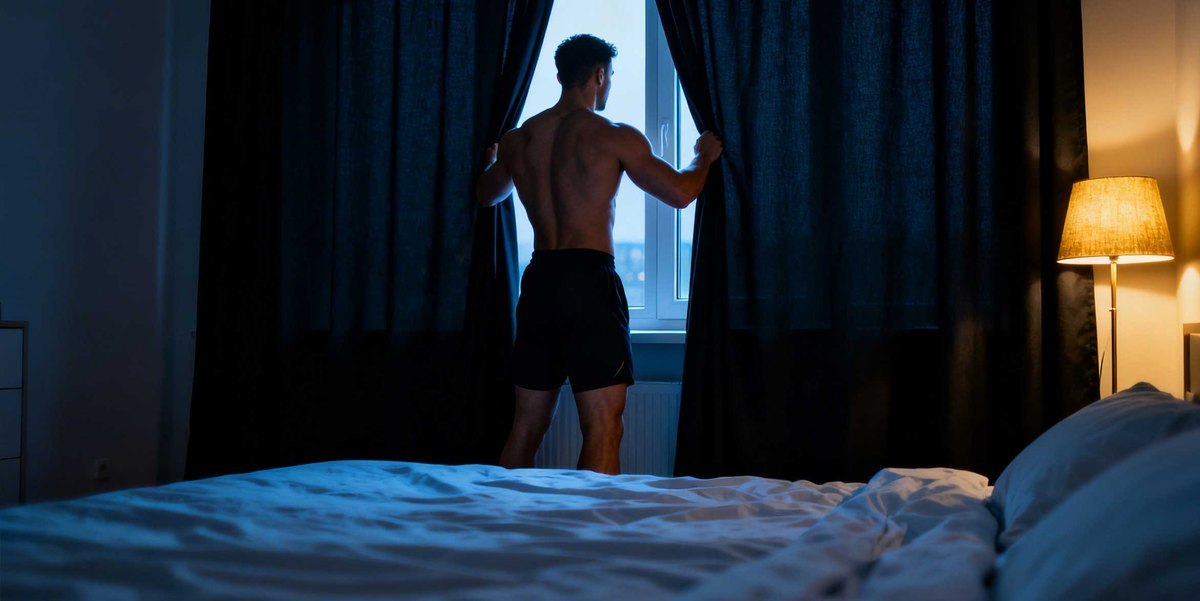
Total Darkness: Your room should be like a cave. Zero lux. Blackout curtains and no blue-light screens at least 60 minutes before bed. If your brain sees blue light, it thinks it's high noon in the Sahara and shuts down melatonin production.
The Ultimate Evening Checklist
-
Drink 240ml of Tart Cherry juice 2 hours before bed.
-
Implement a "Digital Sunset"—no screens 60 minutes before sleep.
-
Take 400mg of Magnesium Bisglycinate.
-
Consume 40g of Casein protein 30 minutes before bed.
-
Perform 5 minutes of 4-7-8 breathing once you're under the covers.
But here is the kicker: consistency is more important than perfection. If you can only manage two of these habits tonight, start there. The reality is, elite performance isn't built in the gym; it's built while you're dead to the world.
Runners Recovery Habits for Evening
For you to understand why your evening recovery is just as important as your morning intervals, firstly you have to look at the "repair window" that opens the second you close your eyes. Most runners think they get stronger on the road, but let’s be honest: you actually get stronger while you’re dead to the world. If you’re training like an elite athlete but recovering like a teenager on a gaming marathon, you’re basically redlining a high-performance engine while the oil is bone dry. Eventually, that chassis is going to crack.
The reality is, your body needs a proper "shutdown sequence" to move from the high-stress, "fight or flight" mode of training into a deep, restorative state. If you’re still scrolling through your phone and eating junk right before bed, you’re living in the past.
But here is the kicker: small, scientific tweaks to your evening can drastically change your morning performance. It’s that simple.
Top 10 Tips
Casein Protein
Consume 40-48g 30 minutes before bed for a slow release of amino acids to prevent muscle breakdown.
Tart Cherry Juice
Drink 240ml two hours before bed for natural melatonin and antioxidants to reduce inflammation.
Magnesium Bisglycinate
Helps calm the central nervous system and relax muscle fibres without upsetting your stomach.
Deliberate Foam Rolling
Spend 10-20 minutes on major muscles to lower tension and blunt the sympathetic nervous system.
4-7-8 Breathwork
Inhale 4s, hold 7s, exhale 8s. This activates the vagus nerve, forcing a parasympathetic recovery state.
Progressive Muscle Relaxation
Tense for 5s, release for 10s. This lowers cortisol and helps mitigate performance anxiety.
Warm Bath or Shower
The rapid cooling when you step out triggers the drop in core body temperature needed for sleep.
Cool Bedroom
Keep it between 16°C and 20°C. A cool room is a biological prerequisite for sleep onset.
Pitch-Black Cave
Use blackout curtains and avoid blue light 60 minutes prior to prevent the suppression of melatonin.
Consistent Wake-Up Time
Keep a fixed wake-up time to anchor your 24-hour circadian clock and improve sleep efficiency.

Stuck in the "Grey Zone"?
If you aren't getting faster, you might be running your easy days too hard. Take our 9-question quiz to optimise your intensity zones. Unlock Your Potential.
Top 10 Tips for The Ultimate Evening Recovery Routine
-
Consume 40g to 48g of casein protein 30 minutes before sleep. Casein forms a clot in your stomach, providing a slow and steady release of amino acids for up to 6 hours to prevent overnight muscle breakdown and boost overnight muscle protein synthesis.
-
Drink 240ml of tart cherry juice. Consuming tart cherry juice twice daily, or two hours before bed, provides natural melatonin to increase total sleep time and antioxidants to reduce inflammation and muscle pain.
-
Take magnesium bisglycinate. Supplementing with magnesium bisglycinate helps calm your central nervous system, relax muscle fibres, and improve sleep onset without upsetting your gastrointestinal tract.
-
Perform slow, deliberate foam rolling. Spending 10 to 20 minutes on self-myofascial release (SMR) for major muscle groups like the quads, glutes, and upper back lowers neuromuscular tension and blunts the sympathetic nervous system.
-
Practice autonomic breathwork like the 4-7-8 technique. Inhaling for 4 seconds, holding for 7, and exhaling for 8 seconds acts as a physiological "stop" sign for stress, activating the vagus nerve to force the body into a parasympathetic recovery state.
-
Use Progressive Muscle Relaxation (PMR). Tense a specific muscle group for 5 seconds while inhaling, then completely release it for 10 seconds while exhaling to lower cortisol, lower your heart rate, and mitigate performance anxiety.
-
Take a warm bath or shower 1 to 2 hours before bed. The warm water draws heat from your core to your skin; when you step out, the rapid cooling triggers the necessary drop in core body temperature to initiate sleep.
-
Keep your bedroom between 16C and 20C (60F to 67F). A cool room is a biological prerequisite that enables the natural decline in your core body temperature needed for sleep onset.
-
Create a pitch-black "cave" and implement a screen curfew. Avoid blue light from screens 30 to 60 minutes before bed, and use blackout curtains or eye masks to achieve zero lux darkness, which prevents the suppression of natural melatonin production.
-
Maintain a consistent wake-up time. Keeping a fixed wake-up time within a 30-minute window, even on weekends and during travel, is critical for anchoring your 24-hour circadian clock and improving overall sleep efficiency.


