

Performance Forever: How to Build a Body That Lasts : 10 Dos and 10 Donts


Dealing with a nagging injury or tightness?
Get instant recovery guidance, stretching protocols, and rest advice right now without leaving the site. Try asking Raye: 'What are the best stretches to relieve tight calves after a long run?' Get recovery advice
The fitness landscape has shifted. We have moved beyond the era of simple activity tracking and aesthetic pursuits into a far more sophisticated paradigm: the era of the "Quantified Self" and the "Digital Twin." For the high-performing individual, the goal is no longer just a faster 10k or a specific body fat percentage. The objective is now "healthspan"-the capacity to maintain high-level physical and cognitive function indefinitely...
Listen on the go. Click play below
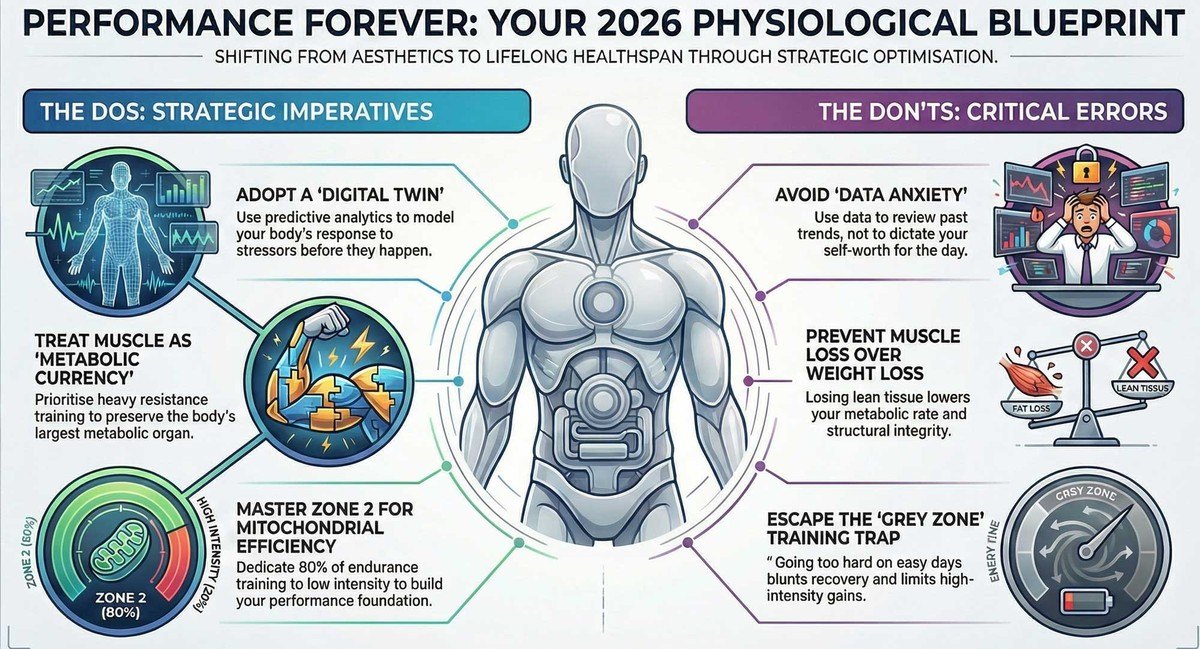
In 2026, the successful athlete treats their body as a high-value asset. This report synthesises current industry data, metabolic studies, and emerging trends to provide a comprehensive strategy for the year ahead. We have distilled this complex ecosystem into twenty core pillars: ten strategic imperatives to adopt, and ten critical errors to eliminate.
This is not about motivation; it is about methodology. It is about playing the long game.
Top 10 Dos
Integrate "Digital Twins"
Move beyond descriptive to predictive analytics to model your physiological response.
Prioritise Muscle Preservation
View muscle not as bulk, but as "metabolic currency" you can spend later in life.

Have a quick training or recovery question?
Get fast expert advice right here on the page—no sign-up, account, or app needed. Try asking Raye: 'What's the best way to relieve tight calves after a run?' Ask a question now
Embrace Hybrid Training
Develop "strength endurance" to avoid the "interference effect" blunting your gains.
Master Zone 2 Training
Train at 60-70% max HR to stimulate mitochondrial biogenesis and efficiency.
Regulate the Nervous System
Shift from "fight or flight" to "rest and digest" through somatic release.
Leverage "Third Spaces"
Social connection is a primary determinant of exercise adherence and resilience.
Optimise Recovery
Create a vascular "pumping" mechanism by alternating heat and cold exposure.
Implement Precision Nutrition
Support hybrid training with targeted chemistry: Creatine, Electrolytes, and Protein.
Train for "Healthspan"
Measure success by functional metrics like VO2 Max and Grip Strength.
Utilise AI as a Tool
Let the algorithm suggest the numbers; let your body dictate the execution.
Strategic Imperatives (The Top 10 Dos)
1. Do Integrate "Digital Twins" and Predictive Biometrics
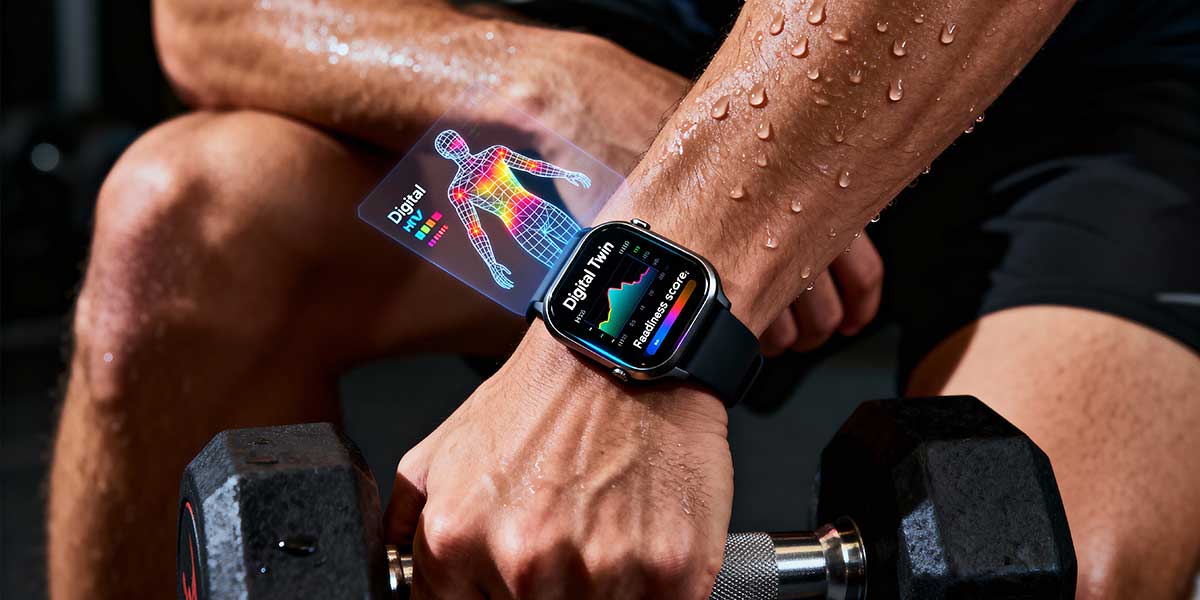
The era of reactive health tracking is over. In 2026, the gold standard for performance technology is the "Digital Twin"-a dynamic, virtual representation of your physiology that evolves in real-time. Originating from engineering protocols used to simulate spacecraft behaviour, this concept has been adapted to human biology to predict outcomes before they manifest physically.
The Strategy: Move beyond descriptive analytics (what you did) to predictive analytics (what you should do). By integrating continuous streams of data-heart rate variability (HRV), blood glucose, and sleep architecture-algorithms can now model how your specific physiology will respond to stressors.
Implementation:
-
System of Systems: Ensure your wearable device communicates with your nutrition logs and strength metrics.
-
Autoregulation: Consult your data daily. If your model predicts a high risk of fatigue based on autonomic stress, adjust your training intensity immediately. This is not "taking a day off"; it is strategic resource management.
2. Do Prioritize Muscle Preservation via Heavy Resistance
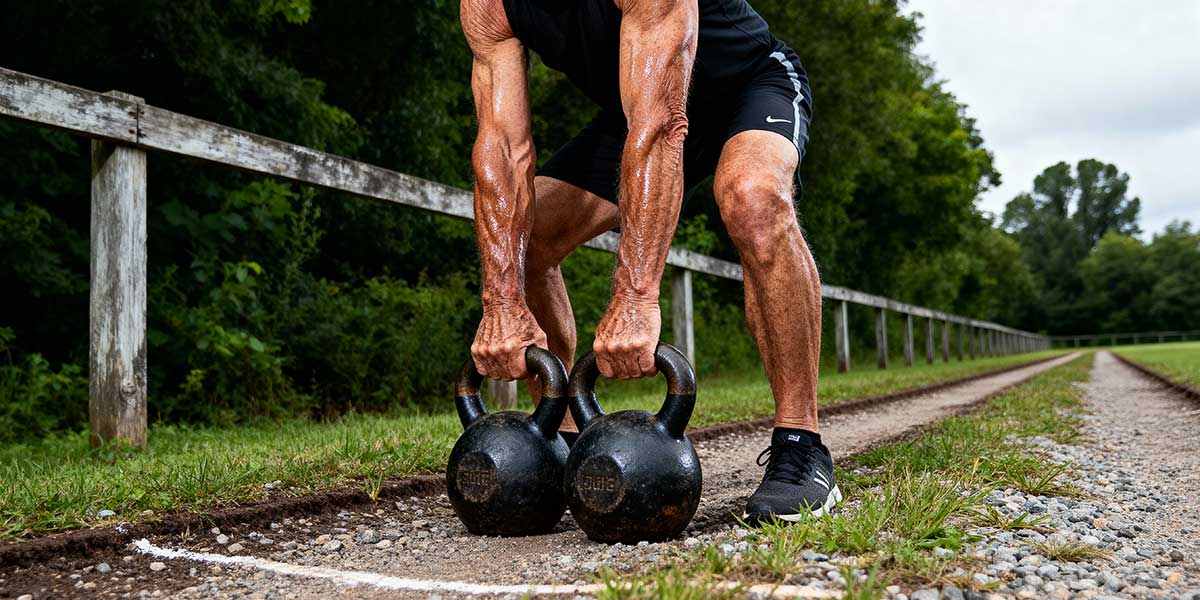
Muscle is the body's largest metabolic organ. It is the primary site for glucose disposal and the armour that protects the skeletal system. While cardiovascular health remains vital, the preservation of Type II (fast-twitch) muscle fibres is the defining factor in functional longevity.
The Strategy: Traditional aerobic exercise is insufficient for preserving fast-twitch fibres. You must engage in heavy resistance training. This provides the mechanical loading necessary to stimulate osteoblasts (bone-forming cells) and maintain metabolic flexibility.
Implementation:
-
Anchor your weekly programme with 2-3 days of heavy resistance training.
-
Focus on multi-joint compound movements (squats, deadlifts, presses) that allow for progressive overload.
-
View muscle not as aesthetic bulk, but as "metabolic currency" that you can spend later in life.
3. Do Embrace Hybrid Training (The Rise of the Functional Athlete)
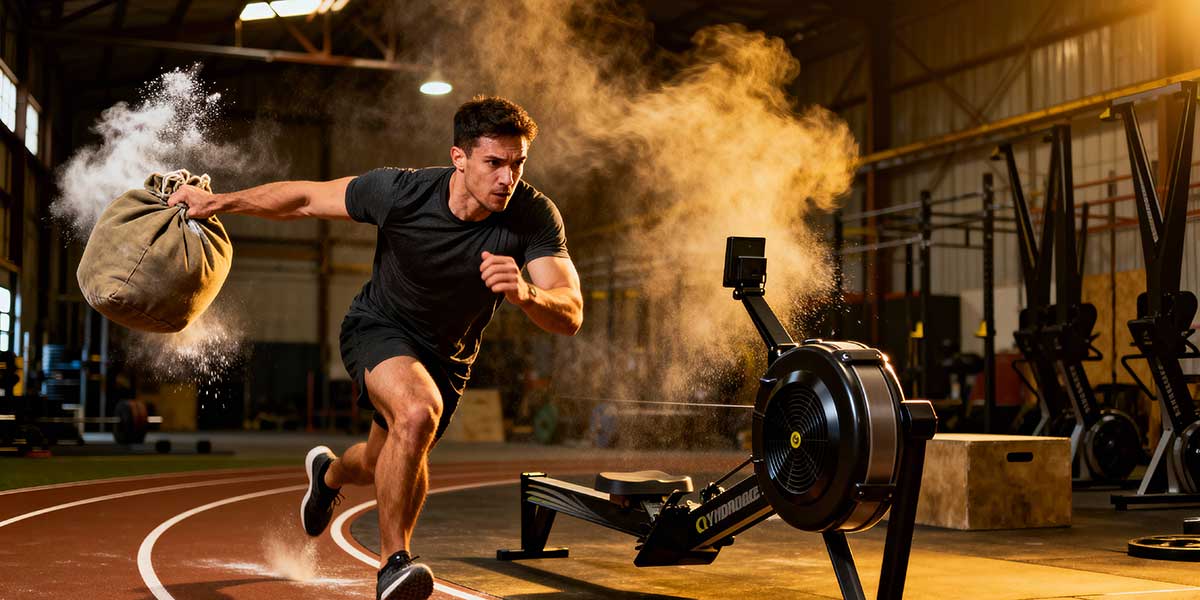
The segmentation of fitness into "endurance" versus "strength" camps has effectively dissolved. The modern high-performer is a "Hybrid Athlete," capable of exerting force repeatedly over time while maintaining a high aerobic ceiling. This shift is exemplified by the explosion of functional fitness racing events like HYROX.
The Strategy: Develop "strength endurance." This requires the ability to run efficiently immediately after heavy lower-body exertion-a skill known as "compromised running." This mimics real-world demands and forces the body to clear lactate efficiently while under mechanical stress.
Implementation:
-
Adopt a concurrent training model.
-
Combine modalities: Pair running with upper-body strength or rowing with lunges to practice transitioning between energy systems without the "interference effect" blunting your gains.
4. Do Master Zone 2 Training for Mitochondrial Efficiency
While High-Intensity Interval Training (HIIT) has its place, the sophisticated trainee understands that the foundation of performance is built at low intensities. Zone 2 training is the engine room of longevity.
The Strategy: Train at 60-70% of your maximum heart rate. At this specific intensity, the body preferentially utilises fatty acids for fuel, stimulating mitochondrial biogenesis (the creation of new mitochondria) and improving the efficiency of the electron transport chain. This improves your ability to transport and utilise lactate as fuel.
Implementation:
-
The Talk Test: If you cannot speak in full sentences, you are training too hard.
-
Volume: Dedicate approximately 80% of your total endurance volume to this zone. It builds the capillary density required to support high-intensity efforts later.
5. Do Regulate the Nervous System Through Somatic Movement
In an increasingly high-stress digital world, the ability to down-regulate the nervous system is a competitive advantage. "Somatic Movement" focuses on interoception (internal sensing) to release chronic tension patterns that traditional stretching cannot reach.
The Strategy: Utilise slow, conscious movements to "reset" the resting length of muscles by engaging the brain's motor cortex. This shifts the body from a Sympathetic ("fight or flight") state to a Parasympathetic ("rest and digest") state, which is where all recovery and adaptation occur.
Implementation:
-
Integrate "exercise snacks" of somatic movement throughout the day.
-
Use techniques like pelvic tilts or "body scanning" to identify holding patterns and signal safety to the brainstem.
6. Do Leverage "Third Spaces" for Community Connection
The gym is no longer just a place to sweat; it is a "Third Space"-a social environment distinct from home and work. Research consistently highlights that social connection is a primary determinant of exercise adherence and mental resilience.
The Strategy: Do not be a lone wolf. The external accountability and oxytocin release associated with group movement provide a powerful antidote to professional burnout.
Implementation:
-
Join a "tribe"-whether a run club, a CrossFit box, or a competitive league.
-
Treat your training partners as part of your performance team.
7. Do Optimise Recovery with Contrast Therapy
Recovery has graduated from passive rest to active protocol. Contrast therapy-the alternating exposure to heat and cold-is now a standard tool for vascular and neurological health.
The Strategy: Create a vascular "pumping" mechanism. Heat causes vasodilation (expanding blood vessels), while cold causes vasoconstriction (constricting vessels). Alternating between the two flushes out metabolic byproducts and reduces inflammation.
Implementation:
-
Heat: 3-5 minutes (Sauna/Hot Tub).
-
Cold: 1-3 minutes (Plunge/Ice Bath).
-
Rounds: 3-4 cycles.
-
Note: Avoid cold immersion immediately after hypertrophy training (within 4 hours) as it may blunt the acute inflammatory signal required for muscle growth.
8. Do Implement Precision Nutrition and Supplementation
The "one-size-fits-all" approach is obsolete. Precision wellness utilises biomarkers to tailor intake.
The Strategy: Support the demands of hybrid training with targeted chemistry.
-
Creatine Monohydrate: Essential not just for muscle, but for cognitive support and reducing mental fatigue.
-
Electrolytes: Critical for neuromuscular function, especially for those utilising saunas or high-volume training.
-
Protein: For the high-performing athlete, an intake of 1.6g to 2.2g per kilogram of body weight is recommended to support synthesis and prevent catabolism.
9. Do Train for "Healthspan" and Functional Longevity
The overarching philosophy is "Longevity Living." The goal is to function at a high level for decades to come.
The Strategy: Measure success by functional metrics that correlate with life expectancy and quality of life.
-
VO2 Max: The strongest predictor of all-cause mortality.
-
Grip Strength: A proxy for overall neuromuscular vitality.
-
Balance and Stability: Critical for injury prevention.
10. Do Utilise AI as a Tool, Not a Master
Artificial Intelligence offers incredible capabilities for data processing and programming. However, it lacks intuition.
The Strategy: Use AI to analyse volume load, sleep trends, and programming structure. Use human intuition (or a professional coach) to assess biomechanics, emotional context, and readiness.
Implementation:
-
Let the algorithm suggest the numbers; let your body dictate the execution.
Top 10 Don'ts
Don't Succumb to "Data Anxiety"
Use data as a "lagging indicator" to review trends, not a "leading indicator" that determines your outlook.
Don't Neglect Muscle Maintenance
Prioritise protein intake and resistance training above all else during any weight-loss phase.
Don't Blindly Follow AI Workouts
Use AI for the maths, but seek professional eyes for the movement.
Don't Get Stuck in the "Grey Zone"
Keep easy days strictly in Zone 2. If you feel like you "worked out," you likely went too hard.
Don't Neglect Mobility
"Garbage in, garbage out." Treat mobility as a performance enhancer, not a chore.
Don't Isolate in the Digital Bubble
Schedule one weekly session with a group. Social glue will sustain your consistency.
Don't Commit Specificity Errors
Don't skip the "brick" sessions. You must condition your neuromuscular system for competition.
Don't Under-Fuel Post-Workout
Consume protein and carbohydrates within the recovery window. Coffee is not a meal.
Don't Chase Fads Over Fundamentals
A trend is supported by data; a fad is supported by marketing. Know the difference.
Don't Ignore the "Joy of Missing Out"
Prioritising restoration is a valid training decision. Embrace JOMO.
Critical Errors (The Top 10 Don'ts)
1. Don't Succumb to "Data Anxiety" (Orthosomnia)
While data offers insight, obsession leads to "orthosomnia"-where the stress of tracking sleep disrupts sleep quality.
The Error: allowing a wearable device to dictate your self-worth or capability for the day. This can induce a "nocebo effect," where you perform poorly simply because a screen told you that you were not recovered. The Fix: Use data as a "lagging indicator" to review trends, not a "leading indicator" that determines your daily outlook.
2. Don't Neglect Muscle Maintenance
With the rise of weight-management medications and strategies, there is a risk of "sarcopenic obesity"-low muscle mass despite normal body fat.
The Error: Prioritising weight loss over body composition. Losing weight at the expense of lean tissue lowers your metabolic rate and structural integrity. The Fix: Prioritise protein intake and resistance training above all else during any weight-loss phase.
3. Don't Blindly Follow AI Workouts
AI cannot see your knees collapsing inward during a squat.
The Error: Performing complex lifts prescribed by an app without having the requisite mobility or technique. The Fix: Use AI for the maths (sets/reps), but seek professional eyes for the movement. Do not outsource your biomechanics to an algorithm.
4. Don't Get Stuck in the "Grey Zone" (Zone 3)
This is the "Black Hole" of training: too hard to be easy, too easy to be hard.
The Error: Turning every "recovery run" into a steady-state effort because running slowly requires discipline. The Fix: Polarise your training. Keep easy days strictly in Zone 2. If you finish a recovery run feeling like you "worked out," you likely went too hard.
5. Don't Neglect Mobility and Fascial Health
In the pursuit of heavy lifts and fast splits, mobility is often the first casualty.
The Error: Skipping the warm-up or cool-down to save time. This restricts range of motion and limits the hypertrophy stimulus of exercises (a partial squat builds less muscle than a full squat). The Fix: "Garbage in, garbage out." Treat mobility as a performance enhancer, not a chore.
6. Don't Isolate Yourself in the Digital Bubble
Home gyms are efficient, but isolation is a performance killer.
The Error: Viewing fitness solely as a solitary grind. The Fix: Leverage the "Third Space." Even if you train at home, schedule one weekly session with a group. The competitive drive and social glue will sustain your consistency when motivation wanes.
7. Don't Commit Specificity Errors
You cannot excel at a hybrid event by training like a specialist.
The Error: Training running and lifting on separate days without ever combining them. The Fix: Don't skip the "brick" sessions. You must condition your neuromuscular system to run on "jelly legs" to prepare for the reality of competition.
8. Don't Under-Fuel Post-Workout
Fasting has benefits, but timing is everything.
The Error: Delaying food intake for hours after a high-intensity session. This extends the cortisol spike induced by exercise, keeping the body in a catabolic (breakdown) state. The Fix: Consume protein and carbohydrates within the recovery window. This initiates repair and lowers stress hormones. Coffee is not a meal.
9. Don't Chase Fads Over Fundamentals
The industry thrives on novelty; your body thrives on consistency.
The Error: Investing in esoteric bio-hacks while neglecting sleep, protein, and progressive overload. The Fix: "Majoring in the minors" yields minimal returns. A trend is supported by data; a fad is supported by marketing. Know the difference.
10. Don't Ignore the "Joy of Missing Out" (JOMO)
The pressure to "do it all" can lead to mental burnout.
The Error: Letting FOMO drive training decisions, leading to overtraining and anxiety. The Fix: Embrace JOMO. It is strategically sound to skip a high-intensity session in favour of a somatic walk or extra sleep if your physiological data demands it. Prioritising restoration is a valid training decision.
Conclusion
The path to performance in 2026 is defined by integration. It is no longer sufficient to be just a runner, or just a lifter, or just a data-tracker. The successful individual integrates the precision of technology with the intuition of the body; the intensity of hybrid training with the restorative power of Zone 2; and the convenience of AI with the essential need for community.
By adhering to these strategic imperatives, you are not merely building a "summer body." You are building a physiology that is resilient, metabolically flexible, and capable of high performance for decades to come.
The Sundried Roundup
What are the pros doing? They are Hybrid Athletes. They have stopped specialising. They lift heavy, run long, and use "Digital Twins" to predict their recovery needs before they even wake up.
How can I build this into my life? Start with the "Big Rocks." Schedule 3 days of resistance training and 2 days of Zone 2 cardio. Use your commute or lunch break for "exercise snacks" (somatic movement) to regulate stress.
The budget approach? Gravity and the pavement are free. Master the bodyweight squat, the press-up, and the Zone 2 run. Prioritise sleep-it is the most effective performance enhancer available, and it costs nothing.
Middle of the road approach, I am serious but not all in yet? Invest in a quality wearable to track HRV and sleep. Join a local run club or functional fitness class once a week for community accountability. Focus your nutrition on high protein and hydration.
Pushed for time, how can I keep up? Intensity over duration, but be smart. If you only have 30 minutes, focus on "strength endurance"-moving a moderate weight quickly with minimal rest. This hits both aerobic and anaerobic systems.
I have 3 hours a week, what can I do? Prioritise strength. Muscle mass is harder to gain and easier to lose than aerobic capacity. Do two 45-minute full-body strength sessions and two 45-minute brisk walks (Zone 2) or energetic play with the family.
I can fit in training 7 days a week. How can I maximise this? Be careful. The risk here is "junk volume." You must polarise your training. 80% of your work should be easy (Zone 2, mobility, somatic flow). Only 20% should be high intensity. If you go hard 7 days a week, you will burn out or break.
The premium approach? I want to chuck everything at this. Hire a coach to programme your "Digital Twin" data. Invest in a home sauna and cold plunge for contrast therapy. Utilise regular blood panels to customise your supplementation stack.
Top Tip Consistency beats intensity. A mediocre plan followed consistently is infinitely better than a perfect plan followed sporadically. Play the long game.


