

Hill Climbing for Fitness: The Ultimate Guide to Incline Training


Need performance advice right now?
Ask our on-site coach anything about your routines. It's completely free and available immediately right here: 'What are 3 quick exercises for ankle mobility?' Ask Raye for free
Why the Incline is Your Best Workout
When you are several thousand metres at altitude and miles away from anywhere, the only sound you can hear is a distant aeroplane and the melting ice turning into the start of a river.
If you are in Switzerland, add some fitness training into your holidays; when it comes to mountain climbing and hiking, you really would struggle to beat it. And a great thing about it is you're doing an intense workout on your own holiday, and you're taking in the scenery in the great outdoors. For me, climbing to the top of the mountain is such a great accomplishment and so much fun....
Listen on the go to our podcast episode on Hill Climbing for Fitness
You struggle to find a nation who enjoys the mountains as much as the Swiss-it really is their playground. Of course, they've got the skiing. They've got the hiking, they've got the mountain biking, they've got the climbing, mountaineering, downhill mountain biking-you name it. If there's a way to slip, slide, ride, or challenge yourself, then the Swiss are already doing it.
For fitness, I'm testing out two different types of climbing. One is climbing up a steep ski piste, and I will get the gondola down, so that is 8 km of flat terrain to 1 km of elevation-so pretty steep. Then I'll be testing that against a longer walk with half the elevation gain, so a lot more gentle.
If you want to really hit your CV hard, be out of breath, and pack in a full workout, then all day long you're going to be better with a shorter, steep climb. Especially if you are at altitude, you're gonna find yourself having to stop to let yourself catch a breath. If you've come from sea level and you're climbing at 2000m, everything is going to be harder, especially if you want a steep gradient pushing yourself close to threshold training. A long, slower climb will be a nice steady burn. Your heart rate won't spike and it'll be a much more comfortable experience, giving you time to take in the views.
When it comes to climbing in the mountains, then a step forward is definitely not equal to a step forward up a steep hill. If your elevation gain is going to be a kilometre, you are lifting your body weight up maybe 2,000 times. Imagine doing 2,000 squats back-to-back without preparing for it.

Need a clear race fuelling strategy?
Get instant, practical advice on hydration and race-day nutrition directly on this page for free. Try asking Raye: 'How many grams of carbs should I take per hour during a half marathon?' Ask for fuelling advice
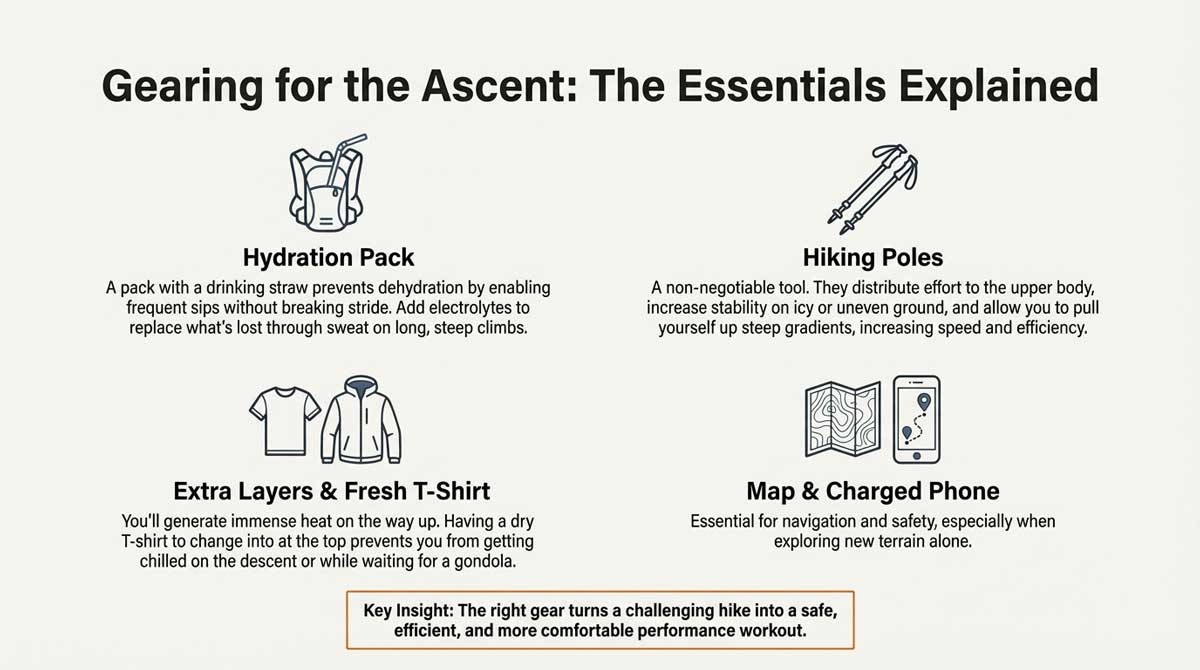
When it comes to hiking, unless there is extreme weather, your kit list really doesn't need to be too much. A hydration pack is an absolute must when I go on the slopes. Of course, it's not essential, but it saves having to stuff your pockets with a water bottle or take your backpack off every time you wanna drink. If you've got a straw coming out of your backpack, you can grab a sip whenever you need one and stop yourself getting dehydrated. Also, it's worth putting some electrolytes into your water because after doing three hours of hiking at a steep gradient, you are gonna sweat an awful lot.
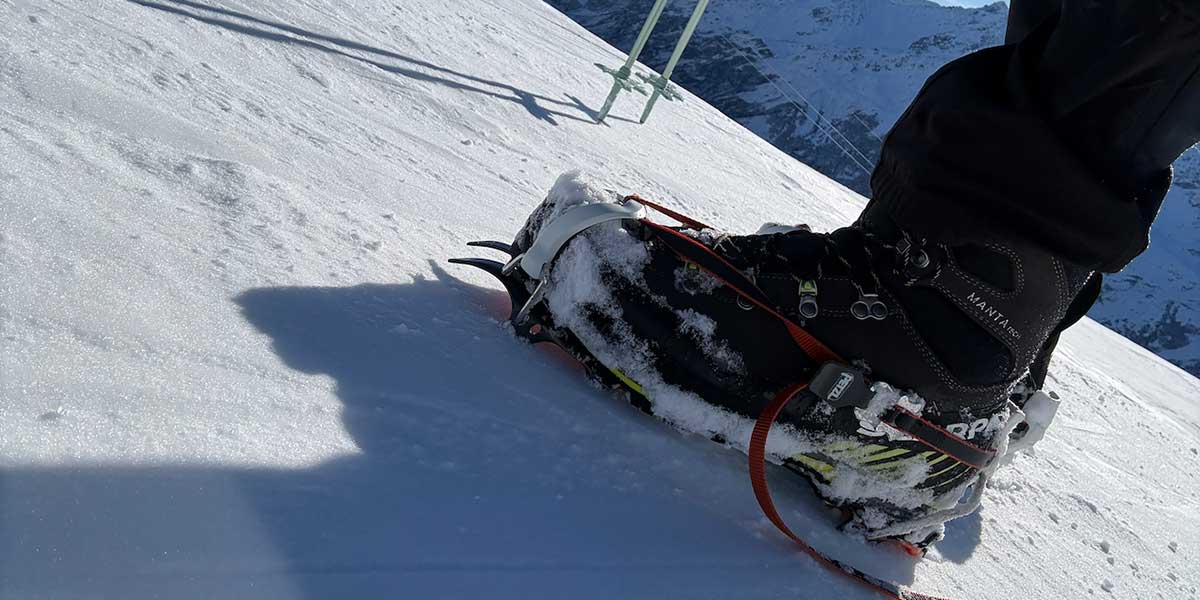
Other things you may not think of: if you're gonna stop at the top, or even if you're gonna wait for a gondola to come down, having a fresh T-shirt to slip on is just a nice-to-have. Rather than sitting in a sweaty T-shirt for the next hour or climbing downhill where you're not working as hard in a damp T-shirt, I would say it's an essential piece of kit. Hiking boots go without fail, and if you check out the YouTube video you'll see my review of the Scarpa hiking boots along with crampons.
A Quick Guide to Mountaineering Boots
Since I mentioned the boots, I've got to explain something that catches a lot of people out. If you pick up a proper technical mountaineering boot, you'll notice the sole is rock hard. It's not because they forgot to make it comfortable; it's actually a brilliant piece of engineering that turns your foot into a stable platform.
Here is why you need that stiffness and how to pick the right pair.
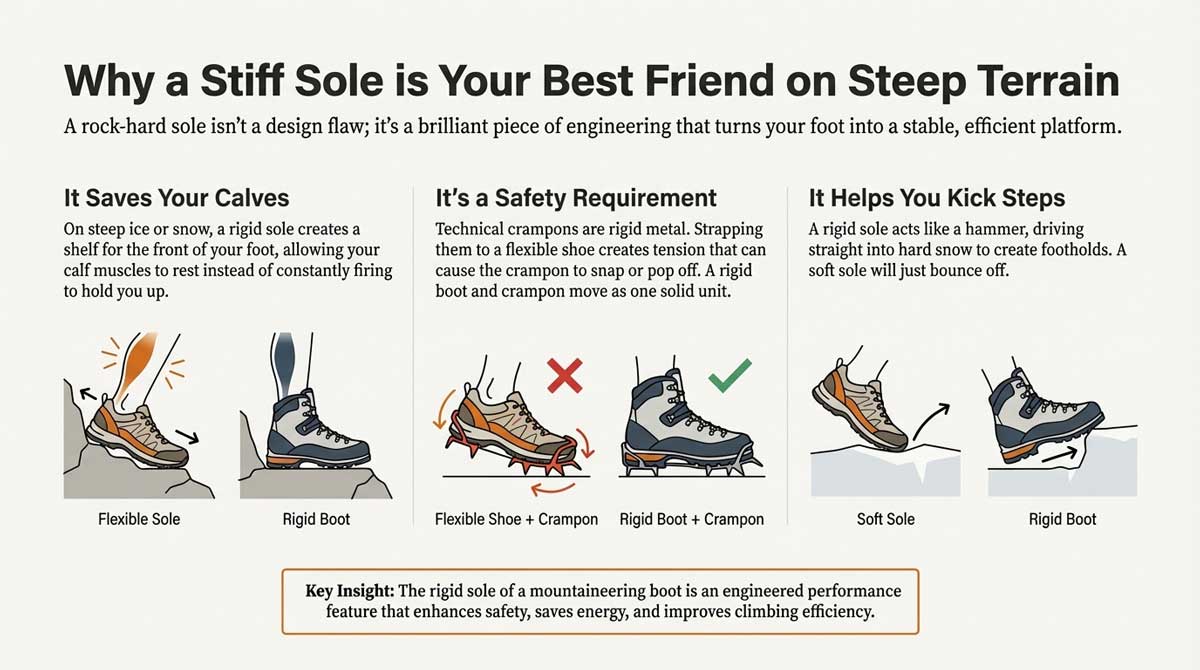
Why the stiff sole? If you tried to climb vertical terrain in a flexible running shoe, you are gonna have a hard time.
-
Save your calves: When you are climbing steep ice or snow, you're often standing on just the front inch of your boot. If your sole bends, your heel drops, and your calf muscles have to fire constantly just to hold you up. With a rigid sole, the boot acts like a shelf. You kick it in, and the boot supports your weight so your muscles can rest.
-
Safety first: This is huge. Technical crampons are made of rigid steel. If you strap a metal bar to a flexible sneaker, the shoe bends and the metal doesn't. That tension can cause the metal to snap or the crampon to pop right off mid-climb. You need the boot and the crampon to move as one solid unit.
-
Kicking steps: In hard snow, you often have to kick your own steps. A rigid sole acts like a hammer, driving straight into the snow. A soft sole is just going to bounce off and you'll probably end up with bruised toes.
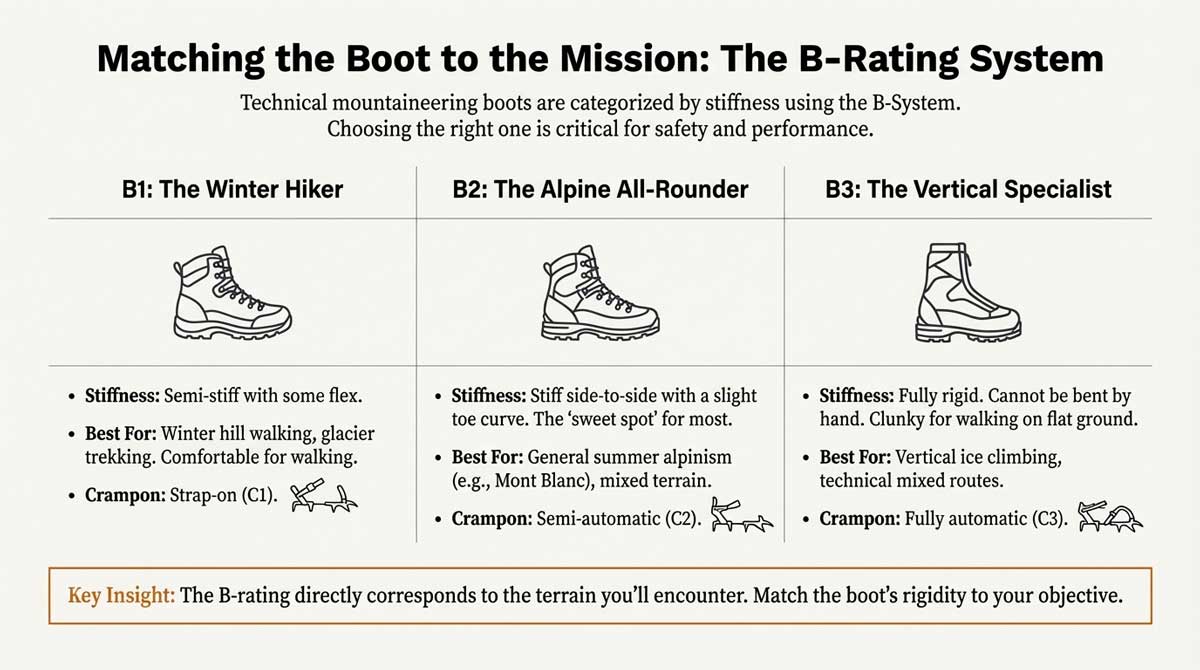
The Options: The B-Rating System Mountaineering boots are categorized by the "B-System." It sounds technical, but it's actually pretty simple.
-
B1 (The Winter Hiker): These are semi-stiff. They have a bit of flex at the ball of the foot so you can walk comfortably, making them perfect for winter hill walking or glacier trekking. They work with "strap-on" (C1) crampons.
-
B2 (The Alpine All-Rounder): This is the sweet spot for most people. They are stiff side-to-side but have a tiny bit of flex or a curve at the toe so you can walk normally. These are great for summer alpinism (like Mont Blanc) and usually take "semi-automatic" crampons (the ones with a heel clip).
-
B3 (The Specialist): These are fully rigid-you literally cannot bend them with your hands. Walking on the flat feels a bit clunky, like wearing ski boots, but if you are on vertical ice walls, they are essential. These take "fully automatic" crampons that click into both the toe and the heel for a rock-solid fit.
Warmth & Build: Single vs. Double Boots Once you know the stiffness, you just need to decide on the build.
-
Single Boots: These are like your standard shoe-one integrated unit. They are lighter and great for technical climbing, but if they get wet inside, they are a pain to dry out.
-
Double Boots: These have a hard outer shell and a removable soft inner bootie. If you are doing a multi-day expedition, these are a total game changer. You can take the inner bootie out and dry it inside your sleeping bag at night, ensuring you put on warm, dry boots in the morning.
-
Integrated Gaiter Boots: This is the modern stuff. It's usually a B3 boot zipped inside a waterproof outer cover. They are super warm, aerodynamic, and you don't have laces catching on your crampons.
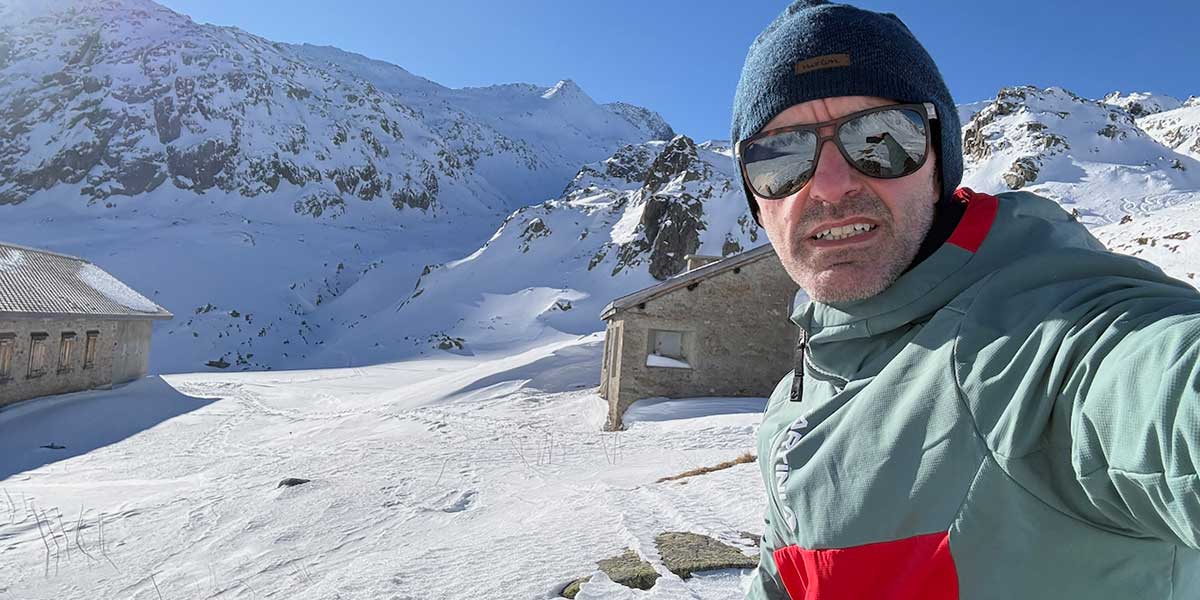
Hiking poles-this is an amazing hack for all times of the year. In the winter it's gonna stop you sliding, and it can really spread out your centre of gravity where it gets a bit icy. You can use your arms to really help pull yourself up steep gradients, and you'll notice how much faster you are than people who are not using poles. I'm currently using Black Diamond fold-up ski poles and I must admit they're incredible. They have cork handles, they're so light, and they come with the snow baskets. And as they fold down, they easily fit into your suitcase, and when you're not using them, you can just pack them down and tuck them in the pocket of your backpack.
Make sure you get yourself a good hiking map if you're in an area you've not walked before, especially if you're going on your own. Make sure your phone is fully charged and you have plenty of liquid and extra layers just in case it does get colder. You'll most likely end up stripping off a few layers if you're going up a steep hill because you're gonna get a lot hotter than you realise. And the calorie burn is going to be worth it.
The Visual Guide to Fitness in the Mountains
The Science Bit: Why The Hills Win
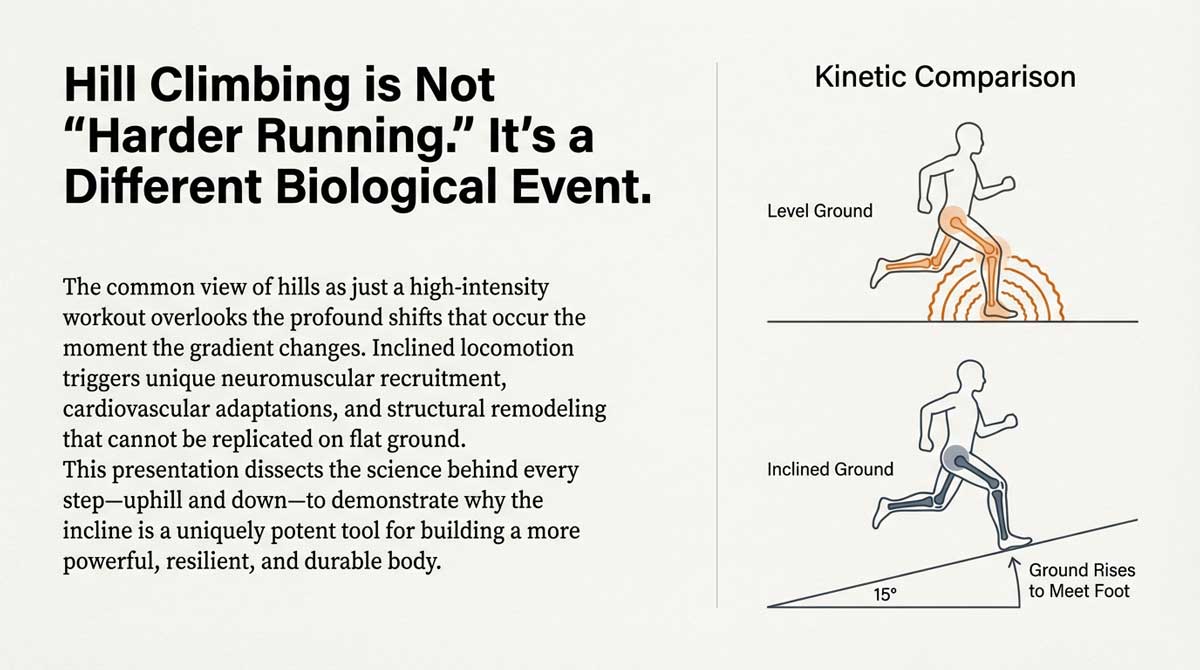
I've been digging into the research on this, and it turns out hill climbing isn't just "harder walking." It is actually a totally different beast for your body. The scientists have a lot to say about why heading up a gradient is superior to slogging it out on the flat.
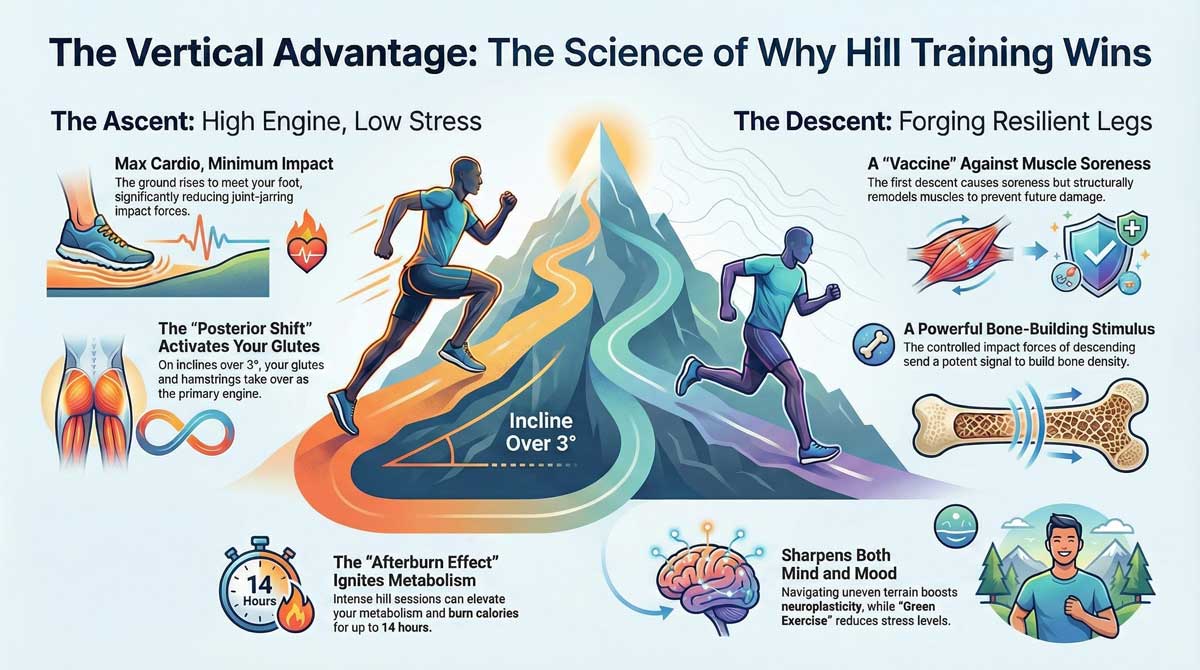
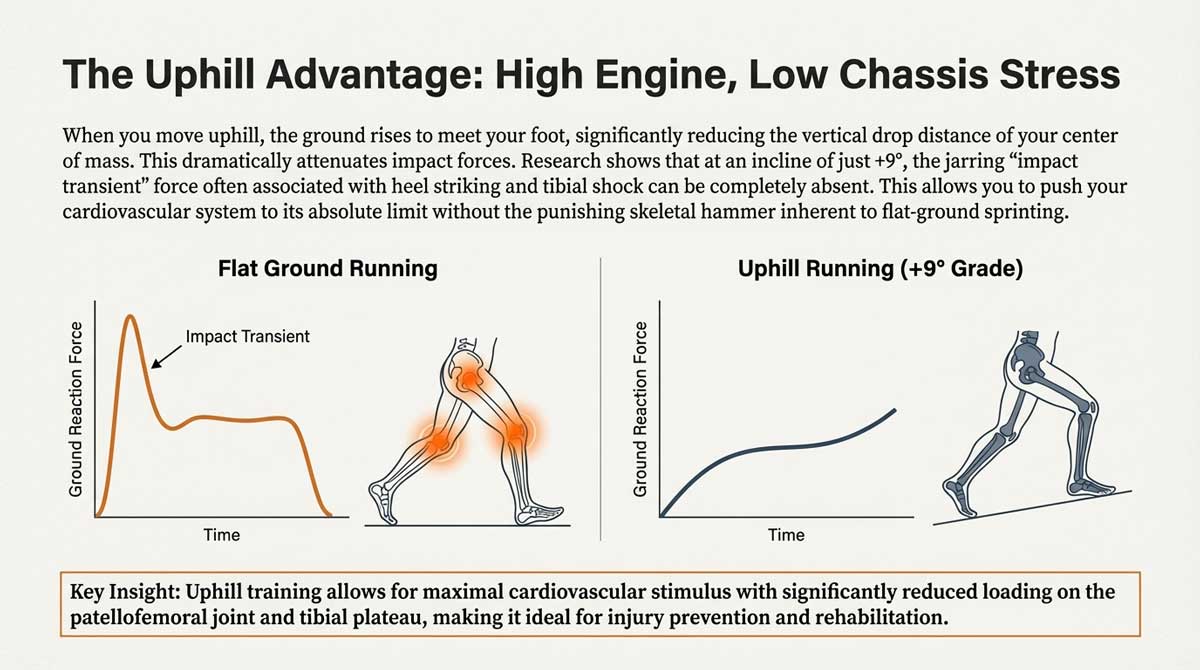
High Engine, Low Chassis Stress This is my favourite takeaway from the research. When you run on the flat, you are hammering your joints with impact every time you land. But when you head uphill, the ground "rises" to meet your foot. The science shows that the impact forces are way lower. It creates a training environment they call "high engine, low chassis stress." Basically, you can push your heart and lungs to the absolute max-getting that elite-level cardio stimulus-without smashing your knees and hips to pieces. It's perfect if you want to get fit but you're worried about old injuries.
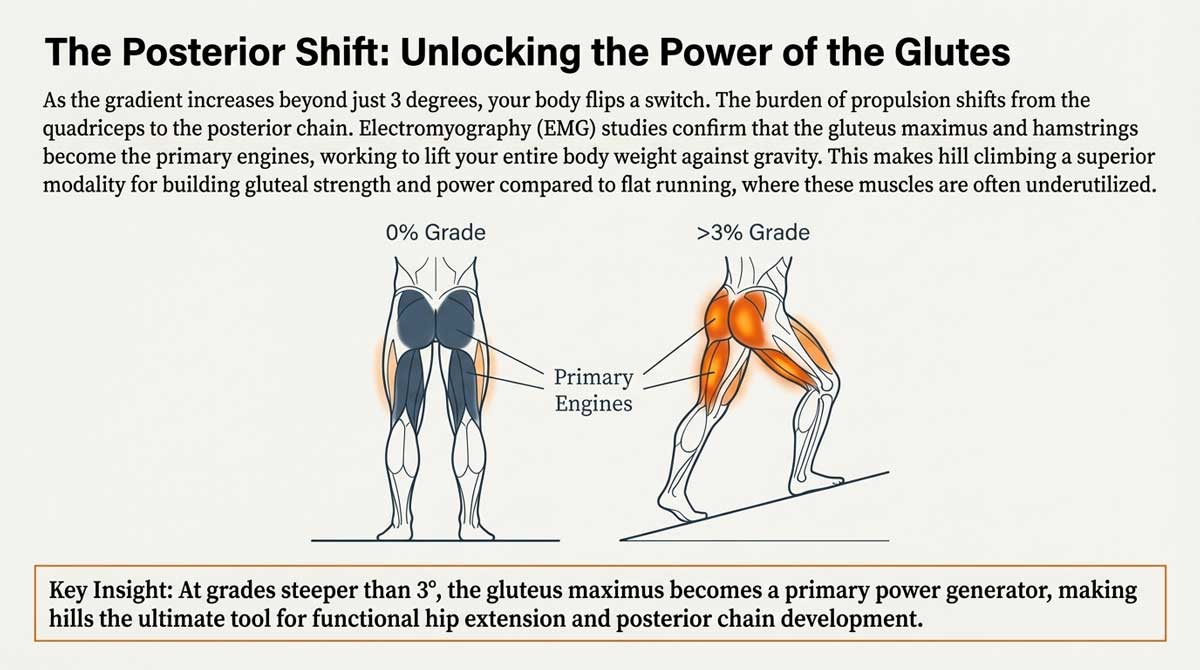
The "Posterior Shift" (The Glute Gain) We all know hills burn, but the research confirms exactly where it's working. As soon as the gradient goes over just 3 degrees, your body flips a switch. It moves from using your quads to a "posterior shift." That means your glutes and hamstrings take over as the main engine to lift your body weight against gravity. The studies show that on steep hills, your glutes are working harder than almost any other muscle. So if you want to build strength in your backside, the mountains are far superior to the treadmill.
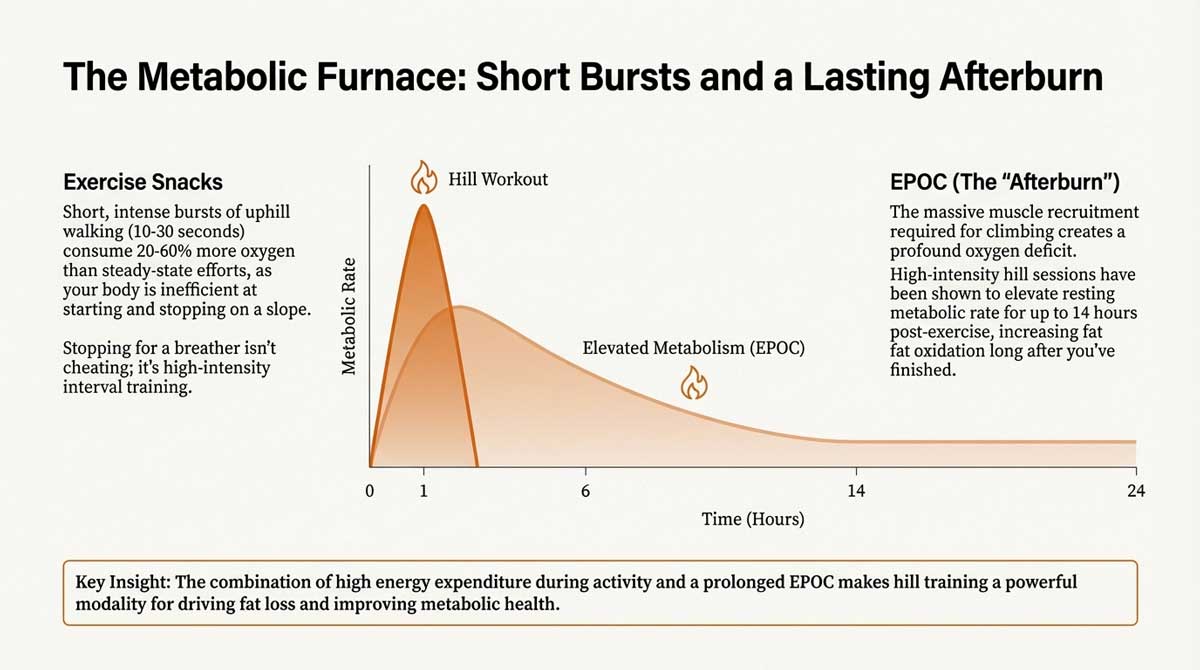
Stopping for a Breather? (The "Exercise Snack" Bonus) If you find yourself stopping to catch your breath, don't worry-science says you are actually burning more calories. There is a concept called "exercise snacks." The research shows that short, intense bursts of uphill walking consume 20-60% more oxygen than steady plodding. Because your body is so inefficient at starting and stopping on a steep slope, those little breaks mean you are constantly rebooting the system, which incurs a higher metabolic cost. So, stopping to look at the view isn't cheating; it's interval training.
The "Afterburn" is Real On top of that, there is the EPOC (Excess Post-Exercise Oxygen Consumption). Because hill climbing recruits so much muscle mass, it creates a massive oxygen deficit. Research suggests that a high-intensity hill session can elevate your metabolism for up to 14 hours after you finish. That means you are still burning fat while you're sitting on the sofa recovering with a drink.
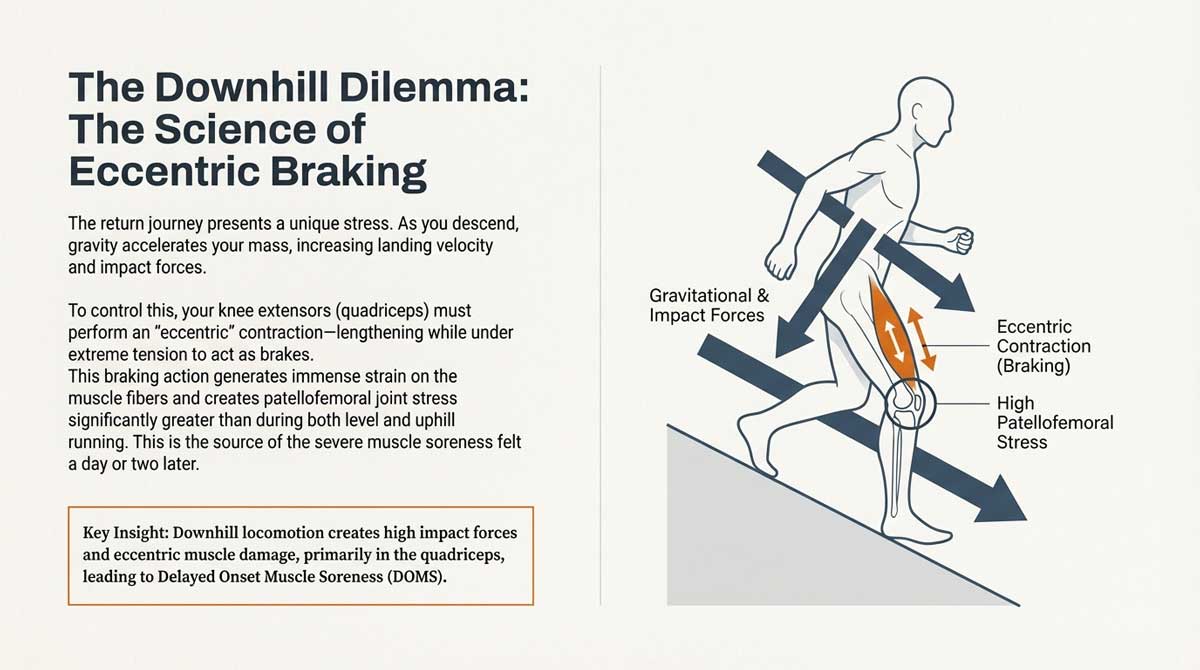
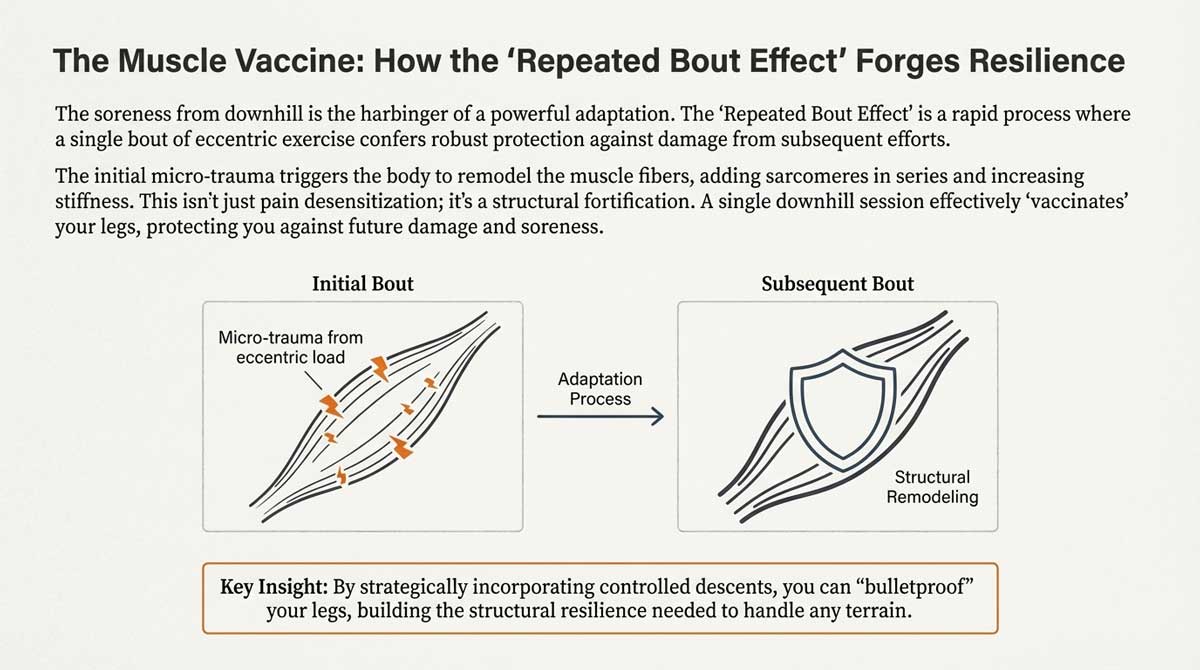
Don't Fear the Downhill (The Vaccine Effect) We usually hate the downhill because it makes our legs sore the next day. That soreness is caused by "eccentric loading"-where your muscles lengthen under tension to put the brakes on. But here is the cool part: the scientists call it the "Repeated Bout Effect." It is basically a vaccine for your muscles. When you do a downhill session, you might get sore the first time, but your muscle fibres actually remodel themselves to become stronger and stiffer. It protects you against future damage. So, if you can get through that first sore day, you have effectively bulletproofed your legs for the rest of the trip.
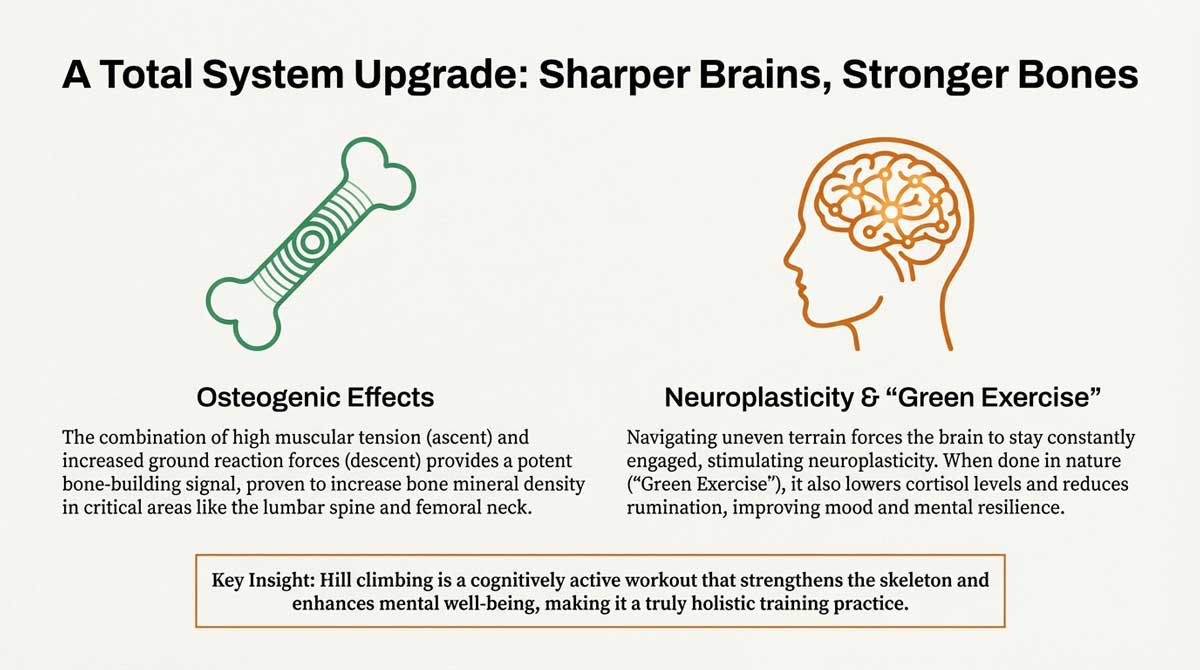
Green Exercise Finally, there is the mental side. They call it "Green Exercise." The data shows that exercising in nature lowers your cortisol (stress) levels and improves your mood way more than doing the same workout in a gym. Navigating uneven ground also forces your brain to stay switched on to watch your footing, which stimulates neuroplasticity. So you're not just training your legs; you're keeping your brain sharp too.
The science backs it up: if you want to get fit, save your joints, and feel good, the only way is up.
10 Scientific Reasons to Hit the Hills
I've dug into the research, and the benefits of heading up a gradient are incredible. It's not just about burning calories; it is about rebuilding your body from the ground up. Here are the top 10 reasons why you need to find a hill:
-
High Engine, Low Chassis Stress This is the holy grail of training. When you run on the flat, you hammer your joints with impact. But on a hill, the ground "rises" to meet your foot, which slashes the impact force on your knees and hips. You get an elite-level heart rate workout (high engine) without smashing your skeleton to pieces (low chassis stress).
-
The "Posterior Shift" (The Ultimate Glute Workout) On flat ground, you rely heavily on your quads. But the research shows that as soon as the incline hits just 3 degrees, your body performs a "posterior shift." Your glutes and hamstrings take over as the main engine to lift your body weight. If you want to strengthen your backside, the hills are scientifically superior to the flat.
-
The 14-Hour Afterburn Hill climbing creates a massive oxygen deficit because you are engaging so much muscle mass. This triggers something called EPOC (Excess Post-Exercise Oxygen Consumption). The science suggests a hard hill session can keep your metabolism elevated for up to 14 hours after you finish. You are literally burning fat while you sit on the sofa that evening.
-
The "Downhill Vaccine" We all dread the sore legs after walking downhill, but that soreness is actually a good thing. It is called the "Repeated Bout Effect." That first session acts like a vaccine; it remodels your muscle fibres to be stronger and stiffer. Once you get through that first sore day, you are effectively inoculated against future damage and your legs become bulletproof.
-
Walking is Often Smarter Than Running There is an "efficiency paradox" on steep hills. The science shows that once the slope gets steep (over 30%), walking is actually mechanically more efficient than running. Even the pro "Vertical Kilometre" racers switch to a power hike on the steepest bits to save their energy stores. So, if you drop to a walk, you aren't quitting-you're being tactical.
-
A Hidden Core Workout You might not feel it happening, but your core is working overtime on a hill. Your obliques (side abs) have to fire up to stop your torso from twisting, and to stabilise your body as you lean forward. It is a functional core workout without doing a single crunch.
-
Brain Training (Neuroplasticity) If you are off-road, every step is different. Your brain has to constantly scan the ground and adjust your feet to avoid rocks and roots. This "cognitively active" walking stimulates neuroplasticity-it keeps your brain sharp and improves your balance and reaction times way more than zoning out on a treadmill.
-
Exercise "Snacks" Burn More If you have to stop to catch your breath, don't feel guilty. The research shows that short, intense bursts of uphill walking (10-30 seconds) actually consume 20-60% more oxygen than steady pacing because your body is so inefficient at starting and stopping on a slope. Those little stops turn your walk into a high-intensity interval session.
-
Stronger Bones Walking on the flat is okay, but it doesn't do much for bone density. The high tension of climbing and the impact of the descent provide the signal your body needs to lay down new bone tissue. It is one of the best ways to fight off osteoporosis and keep your skeleton strong as you age.
-
Green Exercise Beats the Gym Finally, the "Green Exercise" effect is real. Studies show that the combination of physical effort and nature lowers cortisol (stress) levels significantly more than the same exercise indoors. It reduces anxiety and gives you a sense of mastery that you just don't get from a machine.
The Real-World Test: Steep vs. Long
I didn't just want to read the science; I wanted to test it out myself. I tracked two very different hikes here in Switzerland using my heart rate monitor to see how the numbers stacked up.
Climb 1: The Lung Buster (Andermatt)
The Strategy: High intensity up, gondola down.
For this session, I went for pure intensity. I hiked straight up a steep ski piste in Andermatt-a relentless uphill grind. To keep the focus entirely on the uphill engine (and save my knees), I rode the gondola back down.
Climb 2: The Scenic Route (Realp)
The Strategy: Long distance, up and down.
This was a more traditional hike over in Realp. It was double the distance of the first climb but with less overall elevation per kilometre. Because I walked back down, there were long periods of recovery where my heart rate dropped, making it a much gentler day out.
The Head-to-Head Stats
| Metric | Climb 1 (Steep Piste) | Climb 2 (Long Walk) | The Difference |
| Distance | 8.20 km | 16.06 km | I had to walk twice as far in Realp to burn the same calories. |
| Elevation Gain | 951 m | 706 m | The steep climb packed nearly 1km of vertical into a short distance. |
| Active Calories | 1,292 kcal | 1,250 kcal | Almost identical burn, proving that gradient is a calorie multiplier. |
| Total Calories | 1,558 kcal | 1,621 kcal | The long walk burned slightly more total, simply because I was out for longer. |
The Heart Rate Story
This is where you really see the difference in training stimulus.
1. The Threshold Test (Zone 4)
-
Steep Climb: 15% of the time (30 mins)
-
Long Walk: 4% of the time (11 mins)
The Verdict: The steep climb forced me to work at my "Threshold" (hard effort) for nearly three times as long. If you want to improve your VO2 max and get fit fast, the steep gradient is the winner.
2. The Fat Burning Zone (Zone 3)
-
Steep Climb: 35% of the time (1 hr 08 mins)
-
Long Walk: 30% of the time (1 hr 22 mins)
The Verdict: Both walks were great for aerobic conditioning, but the steep climb kept me in this zone more consistently because there were no downhill breaks to let my heart rate drop.
3. The Recovery Zone (Zone 1)
-
Steep Climb: 20% of the time (38 mins)
-
Long Walk: 37% of the time (1 hr 42 mins)
The Verdict: On the long walk, I spent a massive 1 hour 42 minutes in Zone 1 (Warm Up). This was mostly during the descent. While the steep climb was "all work," the long walk offered plenty of active recovery.
My Takeaway
The numbers don't lie. If you are short on time and want a serious fitness hit, tackling a steep gradient like a ski piste is unbeatable-I burned over 1,200 active calories in half the distance of the longer walk. However, the longer walk in Realp was a much more comfortable experience; the lower heart rate meant I could enjoy the conversation and the scenery without gasping for air!
