

7 Technical Hacks to Maintain Running Efficiency Through Winter


Need performance advice right now?
Ask our on-site coach anything about your routines. It's completely free and available immediately right here: 'What are 3 quick exercises for ankle mobility?' Ask Raye for free
Optimising Biomechanical and Physiological Efficiency in Winter Running Environments: A Technical Analysis
Running in winter environments presents a multifaceted challenge that extends far beyond simple thermal discomfort. For the high-performing athlete, the drop in temperature is not merely a nuisance; it is a variable that imposes a quantifiable "Winter Tax" on metabolic efficiency. This tax is driven by a complex interplay of thermoregulatory strain, altered ground reaction forces, aerodynamic drag from bulky apparel, and respiratory heat loss...
Inspired to run right now? Click play on our podcast episode and soak in the content.
... We do not aim our training at the "summer body" or temporary peaks. We focus on the long game: treating the body as a high-value asset that must perform indefinitely. Consequently, winter training is not about "toughing it out" or relying on fleeting motivation. It is about biological strategy. It is about understanding the physics of the environment and engineering a solution to maintain output.
To effectively mitigate these inefficiencies, it is necessary to rigorously define the physiological burden of cold exposure and the biomechanical penalties imposed by traditional defensive strategies. This baseline analysis establishes the "problem space" within which we can apply seven specific technical hacks to optimise performance.
The Baseline: Quantifying the "Winter Tax"
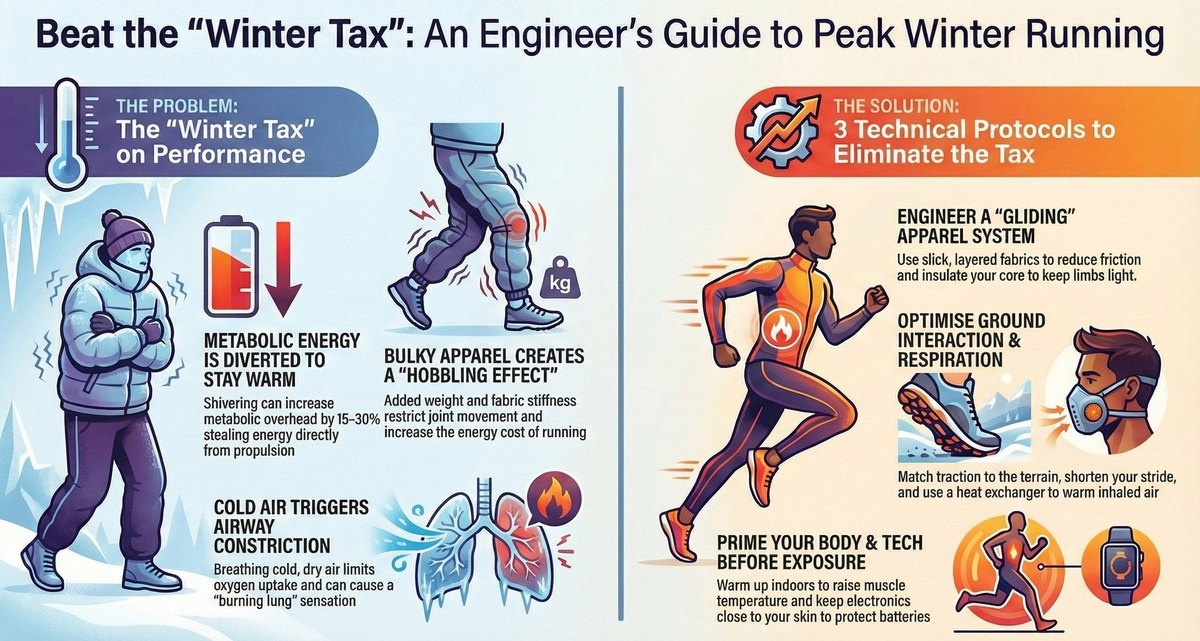
Before implementing solutions, we must understand the inefficiencies we are combatting. In temperate conditions, running economy-the oxygen cost (VO2) required to transport the body over a given distance-is relatively stable. In winter conditions, this cost is elevated by distinct physiological mechanisms that divert energy away from locomotion.
When exposed to cold, the human body prioritises the defence of core temperature over locomotor efficiency. The primary mechanism is peripheral vasoconstriction, a response that reduces blood flow to the "shell"-comprising the skin, subcutaneous fat, and skeletal muscle. While this preserves vital organ function, it creates a temperature gradient that negatively impacts muscle contractility and metabolic efficiency.

Need a clear race fuelling strategy?
Get instant, practical advice on hydration and race-day nutrition directly on this page for free. Try asking Raye: 'How many grams of carbs should I take per hour during a half marathon?' Ask for fuelling advice
If heat loss continues to exceed metabolic heat production-a scenario common during warm-ups, rest intervals, or long slow distance runs in extreme cold-the body engages in shivering thermogenesis. Shivering is an involuntary, asynchronous contraction of skeletal muscle fibres that effectively converts chemical energy into heat but contributes zero propulsive force. Clinical studies have demonstrated that in significant cold, metabolic overhead can rise by 15-30% solely due to this thermoregulatory defence. For the runner, this presents a significant "dual-task" interference. Metabolic energy that would otherwise be directed toward propulsion is diverted to the furnace.
Furthermore, the cardiovascular system operates at a higher load to support thermoregulation before the first running stride is even taken. Research indicates an increase in stroke volume and cardiac output in cold exposure, reducing the cardiac reserve available for high-intensity exercise.
Simultaneously, traditional winter apparel introduces a mechanical penalty known in occupational physiology as the "hobbling effect." Winter systems are often designed to mitigate heat loss through mass. However, added mass-particularly when placed distally on the legs-increases the moment of inertia, requiring greater hip flexor torque to accelerate the leg. Combined with the restriction of joint range of motion caused by stiff fabrics, the runner faces a direct conflict between thermal protection and biomechanical freedom.
To eliminate this tax, we execute the following seven technical protocols.
Hack 1: Advanced Material Physics - The "Active Insulation" Paradigm
The traditional approach to winter dressing-"layering up"-often leads to a catastrophic failure mode in running: the overheating-sweating-freezing cycle. As metabolic heat production ramps up during the run, sweat is produced. If this moisture is trapped by heavy insulation, it reduces the thermal resistance of the clothing. When the runner stops or slows down, the wet clothing conducts heat away from the body rapidly (water's thermal conductivity is roughly 25 times that of air), leading to post-exercise chill and potential hypothermia.
The technical hack lies in utilising advanced materials that decouple thermal insulation from weight and breathability: specifically, Aerogel and Phase Change Materials (PCMs).
Aerogel Integration Aerogel, often termed "frozen smoke," represents a paradigm shift in insulation technology. Originally developed for aerospace applications, it is the lightest solid material known, composed of over 90% air trapped in a silica nanostructure. Its thermal conductivity is exceptionally low because the nanopores are smaller than the mean free path of air molecules, effectively nullifying gas-phase heat conduction.
For the athlete, the application of aerogel in apparel solves the bulk problem identified in the "hobbling effect." A thin layer of aerogel composite can provide thermal retention equivalent to lofted down or heavy fleece at a fraction of the thickness. By replacing thick mid-layers with millimetre-thin aerogel panels, you maintain the full range of motion in the shoulder and hip girdles, preserving the arm swing mechanics essential for efficient running economy.
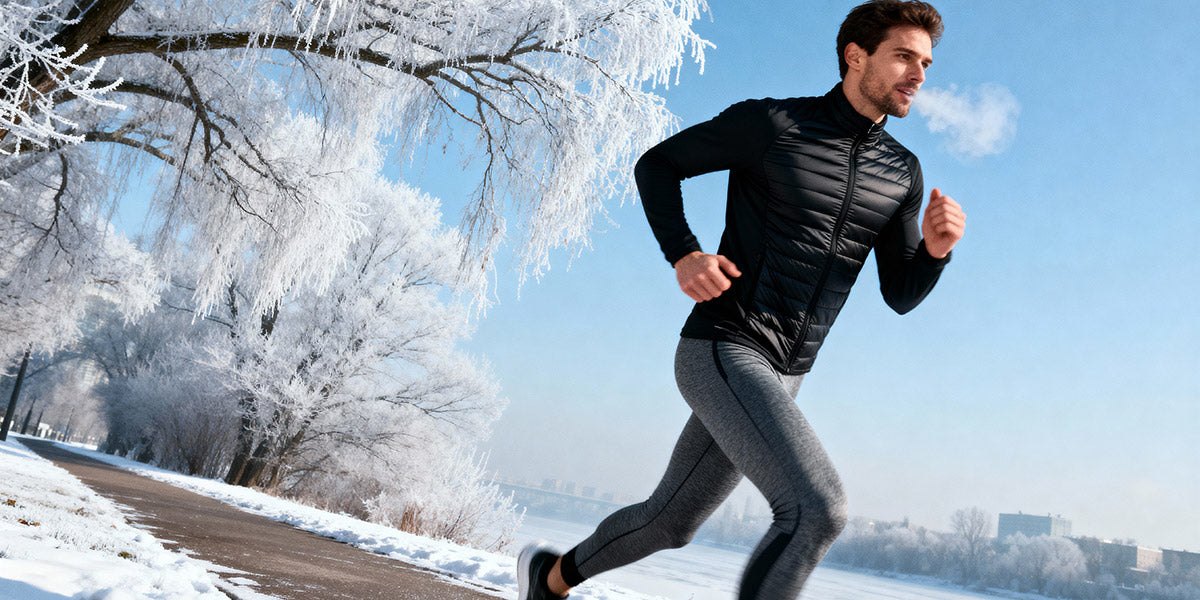
The "Active Insulation" Architecture We must also utilise "active insulation"-fabrics designed to be air-permeable enough to wear during high exertion but insulating enough for static periods. Technologies like Polartec Alpha Direct or Primaloft Evolve differ from static insulation (traditional puffs) which require mechanical venting (zippers) to prevent overheating.
The "hack" here is utilising these fabrics without a liner. They allow you to keep the layer on throughout the run without overheating, removing the kinetic penalty of stopping to de-layer. The high air permeability means that the insulation value can be instantly modulated by adding or removing a wind shell. Without the shell, the wind strips the heat (convection), cooling you; with the shell, the air is trapped, warming you. This modularity is far more efficient than changing entire garments.
Hack 2: Mitigating Friction via Layering Architectures
The metabolic cost of carrying clothing is not just about weight; it is about friction. A "technical hack" for winter running involves restructuring the layering system to minimise the coefficient of friction between layers.
The Kinetic Friction Penalty Multi-layer clothing systems create increased frictional resistance. As you move, fabric layers slide against one another. The energy required to overcome the friction between a base layer, a mid-layer, and a shell is dissipated as heat and does not contribute to propulsion. This "internal shear" force means you are effectively fighting your own equipment with every stride.
The solution is to engineer a "gliding" system. This involves selecting materials based on their surface texture:
-
Base: A hydrophobic synthetic or Merino wool layer with a smooth, high-gauge outer face.
-
Mid: An active insulation layer with a smooth face.
-
Outer: A lightweight wind shell with a slick, calendared inner surface.
This arrangement minimises the coefficient of friction. The shell glides over the mid-layer, and the mid-layer glides over the base, reducing the "internal drag" of the system.
Redistribution of Mass: The Torso Heating Protocol Since distal mass (on feet/ankles) has the highest metabolic penalty, the strategy must prioritise keeping the extremities light while insulating the core heavily. Studies utilising heated vests have demonstrated that maintaining a high core temperature can support peripheral blood flow even if the hands are less insulated. The physiological principle is simple: if the core is warm, the hypothalamus reduces vasoconstrictive signals to the periphery.
Implication: By over-insulating the core (using vests or aerogel panels), you can divert blood flow to the legs and arms without needing heavy, restrictive thermal tights or heavy boots. This preserves the "lightness" of the stride.
Hack 3: Traction Engineering and Ground Reaction Forces
Efficiency on ice is a function of confidence and physics. When a runner perceives low friction, the neuromuscular system adopts a "guarding" strategy: co-contraction of agonist and antagonist muscles to stiffen the joints. This co-contraction wastes energy and increases the rate of fatigue. Technical traction devices restore friction, allowing for a more relaxed, elastic, and efficient gait.
The Physics of Grip: Carbide vs. Steel vs. Rubber The choice of traction material fundamentally alters your interaction with the ground.
-
Tungsten Carbide: This material is extremely hard (Mohs hardness ~9). It is used in high-end studs. Its hardness allows it to bite into ice without dulling quickly on pavement, making it the gold standard for mixed-surface running.
-
Carbon Steel: Softer than carbide. While effective in snow, steel dulls rapidly on pavement and provides less penetration on hard black ice.
-
Specialized Rubber: Technologies like Vibram Arctic Grip use soft rubber compounds embedded with microscopic fillers (like glass fibres). These create friction on wet ice through increased surface area, without the need for metal spikes.
Device Selection and Metabolic Trade-offs Adding traction devices adds mass to the foot-the most metabolically expensive place to carry weight. Therefore, the "hack" is selecting the minimal traction required.
-
For Road Efficiency: "Screw shoes" (inserting hex-head sheet metal screws into the outsole of a standard running shoe) are the most efficient hack. They add negligible weight (~15g) compared to slip-on spikes (>200g), avoiding the energy penalty of heavier footwear while providing carbide-like bite.
-
For Mixed Terrain: Rubber grip technologies provide a safety margin on wet ice without the discomfort or instability of metal studs on dry pavement.
Biomechanical Adjustment: The "100-Mile Stride" Even with traction, the ground reaction force vector on slippery surfaces is more vertical than on dry asphalt. You should adopt a "100-mile stride"-compact, low-impact, high cadence. This reduces the anterior-posterior shear forces required during the braking and propulsive phases of the gait cycle. By keeping the foot strike closer to the centre of mass, you minimise the torque that could lead to a slip.
Hack 4: Respiratory Thermodynamics - Mitigating EIB
Cold, dry air is a potent bronchoconstrictor. Breathing large volumes of air below freezing triggers Exercise-Induced Bronchoconstriction (EIB) due to the osmotic stress placed on the airway surface liquid. As the airways work to humidify dry air (which has very low water vapour capacity at low temperatures), water is evaporated from the lung lining. This causes inflammation and constricts the bronchial smooth muscle, increasing the Work of Breathing (WOB) and limiting oxygen uptake.
Heat and Moisture Exchangers (HME) The technical solution is the Heat and Moisture Exchanger (HME). These are not simple fabric masks or scarves, which can become wet and freeze. HMEs are devices containing a specific mesh or honeycomb matrix (metal or plastic) that captures heat and moisture from exhaled air and transfers it to the inhaled air on the subsequent breath.
Using an HME allows for high-intensity ventilation (VE > 100 L/min) while maintaining inspired air temperature above the EIB threshold. This prevents the dehydration of the tracheal mucosa, preserving airway conductance and preventing the "burning lung" sensation that limits performance.
The Nose Breathing Protocol For moderate cold or lower intensity running, strictly nasal breathing is a physiological hack. The nasal turbinates are highly vascularised structures that increase the surface area for heating and humidifying air before it reaches the lungs. Research indicates that nasal breathing can effectively warm air to body temperature and 100% relative humidity more efficiently than oral breathing. Training at sub-threshold intensities with nasal breathing utilises the body's built-in HME system.
Hack 5: Neuromuscular Potentiation and Temperature Management
Muscle contractile speed and power output are strictly temperature-dependent properties. The physiological performance of skeletal muscle is governed by the Q10 effect, which describes the temperature sensitivity of enzymatic reaction rates.
The Q10 Effect Biological enzymatic reactions typically have a Q10 temperature coefficient of 2-3. This means that reaction rates double or triple with a 10°C increase in temperature. Conversely, cooling reduces contractile speed, peak power, and the rate of force development. A muscle temperature below 27°C is identified as a critical threshold where dynamic exercise performance is significantly disturbed. Cold muscles are also less elastic and more viscous, elevating the risk of strain injury.
The "Indoor Launch" Protocol To counteract these effects, the warm-up must be treated as a thermodynamic charging phase. The traditional "warm-up jog" done outside is insufficient in extreme cold because the heat loss to the environment may exceed the heat production of low-intensity jogging.
The Hack: Perform the neuromuscular warm-up indoors immediately before running. The goal is to raise muscle temperature and core temperature in a warm environment so that you start the run with a "heat buffer."
-
Glute Bridge: Activates the posterior chain without spinal load.
-
Leg Swings: Provides dynamic stretching to mobilise the hip capsule and reduce viscosity.
-
Toe/Heel Walks: Activates the intrinsic foot muscles and tibialis anterior, crucial for stability on uneven ice and snow.
By conducting this routine indoors, you induce mild vasodilation and enzymatic priming. Upon stepping outside, the initial vasoconstrictive shock is buffered by the elevated metabolic heat production, allowing for a smoother transition to running intensity.
Hack 6: Fluid Dynamics and Freezing Point Depression
Hydration in winter is deceptive. Cold suppresses the thirst mechanism, yet respiratory water loss is high due to the humidification of dry air. Furthermore, the physics of freezing presents a logistical barrier: fluids in bottles can freeze, rendering them useless and turning hydration weight into dead weight.
Freezing Point Depression Chemistry The "hack" involves applying the chemical principles of colligative properties. Adding solutes to water lowers its freezing point.
-
Electrolytes (Salt/NaCl): Sodium chloride dissociates into two ions, giving it a high Van 't Hoff factor. This makes salt highly effective at lowering the freezing point.
-
Sugars: Adding carbohydrates increases the molality of the solution.
The Hack: Use a hypertonic electrolyte/carbohydrate mix. A warm, concentrated sports drink carried close to the body utilises both thermal mass and freezing point depression to remain liquid in sub-zero conditions.
Hand-Held vs. Bladder Thermodynamics Using a hydration bladder with a tube in winter is risky because the fluid in the narrow tube has a high surface-area-to-volume ratio, leading to instant freezing. If using a bladder, the tube must be routed under the armpit or inside the jacket to utilise the microclimate of the torso for heat. Alternatively, carrying soft flasks inside mittens utilises the conduction of body heat to prevent the fluid from freezing.
Hack 7: Electronic Preservation in Cryogenic Conditions
Running efficiency in the modern era also relies on data-pacing, heart rate, and GPS navigation. However, Lithium-ion (Li-ion) batteries, the power source for virtually all running watches, degrade rapidly in cold conditions due to electrochemical limitations.
The Chemistry of Cold Batteries Low temperatures increase the internal resistance of Li-ion batteries and slow the electrochemical reactions. This manifests as a significant voltage drop. If the voltage drops below the device's cutoff threshold, the watch will shut down, even if the battery still holds a charge capacity.
Optimization Protocols for Data Integrity
-
Thermal Proximity: The most effective hack is to wear the watch under the sleeve or base layer, directly against the skin. The body heat keeps the battery within its optimal operating temperature range.
-
Heart Rate Data: Wearing the watch over clothing renders the optical heart rate sensor useless. Furthermore, cold-induced vasoconstriction reduces peripheral blood flow at the wrist, making optical sensors unreliable even against the skin. The solution is to use a Bluetooth chest strap. The strap is worn under all layers, staying warm and measuring electrical signals directly.
-
GPS Sampling: Use standard GPS intervals (1-second update rate) to maintain data fidelity but disable other drainers. Turn off the backlight and disable Bluetooth syncing during the run to preserve the critical navigation data while mitigating the cold-induced voltage sag.
The Sundried Roundup
What are the pros doing? Elite athletes do not leave warmth to chance. They utilise custom-studded footwear (often drilled specifically for their gait) and train with HME devices to protect lung capacity for the racing season. Many utilise "over-dressing" protocols during easy runs to force heat adaptation, stripping down only for high-intensity intervals to prevent the "wet-out" effect.
How can I build this into my life? Preparation is the antidote to friction. Pre-pack your "gliding" layer system the night before. Keep your shoes and electronics indoors, not in the car or garage. The "Indoor Launch" means you are physically ready to perform the second you open the door, eliminating the miserable first 10 minutes of a cold run.
The budget approach? The "Screw Shoe" is the ultimate budget hack. For the cost of a bag of 3/8-inch hex-head sheet metal screws, you can turn an old pair of road shoes into ice-eating machines. Combine this with a standard windbreaker over a wool jumper (gliding layers) and focus on the indoor warm-up.
Middle of the road approach, I am serious but not all in yet? Invest in a high-quality wind-proof shell and a dedicated pair of winter traction devices like Kahtoola NanoSpikes. Ensure you are using a chest strap for heart rate, as your expensive watch is likely providing inaccurate data via the wrist sensor in the cold.
Pushed for time, how can I keep up? Intensity over volume. Cold weather is excellent for threshold intervals because the environment prevents overheating. Use the "Indoor Launch" to combine your strength work and warm-up, then head out for 30 minutes of precise, high-quality structural loading.
I have 3 hours a week, what can I do? Focus on three 60-minute sessions: one tempo run (steady state), one interval session (speed), and one long progression run. Use the cold to your advantage-your heart rate won't drift as high as in summer, allowing you to push the aerobic intensity without thermal strain.
I can fit in training 7 days a week. How can I maximise this? Volume in winter requires strict energy management. Rotate your footwear to alter loading patterns and allow shoes to dry completely. Utilise the "Torso Heating Protocol" on recovery days to ensure you don't burn excess glycogen just trying to stay warm. Pay close attention to hydration; you are losing more fluid via respiration than you realise.
The premium approach? I want to chuck everything at this. Invest in Aerogel-infused apparel to minimise bulk. Use a premium HME (like AirTrim) for all outdoor sessions. Equip yourself with a heated vest to maintain core temp during warm-ups and cool-downs. Utilise a Stryd power meter for pacing, as it is unaffected by the wind and surface conditions that skew GPS pace.
Top 10 Tips
Warm up indoors
Get muscle temperature >27°C before exposure.
Layer for friction
Smooth base, active mid, slick shell.
Insulate the core
Keep the vest heavy so the limbs can be light.
Traction matches terrain
Screws for road, spikes for trail.
Protect the lungs
Use an HME or nasal breathing.
Hydrate with chemistry
Salt and sugar prevent freezing.
Wear tech inside
Keep batteries warm against the skin.
Strap up
Use a chest strap for heart rate data.
Shorten the stride
High cadence reduces slip risk.
Be stoic
Cold is just physics; dress like an engineer.


