

Heartrate Training Explained: The 5 Zones Every Athlete Must Know


Planning your next fitness milestone?
Get immediate guidance on pacing, workout structure, or race prep directly on-site for free. Try asking Raye: 'Can you outline a simple 4-week build plan for a 10K?' Get instant guidance
Optimising Your Fitness Through Heartrate Training
Have you ever tried training to heart rate? There's many benefits of knowing the various levels your body can work at and the five heart rate zones for everyone those zones are different and training to heart rate is a very personal way of training and because it is so personalised, it can be massively beneficial.
Some people like to say you wouldn't run a business without knowing those key performance indicators and you wouldn't like to go in purely guessing you need to start relying on data and isn't athlete whatever level you were at data can be really key to optimise your training. If you're into the numbers then you can park motivation to one side and work to data knowing that you are working towards a roadmap to efficiency
Heart Rate training is not just about being slaved to number it's about understanding your bodies feedback and ensuring every mile every Burpee every squat that you do every session as a real purpose. This type of training should not just be about the current season but potentially for the rest of your life.
Take a moment to read our guide to the five heart rate zones and give yourself a minute to understand potential max heart rate for yourself based on your age. Max heart rate test determines your highest achievable heart rate and there are simple formulas which is 220 take away your age although this is quite less accurate than actually testing yourself you can get on the treadmill in the gym and run some Hill sprints or a time defer to track your heart rate areas for me. The ultimate test is something you may remember from your days at school the dreaded bleep test it is one way of really challenging your body but make sure you hit record on your heart rate watch or your chest strap before you dive in the simple formula for example 220 minus your age will give you your maximum potential but if you are a fit older athlete then this may be off by 10 to 20 beats a minute. The most accurate is definitely the lab test in a controlled environment but that's gonna cost you time and money so work it out overtime keep your heart rate watch on and monitor your perceived exertion levels and you'll soon get to understand what you're real max heart rate is personally. Personally, I find trying to max out the heart rate. Is a real effort because lots of things determine your performance from sleep time of day and just how your personally feeling
The scientific efficiency so why would you want to monitor your heart rate? Heart rate training involves monitoring your BPM and gauge to gauge your precise intensity of exertion if you're using a bike or measuring your power with one of the other apps or watches? This is an output metric whereas your heart rate is purely internal input. Metric tells you how much stress your system is under.
By training within your specific zone manipulating your bodies energy systems you can teach your body to burn more fat efficiently. You can clear metabolic waste faster and tolerate higher levels in intensity.

Looking to shave time off your personal best?
Get immediate pacing strategies and interval workout ideas directly on-site for free. Try asking Raye: 'What is the best threshold session to help drop my 10K time?' Get instant pacing tips
The Science of Efficiency: Why Monitor the Pump?
Heartrate training involves monitoring your beats per minute (BPM) to gauge the precise intensity of your exertion. Unlike pace or power, which are external output metrics, heart rate is an internal input metric. It tells you exactly how much stress your system is under to produce a specific result.
By training within specific "zones," you manipulate your body's energy systems. You can teach your body to burn fat more efficiently, clear metabolic waste faster, or tolerate higher levels of intensity.
The Return on Investment (ROI)
Why should a busy professional bother with the data? Because time is your scarcest resource. Heartrate training ensures high ROI on your gym time:
-
Precision: You avoid the "grey zone"-that middle ground where you are working too hard to recover but not hard enough to trigger high-end adaptations.
-
Sustainability: By capping intensity on easy days, you prevent the cumulative fatigue that leads to burnout and injury.
-
Data-Driven Progress: You can track tangible improvements. Seeing your heart rate drop for the same pace is a clear indicator that your cardiovascular engine has been upgraded.
Decoding the Dashboard: Your Metrics
To execute this strategy, you need to establish your baseline data.
1. Resting Heart Rate (RHR)
This is your engine at idle. A lower RHR generally correlates with a more efficient heart (higher stroke volume) and better aerobic fitness. Most adults sit between 60-100 BPM, but trained endurance athletes often see numbers in the 40s or 50s.
-
Action: Measure this first thing in the morning before caffeine or stress hits. An unexpected spike in RHR is often your first warning sign of illness or overtraining.
2. Maximum Heart Rate (MHR)
This is the redline-the fastest your heart can beat under maximal load.
-
The Flaw in the Formula: You will often see the formula "220 minus age." For a serious athlete, this is a blunt instrument and can be inaccurate by 10-12 beats.
-
The Better Calculation: The Tanaka formula (208 - (0.7 x age)) is slightly sharper, but a field test (like a maximal 5k finish or a hill sprint session) usually provides the most accurate real-world data.
3. Heart Rate Reserve (HRR) and The Karvonen Method
If you want true precision, do not just use a percentage of your Max HR. Use the Karvonen formula, which accounts for your fitness level by factoring in your Resting Heart Rate.
-
Formula: Target HR = ((Max HR − Resting HR) × %Intensity) + Resting HR. This creates a bespoke training zone that adapts as you get fitter and your RHR drops.

The Zones: Your Strategic Blueprint
Think of these zones as different gears in a car. You cannot drive on the motorway in first gear, and you cannot pull away in fifth. Each zone serves a distinct mechanical purpose.
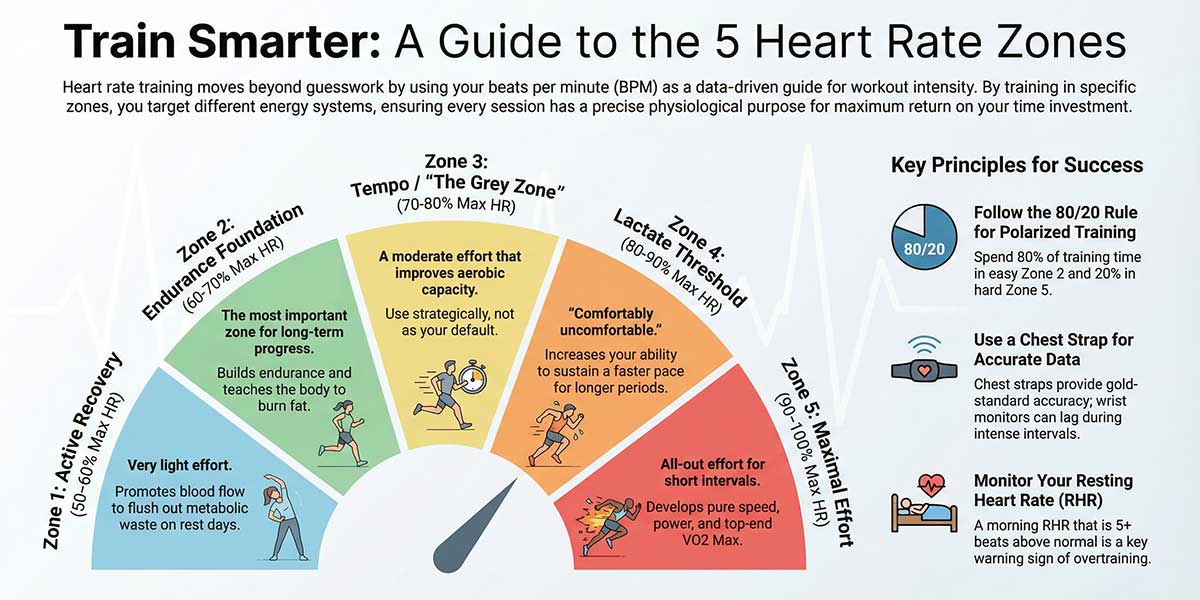
Zone 1: Active Recovery (50-60%)
-
The Feel: Very light. You could hold a boardroom meeting while doing this.
-
The Purpose: flushing out metabolic waste and promoting blood flow without adding stress. This is crucial for "active rest" days.
Zone 2: The Endurance Foundation (60-70%)
-
The Feel: Light and conversational. You could speak in full sentences.
-
The Strategy: This is where the magic happens for the long game. Training here builds mitochondrial density (the energy powerhouses of your cells) and teaches the body to utilise fat as a primary fuel source.
-
The Challenge: For high achievers, Zone 2 is mentally difficult because it feels "too slow." Trust the process. This is the foundation upon which speed is built.
Zone 3: The Grey Zone / Tempo (70-80%)
-
The Feel: Moderate. Conversation becomes broken sentences.
-
The Purpose: Improves aerobic capacity and blood circulation. However, spend too much time here on "easy" days, and you accumulate fatigue without the specific benefits of high-intensity work. Use strategically for tempo runs, not as a default setting.
Zone 4: Threshold (80-90%)
-
The Feel: Hard. "Comfortably uncomfortable." Talking is limited to single words.
-
The Strategy: This raises your anaerobic threshold-the point at which lactic acid accumulates faster than you can clear it. Training here allows you to maintain a faster pace for longer.
Zone 5: Maximal Effort (90-100%)
-
The Feel: Maximal. Your lungs burn; speaking is impossible.
-
The Purpose: Pure speed, power, and VO2 Max expansion. These are short, sharp shocks to the system (sprints, HIIT).
Practical Application: The Tools and The Trade
The Tech: Wrist vs. Chest
In the data world, garbage in equals garbage out.
-
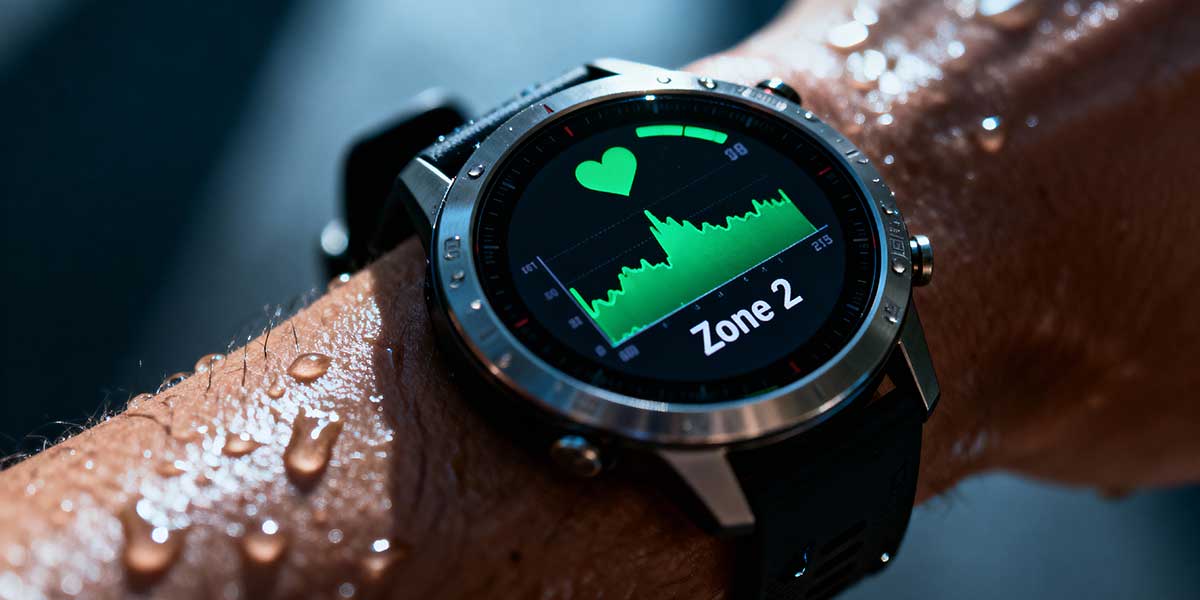
Optical (Wrist) Monitors: Convenient for 24/7 tracking and sleeping heart rate. However, during high-intensity intervals, they can suffer from "lag" or inaccuracy due to sweat and arm movement.
-
Chest Straps: The gold standard. They measure the electrical signal of the heart (ECG). If you are serious about data integrity during training, wear the strap.
RPE: The Subjective Backup
Technology can fail. Batteries die. Sometimes, the sensors get it wrong. Always calibrate your data against Rate of Perceived Exertion (RPE). If your watch says Zone 2 but you are gasping for air, listen to your body, not the device. The "Talk Test" remains one of the most effective calibration tools available.

The Physiology of the Long Game
We are not training for a single summer; we are training for a lifetime of performance. Consistent heartrate training forces the body to adapt in profound ways:
-
Mitochondrial Biogenesis: You actually grow more mitochondria in your muscle cells. This means you can process more energy, faster.
-
Capillarisation: You increase the network of tiny blood vessels delivering oxygen to your muscles.
-
Fat Adaptation: By adhering to Zone 2 work, you become a "fat-burning machine," preserving your limited glycogen stores for those high-intensity Zone 5 efforts.
This is asset management at its finest-increasing the efficiency of the engine so it can run faster, longer, and with less wear and tear.
Risk Management: Overtraining
In our drive for success, the most common error is doing too much. Overtraining Syndrome (OTS) is a state of "physiological bankruptcy."
Watch your dashboard for these warning lights:
-
Elevated Morning RHR: If it is 5+ beats higher than normal for a few days, back off.
-
Heart Rate Suppression: You are pushing hard, but your heart rate won't rise. This is a sign of deep fatigue.
-
Insomnia and Irritability: When the sympathetic nervous system is fried, sleep suffers.
Recovery is not the absence of training; it is the time when the training takes effect. If you do not schedule maintenance, the machine will break.
The Sundried Roundup
You have the theory. Now, let's look at the execution. Here is how to apply this strategy to your specific lifestyle.
What are the pros doing?
The elites typically follow an "80/20" or "Polarised" model. They spend 80% of their training volume in Zone 2 (easy) and 20% in Zone 5 (very hard). They rarely spend time in the middle "grey zone." They have the discipline to go incredibly slow so they have the energy to go incredibly fast.
How can I build this into my life?
Start by capping your easy runs. Put an alarm on your watch. If your heart rate spikes above your Zone 2 limit (usually around 140-145 BPM for many), walk until it drops. It requires ego-suppression, but it pays dividends in endurance.
The budget approach?
You do not need a £500 watch. Use a stopwatch and the "Talk Test."
-
Easy days: You must be able to recite a paragraph of text out loud without gasping.
-
Hard days: You shouldn't be able to say more than "yes" or "no."
Middle of the road approach, I am serious but not all in yet?
Invest in a reliable chest strap monitor (like a Polar H10 or Garmin HRM) and pair it with your smartphone or a mid-range GPS watch. Calculate your zones using the Karvonen formula and stick to them for your key sessions.
Pushed for time, how can I keep up?
Intensity compensates for volume, to a degree. If you only have 30 minutes, a Zone 2 run offers limited benefit. In this scenario, Zone 4/5 intervals (HIIT) give you the most "bang for your buck" regarding cardiovascular stimulus. However, try to find one slot a week for a longer, lower-intensity session to maintain aerobic base.
I have 3 hours a week, what can I do?
-
Session 1: 45 mins High Intensity (Intervals).
-
Session 2: 45 mins Tempo (Zone 3/4).
-
Session 3: 90 mins Long Slow Distance (Zone 2). This creates a micro-version of the polarised model.
I can fit in training 7 days a week. How can I maximise this?
Be careful. The risk here is recovery. If you train 7 days, 3 or 4 of those must be strictly Zone 1 or Zone 2 recovery sessions. Use the extra volume to build a massive aerobic base, but ensure your "hard" days are separated by easy days to allow for adaptation.
The premium approach? I want to chuck everything at this.
Go to a sports lab for a VO2 Max and Lactate Threshold test. This will give you your exact physiological crossover points, removing all guesswork from your zone calculations. Pair this with a top-tier wearable (Garmin Fenix/Epix or Whoop) and a coach who analyses your heart rate variability (HRV) to prescribe daily training loads based on your recovery status.
Top 10 Tips
Trust the Data
It doesn't lie, even if your ego wants to run faster.
Hydrate
Dehydration causes "cardiac drift," making your HR spike even if effort remains stable.
Strap Up
Use a chest strap for interval work; wrist monitors lag too much.
Re-test
Your zones will change as you get fitter. Re-calculate every 8–12 weeks.
Sleep is King
Your heart rate profile is heavily influenced by your sleep quality.
Patience
Zone 2 training takes weeks to feel "normal." Stick with it.
Weather Matters
Heat and humidity increase heart rate. Slow down to stay in the zone.
The 80/20 Rule
Keep most of your training easy so your hard training can be effective.
Listen to the Body
If the tech says go, but the body says no, rest wins.
Consistency
A perfect plan done sporadically is useless. A good plan done consistently is unbeatable.


