

The Best Knee-Friendly Squat Alternatives for Athletes


Need performance advice right now?
Ask our on-site coach anything about your routines. It's completely free and available immediately right here: 'What are 3 quick exercises for ankle mobility?' Ask Raye for free
Knee-Friendly Squat Alternatives for Athletes: An Asset Management Strategy
Introduction: The Performance Paradigm Shift
The trajectory of an athletic lifespan is rarely linear; it is characterised by distinct physiological epochs, each demanding a bespoke strategy to maintain output. For the Executive Athlete-high-performing individuals who treat their physical vessel as a high-value asset-the primary training objective undergoes a subtle but profound shift. While the pursuit of strength, hypertrophy, and power remains central, the overarching governor of training success becomes longevity and orthopaedic resilience.
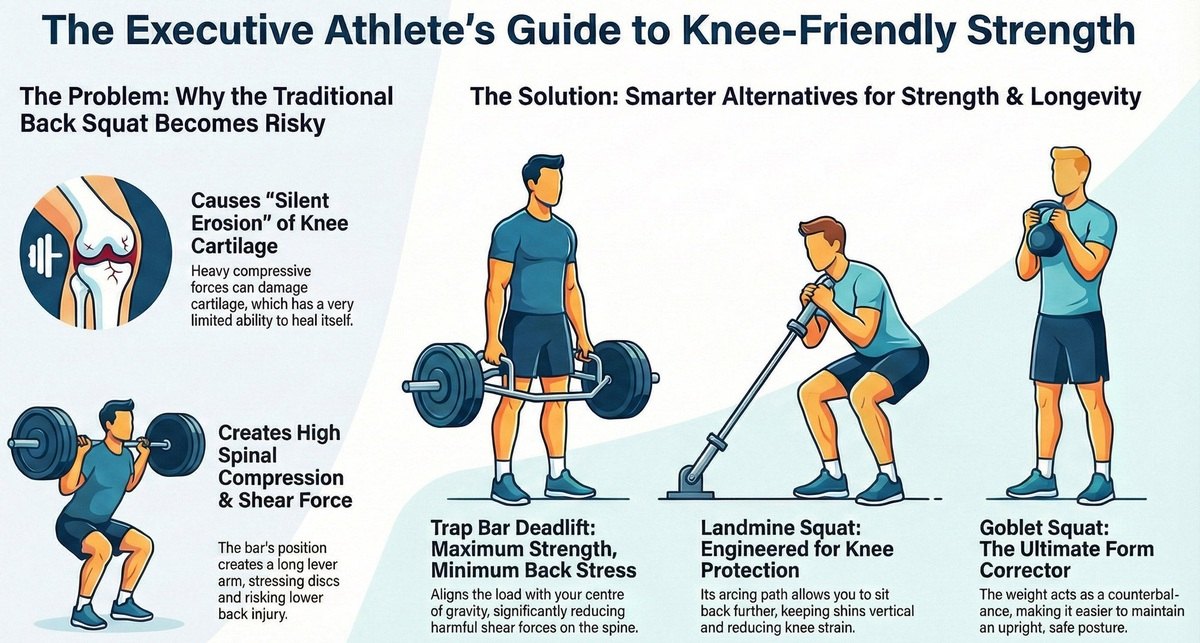
The heavy barbell back squat has historically been revered as the "king of exercises" for its capacity to elicit systemic anabolic responses and maximal motor unit recruitment. However, for the experienced operator, it presents a complex risk-to-reward calculus. As the musculoskeletal system accumulates mileage, the margin for biomechanical error narrows. The robust connective tissues of early adulthood can withstand the shear forces of a slightly misaligned squat or the compressive loads of high-volume spinal loading. However, physiology evolves. Changes in articular cartilage composition, reduced tendon compliance, and alterations in bone mineral density make traditional loading parameters potentially hazardous inefficiencies.
This report posits that preserving structural integrity is not about the cessation of activity-which accelerates depreciation-but about the intelligent selection of biomechanical alternatives. We must deploy knee-friendly squat alternatives for athletes that optimise joint stress distribution while maintaining high-level muscular output.
We will explore the physiological underpinnings of the knee and spine, deconstruct the mechanics of the back squat to identify specific injury mechanisms, and present a comprehensive analysis of five evidence-based alternatives. This is a holistic blueprint for the athlete to train with intensity and precision.
The Physiological Landscape: An Audit of the Terrain
To understand the necessity of modifying lower-body training, one must first appreciate the biological reality of the musculoskeletal system. The changes occurring over time are cellular, structural, and systemic, fundamentally altering how the body absorbs and dissipates mechanical energy.
Articular Cartilage: The Silent Erosion
The primary limiting factor for knee longevity in heavy squatting is the health of the articular cartilage. This hyaline cartilage covers the articular surfaces of the femur and tibia, providing a nearly frictionless environment for movement and acting as a shock absorber. Unlike muscle tissue, which is highly vascular and regenerative, articular cartilage is avascular and aneural, meaning it possesses a severely limited capacity for intrinsic repair.

Need a clear race fuelling strategy?
Get instant, practical advice on hydration and race-day nutrition directly on this page for free. Try asking Raye: 'How many grams of carbs should I take per hour during a half marathon?' Ask for fuelling advice
In a youthful joint, chondrocytes (cartilage cells) maintain a dynamic equilibrium between the synthesis and degradation of the extracellular matrix. Research indicates that over time, the composition of the matrix changes. The proteoglycans become smaller and less capable of retaining water. This dehydration of the cartilage tissue reduces its stiffness and compressive modulus, making it more susceptible to micro-damage under heavy loading. When an athlete performs a heavy back squat, the compressive forces transmitted through the tibiofemoral joint can exceed the structural integrity of this matrix, leading to fibrillation of the cartilage surface.
The "Motion is Lotion" Mechanism
Despite the vulnerability of cartilage, complete rest is detrimental. Cartilage relies on cyclic loading to facilitate the diffusion of nutrients from the synovial fluid-a process often termed "motion is lotion." Studies suggest that moderate physical activity does not damage knee cartilage and may even increase glycosaminoglycan content, effectively "conditioning" the tissue. The critical distinction lies in the type and magnitude of the load. While walking or light resistance training promotes fluid exchange, the extreme compressive peaks found at the bottom of a heavy back squat (often exceeding 4-6 times body weight) can be destructive rather than restorative.
The Muscle-Bone Interface
The aging process is also characterised by sarcopenia (loss of muscle mass) and dynapenia (loss of muscle strength). This loss is not uniform; it predominantly affects Type II (fast-twitch) muscle fibres, which are responsible for high-force, explosive movements. As these fibres atrophy, the muscles surrounding the knee-specifically the quadriceps mechanism-lose their ability to act as dynamic shock absorbers. This transfers more mechanical stress directly to the joint structures during deceleration phases of lifting.
Simultaneously, tendons and ligaments undergo biochemical changes that increase the cross-linking of collagen fibres, reducing water content. The result is increased stiffness and decreased compliance. A stiffer tendon is less able to store and release elastic energy efficiently. In dynamic movements, this places higher peak loads on the tendon-bone insertion points, increasing the risk of tendinopathy.
Biomechanical Analysis: The Back Squat Under the Microscope
While the barbell back squat is a fundamental movement, its specific biomechanical demands are often at odds with the physiological reality of the experienced athlete. To understand why alternatives are necessary, we must dissect the forces at play.
Spinal Kinetics: Compression and Shear
The placement of the barbell on the upper back creates a long lever arm relative to the lumbar spine. To maintain equilibrium, the erector spinae muscles must generate massive forces to counteract the flexion moment created by the weight of the bar and the torso.
The resulting force is axial compression-a downward pressure through the spinal column. For an athlete with dehydrated intervertebral discs, this compression can narrow the intervertebral foramen, potentially compressing nerve roots. The greater risk, however, is shear force-the sliding of one vertebra over another. This is maximised when the spine moves into flexion (rounding) under load. Many athletes lack the hip mobility to reach parallel depth with a neutral spine. As they approach the bottom of the squat, the pelvis rotates posteriorly (the "butt wink"), flexing the lumbar spine. Research demonstrates that this lumbar flexion significantly increases shear forces at the L5/S1 junction.
Knee Kinetics: The Patellofemoral Fulcrum
The knee joint functions as a fulcrum during the squat, experiencing both compressive and shear forces that vary with depth and technique. As the knee bends, the patella is pressed into the trochlear groove of the femur. The magnitude of this compressive force is a function of quadriceps tension and the knee flexion angle. At deep angles (beyond 90 degrees), the Patellofemoral Joint Reaction Force (PFJRF) can escalate dramatically. For athletes with any degree of cartilage softening, this compression is the primary source of anterior knee pain.
Strategic Alternatives to the Back Squat
The following five movements act as knee-friendly squat alternatives for athletes. They offer superior biomechanical leverage, reduced spinal loading, and high muscular return on investment.
The Trap Bar Deadlift
The Trap Bar Deadlift (TBD), or hex bar deadlift, represents a paradigm shift in closed-chain lower body training. While nomenclature classifies it as a deadlift, biomechanical analysis reveals it to be a hybrid movement that offers the knee-dominant strength benefits of a squat with the hip-dominant safety profile of a hinge. For the Executive Athlete, it is arguably the superior choice for maximal loading.
Biomechanical Advantages: Centre of Mass The fundamental flaw of the back squat for compromised spines is the placement of the load on the thoracic spine. The TBD circumvents this by placing the load in the hands, at hip level. Because the athlete steps inside the hexagonal frame, the resistance is aligned directly with the body's centre of gravity.
This contrasts sharply with the conventional straight-bar deadlift, where the bar must travel in front of the shins, creating a longer resistance arm and greater torque on the lumbar spine. Studies confirm that the TBD generates significantly lower peak moments at the L5/S1 joint compared to both the conventional deadlift and the back squat. This reduction in shear force allows the athlete to train with high intensity while mitigating the risk of lumbar injury.
The "Squat-Lift" Profile While sparing the back, the TBD does not neglect the legs. Kinematic data shows that the TBD involves greater knee flexion (approx. 20 degrees more) than a conventional deadlift. This increased knee excursion recruits the vastus lateralis and rectus femoris (quadriceps) to a degree comparable to a back squat. Thus, the athlete receives the leg-building stimulus of a squat without the axial compression on the spine.
Implementation Strategy To maximise safety and efficacy, utilise the high handle setting on the trap bar. This reduces the range of motion by several inches, accommodating reduced hamstring flexibility and allowing for a more upright, neutral spine at the start of the lift.
The Landmine Squat
The Landmine Squat is a highly effective variation that serves as a bridge between free weights and fixed machines. By anchoring one end of the barbell to the floor, the movement path becomes an arc rather than a vertical line. This curvilinear path fundamentally alters the biomechanics of the squat in favour of joint preservation.
The Geometry of the Arc In a traditional barbell squat, the centre of mass must remain over the midfoot. If the athlete leans back, they fall; if they lean forward, they stress the lower back. The landmine setup, however, allows the athlete to lean into the weight.
Because the bar is anchored, the athlete can sit their hips back further than balance would normally allow. This posterior weight shift keeps the shins more vertical, which directly reduces the anterior shear force on the knee joint. The "leaning tower" effect allows for significant hip flexion (loading the glutes) while minimising the forward knee travel that aggravates patellar tendonitis.
Self-Correcting Posture The bar is typically held in a "goblet" position at the chest. If the athlete's chest collapses or they lean too far forward (a common fault due to weak thoracic extensors), the bar will physically press into their sternum. This provides immediate, tactile feedback, forcing the athlete to maintain an upright, rigorous posture throughout the movement. Furthermore, the anterior loading creates a long lever arm acting on the torso. To prevent extending backward or crumpling forward, the athlete must intensely engage the anterior core. This creates high intra-abdominal pressure, which acts as a "pneumatic splint" for the lumbar spine.
The Box Squat
Originating from powerlifting disciplines, the Box Squat is frequently misunderstood. However, when adapted for the general population, it becomes one of the premier rehabilitation and longevity tools for the lower body.
Breaking the Stretch-Shortening Cycle The most dangerous moment in a conventional squat for an aging knee is the transition point (the "turnaround") at the bottom. In a standard squat, the athlete descends and uses the stored elastic energy in their tendons (the Stretch-Shortening Cycle) to "bounce" out of the hole. This bounce generates massive peak tension on the patellar tendon.
In a Box Squat, the athlete sits completely on the box, momentarily relaxing the hip flexors while keeping the core tight. This dissipates the stored kinetic energy. To stand up, the athlete must generate pure concentric force. This eliminates the ballistic stress on the connective tissues, making the movement far safer for brittle tendons and worn cartilage.
Depth Control and Vertical Shins The box acts as a physical depth gauge. If an athlete has patellofemoral pain at 90 degrees of flexion, the box can be set to 85 degrees. This allows the athlete to train with heavy loads exactly up to their pain threshold without risk of inadvertently going too deep. Additionally, to sit back onto a box safely, the athlete must utilise a hip-dominant mechanic. Biomechanically, this forces the shins to remain vertical. Research confirms that maintaining a vertical shin position minimises anterior displacement of the knee, drastically reducing shear stress on the ACL.
The Goblet Squat
For the athlete focusing on functional maintenance, mobility correction, and moderate loading, the Goblet Squat is the gold standard.
The Counterbalance Mechanism The defining feature of the goblet squat is the anterior placement of a single weight (kettlebell or dumbbell) held against the chest. This acts as a physical counterbalance. Many athletes suffer from limited ankle mobility, causing them to lean forward excessively in a back squat. The weight held in front allows the athlete to sit their hips back and down while keeping the torso upright. The weight essentially "pulls" them into the correct biomechanical position.
Thoracic Extension and Hip Prying To hold the weight at chest height, the athlete must actively retract the shoulder blades and extend the thoracic spine. This provides a corrective stimulus for thoracic kyphosis (rounding of the upper back). Furthermore, the goblet squat provides built-in coaching cues. As the athlete descends, the elbows should track inside the vastus medialis (inner thigh). To fit the elbows between the knees, the athlete must actively push the knees outward. This tactile cue automatically corrects knee valgus (knees caving in), engaging the gluteus medius and protecting the MCL.
The Bulgarian Split Squat
Bilateral movements can hide a multitude of sins. It is common for athletes to have a dominant leg, often due to past injuries or natural asymmetry. The stronger leg compensates, leading to muscular imbalances and pelvic torsion. Unilateral training, specifically the Bulgarian Split Squat (BSS), is essential for rectifying these issues.
The Bilateral Deficit The "bilateral deficit" is a neuromuscular phenomenon where the maximal force produced by one leg is greater than 50% of the force produced by both legs together. Essentially, the nervous system can drive one leg harder than it can drive two.
To achieve a maximal stimulus on the quadriceps using a back squat, a lifter might need 150kg on their spine. To achieve that same local muscular stimulus on one leg in a BSS, they might only need 30kg held in their hands. This drastic reduction in axial spinal loading allows the athlete to train the legs to failure while keeping the spine virtually unloaded.
Hip Mobility and "Anti-Sitting" Training The BSS setup involves elevating the rear foot. This position places the hip flexors of the rear leg into a deep stretch under load. For the executive who likely spends hours sitting, hip flexor tightness is a plague that causes anterior pelvic tilt and lower back pain. The BSS acts as a dynamic stretch for the rear leg while strengthening the front leg. It is functionally the "anti-sitting" exercise.
Essential Mobility: The RAMP Protocol
Providing alternatives to the back squat is only half the equation. The joint system relies heavily on the viscosity of synovial fluid for lubrication. The "cold start"-jumping straight into lifting-is a primary cause of injury. The RAMP protocol (Raise, Activate, Mobilise, Potentiate) is the scientifically validated framework for preparation.
-
Raise: Increase core body temperature. As joint temperature rises, the viscosity of synovial fluid decreases (becomes thinner), allowing it to better lubricate the articular surfaces. 3-5 minutes of low-impact activity (AirBike or rowing).
-
Activate: Target the "lazy" muscle groups that atrophy with disuse, specifically the gluteal complex. Execute Glute Bridges to wake up the hip extensors.
-
Mobilise: Address specific restrictions in the ankle, hip, and thoracic spine. Ankle dorsiflexion is a priority; restricted ankles destroy knees.
-
Potentiate: Prime the nervous system for high-force output. Low-amplitude plyometrics or speed squats to "wake up" the fast-twitch fibres.
Load Management: The Sustainability Algorithm
The physiology of the experienced athlete dictates that recovery, not intensity, is the limiting factor in progress. Collagen synthesis rates are slower, and the inflammatory response to micro-trauma is prolonged. Load management is the safety valve of the training system.
The Acute:Chronic Workload Ratio (ACWR)
Research has highlighted the ACWR as a predictor of injury. The acute load (this week's volume) should be balanced against the chronic load (the average of the last 4 weeks). The 10% Rule: A simplified guideline is to never increase total volume or intensity by more than 10% per week. This gradual progression allows the slower-adapting connective tissues (tendons/ligaments) to strengthen alongside the muscles.
Frequency and Recovery
Training the lower body intensely twice a week allows for 72 hours of recovery, which is often necessary for complete restoration of neuromuscular function and glycogen replenishment. Every 4-6 weeks, volume should be cut by 40-50% for a "deload week." This period allows for the dissipation of accumulated fatigue and the healing of minor micro-trauma before it becomes a chronic injury.
The Sundried Roundup
What are the pros doing?
The elite operators are pivoting. They are moving away from ego-driven lifting toward longevity-focused metrics. They utilise the Trap Bar Deadlift as their primary strength builder and treat unilateral work (Split Squats) as mandatory, not accessory. They do not skip the warm-up; they view the RAMP protocol as part of the work set.
How can I build this into my life?
Audit your current training. If the back squat causes discomfort, replace it immediately with the Trap Bar Deadlift or Landmine Squat. Implement the "Motion is Lotion" principle: sitting is the enemy of the spine. Ensure you stand and move periodically throughout the day to maintain tissue hydration.
The budget approach?
The Goblet Squat and the Split Squat require minimal equipment. A single kettlebell or dumbbell is sufficient to execute a high-level workout. Focus on tempo (slowing down the descent) to increase intensity without needing to purchase an entire rack of weights.
Middle of the road approach, I am serious but not all in yet?
Invest in a gym membership or a basic home setup with a trap bar. Commit to training the lower body twice a week with a minimum of 72 hours recovery between sessions. Follow the RAMP protocol religiously before touching a weight.
Pushed for time, how can I keep up?
Focus on compound efficiency. The Trap Bar Deadlift hits the legs, back, and grip in a single movement. 30 minutes of high-density training (short rest periods) using just this lift and a pressing movement will yield significant structural returns.
I have 3 hours a week, what can I do?
Split your time into two 90-minute or three 60-minute sessions. Dedicate one session to heavy loading (Trap Bar) and one to metabolic/structural health (Goblet Squats and mobility). You do not need volume; you need precision.
I can fit in training 7 days a week. How can I maximise this?
Do not train heavy 7 days a week. Use the "high-low" method. Train high intensity (heavy lifting) 2-3 days a week. On the other days, focus on active recovery-swimming, cycling, or extensive mobility work-to flush the system and promote collagen repair without incurring further structural damage.
The premium approach? I want to chuck everything at this.
Hire a biomechanics coach to audit your movement patterns. Utilise velocity-based training (VBT) technology to auto-regulate your loads based on your daily readiness. Integrate regular soft-tissue therapy to maintain fascial sliding surfaces. Treat your recovery (sleep, nutrition, therapy) with the same discipline as your training.
Top 10 Tips
Pain is Data
If it hurts, stop and analyse. Do not push through joint pain.
Earn Your Load
Do not add weight until your mechanics are flawless.
Unilateral is Key
Train one leg at a time to expose and fix imbalances.
Respect the RAMP
Never lift cold. Lubricate the joints first.
Control the Eccentric
Lower the weight slowly (3-4 seconds) to build tendon strength.
Manage Volume
Adhere to the 10% rule. Progress slowly.
Prioritise Spine Hygiene
Avoid spinal flexion under load at all costs.
Mobilise Daily
Ankle and hip mobility are use-it-or-lose-it assets.
Hydrate
Intervertebral discs require water to function as shock absorbers.
Think Long Term
Train today so you can still train effectively in twenty years.
