

7 Travel Fitness Hacks That Actually Work (Backed by Science)


Want to build strength to support your running?
Get targeted strength routines and mobility exercises designed specifically for runners directly on-site. Try asking Raye: 'What are 3 key gym exercises to improve running economy?' Get strength tips
7 Travel Fitness Hacks That Actually Work (Backed by Science)
Travel is a logistical stress test. For the high-performing athlete, it introduces variables that threaten the stability of your most valuable asset: your body.
The contemporary business environment demands high-performance cognitive output, yet the reality of business travel imposes a physiological burden that directly undermines this objective. In occupational health literature, this is referred to as the "allostatic load"-the cumulative wear and tear on the body that accumulates when an individual is exposed to repeated chronic stress...
If you are on the road then hit play below and start your hotel room training.
... For the "Road Warrior"-the frequent flyer managing timezone shifts, irregular nutritional inputs, and confined sedentary periods-the challenge is not merely logistical; it is deeply biological. You are dealing with the hypoxic environment of a pressurised cabin, extreme aridity that accelerates dehydration, and the disruption of your circadian pacemaker.
When you are on the road, the goal shifts. You are not looking to set a new personal record; you are looking to mitigate depreciation. The objective is maintenance, cognitive clarity, and readiness. When you view your physical condition as overhead for your professional success, skipping a workout or eating poorly isn't "treating yourself"-it is bad management.
Here is the strategic protocol for maintaining physical integrity while navigating the chaos of modern travel, backed by physiological data.
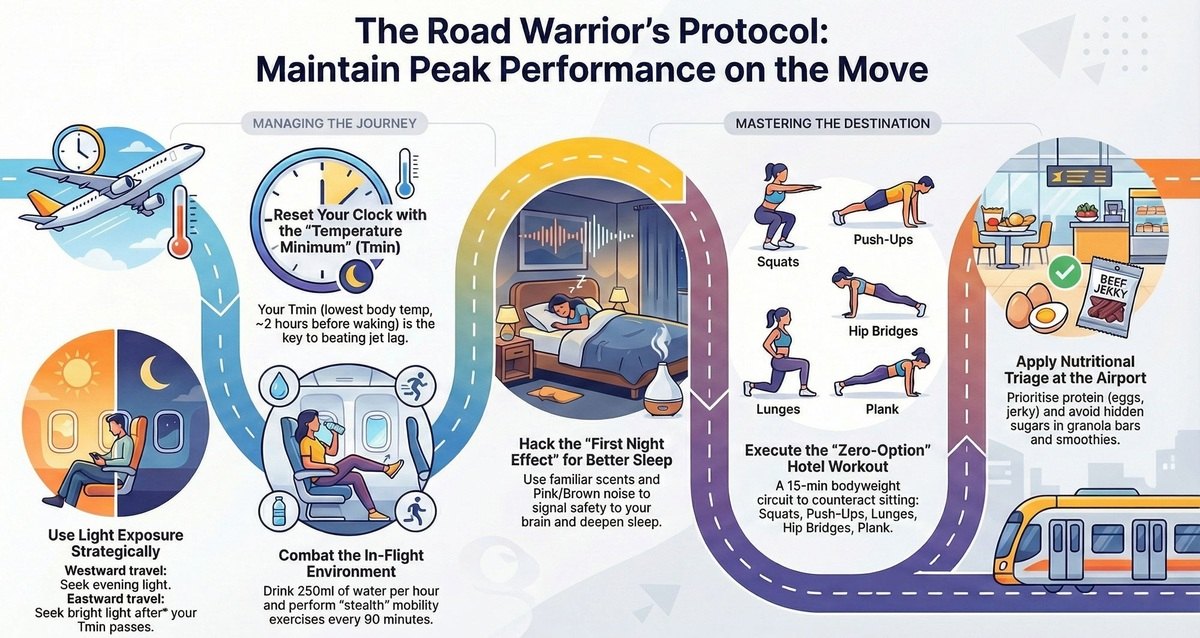
Top 7 Hacks
Master Circadian Engineering
Manage light exposure relative to your Temperature Minimum (Tmin) to shift your internal clock.

Have a specific performance goal in mind?
Get direct feedback on your training targets right here on the page—no sign-up or account required. Try asking Raye: 'How should I adjust my weekly mileage for a sub-20 minute 5K?' Ask about your goals
Hack the "First Night Effect"
Bring a familiar scent (Olfactory Anchoring) to trick the limbic system into recognising safety.
The "Zero-Option" Protocol
Use a 15-minute structural flush circuit to wake up the posterior chain when gyms fail.
Unconventional Resistance
Use your luggage for Suitcase Farmer's Walks to target grip and core stability.
In-Flight "Stealth" Mobility
Execute seated twists and calf pumps every 90 minutes to prevent DVT.
Nutritional Triage
Prioritise hard-boiled eggs and nuts. Avoid sugar-laden "healthy" granola bars.
Hydration Logistics
Drink one glass of water for every alcoholic beverage. Electrolytes are mandatory.
1. Master Circadian Engineering (The "Temperature Minimum")
The most profound disruptor of performance is the misalignment between your internal clock and the external environment. Most travellers rely on caffeine and willpower to fight jet lag. A strategic athlete relies on the "Temperature Minimum" (Tmin).
Your body's core temperature fluctuates in a predictable wave over a 24-hour cycle. Your Tmin represents the lowest point of this cycle, typically occurring two hours before your average wake-up time. If you usually wake at 07:00, your Tmin is roughly 05:00. This marker is the fulcrum for shifting your circadian clock.
The Protocol: The "Phase Response Curve" dictates that light exposure has opposite effects depending on when it occurs relative to your Tmin.
-
To Delay Your Clock (Westward Travel): You need to push your day later. Seek bright light in the evening of the new time zone and avoid it in the early morning.
-
To Advance Your Clock (Eastward Travel): You need to start your day earlier. This is the more difficult shift. You must avoid light before your Tmin (which might be mid-morning in your new location) and seek bright light immediately after your Tmin passes.
Implementation: If you fly East (e.g., New York to London) and land at 10:00 AM, your body thinks it is 05:00 AM (your Tmin). Exposing yourself to bright light immediately will push your clock backward, not forward. You must wear sunglasses and block light until your Tmin has passed (around 12:00 PM or 1:00 PM London time). It is not about toughness; it is about manipulating the suprachiasmatic nucleus to realign your biology.
2. Hack the "First Night Effect"
Even with perfect circadian management, travellers often suffer from the "First Night Effect" (FNE). This is a documented physiological phenomenon where one hemisphere of the brain (typically the left) remains partially alert during slow-wave sleep in a new environment-an evolutionary defence mechanism to monitor for threats. The result is fragmented sleep and reduced recovery.
You cannot eliminate FNE, but you can dampen the vigilance response by reducing the "novelty" signal to the brain.
Olfactory Anchoring: The olfactory bulb has direct neural links to the limbic system, which regulates emotion and safety processing. Bring a familiar scent from home-a specific pillow mist, a small travel candle, or even a t-shirt you have slept in. This "tricks" the limbic system into recognising the hotel environment as familiar territory, lowering the threat response.
Acoustic Engineering: Hotel rooms are rarely silent. Intermittent noises trigger the vigilant brain hemisphere. Silence is often insufficient; you need "coloured" noise.
-
Pink Noise: Mimics natural sounds like steady rain. It has been shown to enhance deep sleep and memory consolidation.
-
Brown Noise: A deeper rumble (like a heavy waterfall) which many analytical minds find superior for quieting the "racing mind" associated with travel hyper-vigilance. Use an app to generate this soundscape rather than relying on the inconsistent hum of an air conditioning unit.
3. The "Zero-Option" Hotel Room Protocol
The most common error is assuming a hotel gym is necessary for maintenance. Often, these facilities are under-equipped or closed. The "Zero-Option" protocol ensures you can generate a metabolic signal in a confined space without equipment.
The goal here is not hypertrophy; it is structural balance. Sitting shortens the hip flexors, deactivates the glutes (gluteal amnesia), and stiffens the thoracic spine. Your workout must counteract the specific shape of travel.
The 15-Minute Structural Flush: Perform this circuit with minimal rest. It is designed to wake up the posterior chain and flush cortisol.
-
Bodyweight Squats (20 reps): Focus on full depth to engage the glutes.
-
Incline Push-Ups (15 reps): Hands on a desk. Focus on core stability.
-
Reverse Lunges (10 reps per leg): Opens the tight hip flexors dynamically.
-
Single-Leg Hip Bridges (12 reps per side): Lie on the floor, drive one heel down. This is critical for reactivating glutes that have been dormant during a flight.
-
Plank (45 seconds): Anti-extension core stability to protect the lower back.
Repeat for 3-4 rounds. This is the "Minimum Effective Dose." It signals to your body that demand is still present, regulating insulin sensitivity before you head to dinner.
4. Unconventional Resistance: The Suitcase Carry
If you require higher resistance and the gym is unavailable, your luggage is a valid tool. A fully packed carry-on can weigh between 10kg and 15kg, providing sufficient load for maintenance resistance training.
The Suitcase Farmer's Walk: Hold the suitcase in one hand while walking the length of your hotel room or hallway. This exercises "anti-lateral flexion." Your obliques must fire aggressively to keep your spine vertical against the offset load. It targets grip strength, shoulder stability, and the quadratus lumborum (lower back). Ensure your spine remains perfectly vertical-do not lean toward or away from the weight.
The Suitcase Row: Use the bag as a dumbbell for single-arm bent-over rows (using the bed for support). This targets the scapular retractors, directly counteracting the "hunch" of laptop work and economy seating.
Note: Luggage handles are designed for static carrying, not dynamic torque. avoid explosive movements like swings. Lift smoothly and with control.
5. In-Flight "Stealth" Mobility
Deep Vein Thrombosis (DVT) and stiffness are risks of the "sedentary confined" model of travel. You must move, but you do not need to be conspicuous. Execute "stealth" mobility work every 90 minutes.
-
Seated Spinal Twist: Anchor your left hand on your right knee or armrest to rotate the thoracic spine. Hold for 30 seconds to hydrate the intervertebral discs.
-
The Pump Mechanism: Perform seated calf raises and ankle circles. This activates the "muscle pump" of the lower leg, assisting venous return to the heart and reducing oedema (swelling).
-
Neck Decompression: Gently drop the ear to the shoulder to stretch the upper trapezius.
Post-Flight: The Viper: Upon arrival at your hotel, perform "Legs Up the Wall" (Viparita Karani). Lie on the floor with your legs elevated against the wall for 10 minutes. This facilitates venous drainage, reduces swelling in the feet, and activates the parasympathetic nervous system, signalling the body to transition from "travel mode" to "recovery mode."
6. Nutritional Triage: The Airport & Fast Food
Nutritional discipline is often the first casualty of business travel. The solution is not deprivation; it is logical selection. We apply a "Triage" system to airport and fast-food dining.
Airport Foraging (Hudson News/WHSmith):
-
Tier 1 (Optimal): Hard-boiled eggs (often sold in twin packs) provide high-quality protein and choline. Nuts (pistachios or almonds) provide healthy fats; choose shell-on pistachios to slow consumption.
-
Tier 2 (Acceptable): Beef or Turkey jerky. Critical Data Point: Check the ingredients. Ensure sugar is not in the top three ingredients.
-
Tier 3 (Avoid): "Healthy" looking granola bars (often sugar bombs), dried fruit (calorically dense), and pre-made smoothies.
The Fast Food Protocol: Sometimes, a chain restaurant is the only option.
-
McDonald's: The Egg McMuffin is surprisingly balanced (310 calories, 17g protein). For lunch, a Double Cheeseburger (bun removed or eaten open-faced) provides a high protein-to-calorie ratio. Always swap fries for apple slices to reduce inflammatory seed oil intake.
-
Asian Chains (e.g., Panda Express): Look for "Wok Smart" options. The String Bean Chicken Breast or Broccoli Beef are high-protein, moderate-fat choices. The critical move is to swap the rice/noodles for "Super Greens" (mixed vegetables). This saves hundreds of calories and stabilises blood sugar.
-
The Steakhouse Rule: Business dinners are high-risk. The safest strategy is the steakhouse. A fillet steak or salmon fillet with spinach is a nutrient-dense, high-performance meal. The danger lies in the bread basket and heavy sides. Skip the bread entirely to avoid the glucose spike and subsequent energy crash.
7. Hydration Logistics and the "One-to-One" Rule
Air travel is inherently dehydrating. Cabin humidity sits at 10-20%, drier than the Sahara Desert. This accelerates insensible water loss through respiration.
The Hydration Metric: You lose approximately 1 litre of water for every 4-5 hours of flight. Aim for 200-300 mL per hour of flight. Water alone is often insufficient; pack electrolyte tablets to retain fluid and support neurological function.
Alcohol as a Toxin: Alcohol disrupts REM sleep and suppresses Heart Rate Variability (HRV). For the high-performer, it is a depressant, not a reward. If social capital demands a drink, adopt the "One-to-One" protocol: one glass of water for every alcoholic beverage. Ideally, stick to clear spirits or dry wines and avoid sugar-laden cocktails. View alcohol as a toxin you must budget for, rather than a treat you deserve.
The Long Game
Consistency is the only metric that matters. One perfect week at home does not offset three weeks of neglect on the road.
The Road Warrior Protocol is about the aggregation of marginal gains. It is about understanding that pain is data, not drama. By controlling the variables of light, movement, and nutrition, you shift from a state of survival to a state of high performance.
Do not seek to destroy yourself in the hotel gym; seek to maintain the machine so it continues to serve you. Adjust, execute, and keep moving.
The Sundried Roundup
You have the strategy; now you need the application. Here is how to scale the Road Warrior Protocol to fit your resources and schedule.
What are the pros doing?
The elite bracket does not rely on "feeling" fit; they rely on data. Professional athletes travelling for competition utilise biometric tracking (HRV rings, sleep trackers) to quantify their recovery status. They do not guess if they are jet-lagged; they look at their resting heart rate and temperature deviation. They view travel as a "recovery deficit" that must be paid back with precise sleep hygiene and hydration before high-intensity training resumes.
How can I build this into my life?
Stop viewing travel fitness as a separate entity from your home routine. Integration requires "Non-Negotiable Anchors." Choose two behaviours that happen regardless of your location or schedule. For example: "I never consume alcohol on flights" and "I always perform 10 minutes of mobility upon arrival." Systems survive where willpower fails. Establish the protocol once, and execute it automatically.
The Bootstrapper's Protocol (Budget)
You do not need capital to maintain the machine; you need discipline.
-
Gear: None. Utilise gravity. The floor is your gym.
-
Nutrition: Fasting. It is free and often superior to eating low-quality airport food.
-
Recovery: Cold showers (contrast therapy) and manual self-massage using a tennis ball in the hotel room.
-
Strategy: Your focus is on subtraction (removing junk food, alcohol, and late nights) rather than the addition of expensive supplements.
The Balanced Executive (Mid-Range)
I am serious, but I am not hiring a sleep coach.
-
Gear: A set of resistance bands and a high-quality skipping rope. These fit in a carry-on and replicate gym intensity.
-
Nutrition: Buying high-quality protein snacks (jerky, whey sachets) and electrolyte tablets.
-
Recovery: A subscription to a noise-generation app (for Brown Noise) and a good eye mask.
-
Strategy: You invest in tools that remove friction. You buy the healthy salad at the airport rather than packing one, trading money for convenience.
The "All-In" Asset Management (Premium)
I want to throw everything at this to maximise performance.
-
Gear: Noise-cancelling headphones are mandatory. Portable pneumatic compression boots (for circulation).
-
Tech: A subscription to the Timeshifter app for precise light-exposure schedules. Wearable tech (Whoop/Oura) to dictate training intensity based on recovery scores.
-
Nutrition: Pre-ordered meal delivery to the hotel to avoid room service entirely. High-end supplement stack (Magnesium L-Threonate, Apigenin).
-
Strategy: You outsource decision-making. The app tells you when to sleep; the data tells you how hard to train.
Pushed for time? How can I keep up?
If you have zero margin, you must rely on the "Micro-Dose." You do not need a 45-minute block. You need three 5-minute blocks dispersed throughout the day. 50 air squats before the shower; 2 minutes of stretching while the coffee brews; a 10-minute brisk walk between meetings. Keep the metabolic fire burning with kindling rather than logs.
I have 3 hours a week. What can I do?
Three hours is plenty for maintenance if the intensity is sufficient.
-
The Split: Three 60-minute sessions or four 45-minute sessions.
-
The Focus: Compound movements only. If you are in a hotel gym: Dumbbell Thrusters, Renegade Rows, Goblet Squats.
-
The Logic: Do not waste time on isolation exercises (bicep curls). You need movements that recruit the maximum amount of muscle tissue per second. If you cannot get to a gym, execute three high-intensity bodyweight circuits in your room.
I can fit in training 7 days a week. How can I maximise this?
Caution: Just because you can train 7 days does not mean you should, especially while travelling. Travel is a stressor. Adding 7 days of high-intensity training is a recipe for burnout and injury.
-
The Strategy: Polarised Training.
-
Hard Days (3 days): High-intensity resistance or interval training.
-
Soft Days (4 days): Active recovery. Long walks, yoga flows, swimming, or dedicated mobility work.
-
The Goal: Use the "Soft Days" to support the "Hard Days." If you treat every day as a test day, you will fail the long game.
Top 10 Tips
Respect the Tmin
Manage light exposure based on your body temperature minimum, not the clock on the wall.
Hydrate by Metric
250ml of water for every hour in the air. No exceptions.
Protein First
Anchor every meal around protein to maintain satiety and lean mass.
Mobility Over Vanity
Prioritise hip and thoracic spine mobility over bicep curls.
The One-to-One Rule
One glass of water for every alcoholic beverage.
Create a Sanctuary
Optimise your hotel room for sleep (temperature, light, noise) immediately upon arrival.
Pack "Must-Haves"
Resistance bands and electrolytes should live in your carry-on permanently.
Don't Rely on Gyms
Have a "Zero-Option" bodyweight workout ready for when facilities fail.
Fast to Reset
Use strategic fasting to reset your circadian rhythm and avoid inflammatory plane food.
Pain is Data
Listen to your body. If your HRV is low, stretch; don't sprint. Keep the long game in mind.


