

Automated Fueling Alerts: The Future of Precision Endurance Nutrition


Need performance advice right now?
Ask our on-site coach anything about your routines. It's completely free and available immediately right here: 'What are 3 quick exercises for ankle mobility?' Ask Raye for free
What are the press saying?
Industry analysts and sports scientists are unanimous: the era of guessing your nutrition strategy is over. Leading cycling publications have praised the integration of power meter data with real-time metabolic algorithms, describing it as the 'holy grail' of performance optimisation. Critics note that while athletes have long relied on interval timers, the shift toward dynamic, telemetry-based alerts marks a significant leap forward in endurance management.
By linking bike computer telemetry to physiological expenditure, these systems provide a bespoke fueling roadmap. Reporters note that professional teams are already leveraging these tools to eliminate the guesswork that often leads to the dreaded 'bonk' during long-distance racing. The consensus suggests that this technology is not merely a luxury but an essential component for competitive cyclists and endurance runners who prioritise marginal gains.
Comfort & Fit
While the software operates in the digital realm, the physical interface is crucial. A bike computer must be mounted centrally, ensuring the screen is easily readable without breaking the rider's aerodynamic tuck. Modern mounts are designed for stability, minimising vibration so that alerts remain clear even on rough road surfaces.
Equally important is the integration with apparel. Frame bags and jersey pockets must be organised to allow for rapid access to nutrition. When the computer signals that it is time to consume 30 grams of carbohydrates, there is no room for fiddling with awkward packaging. Optimised cycling kits now feature accessible storage that mirrors the urgency of the digital notification.
Features to Look out For
When selecting a head unit, prioritise devices that support real-time data fields linked to power output ($kJ$). A high-quality unit should calculate caloric expenditure dynamically, rather than relying on static averages. Look for customisable alert thresholds that adjust based on heart rate stress, as higher intensity efforts require faster glycogen replenishment.
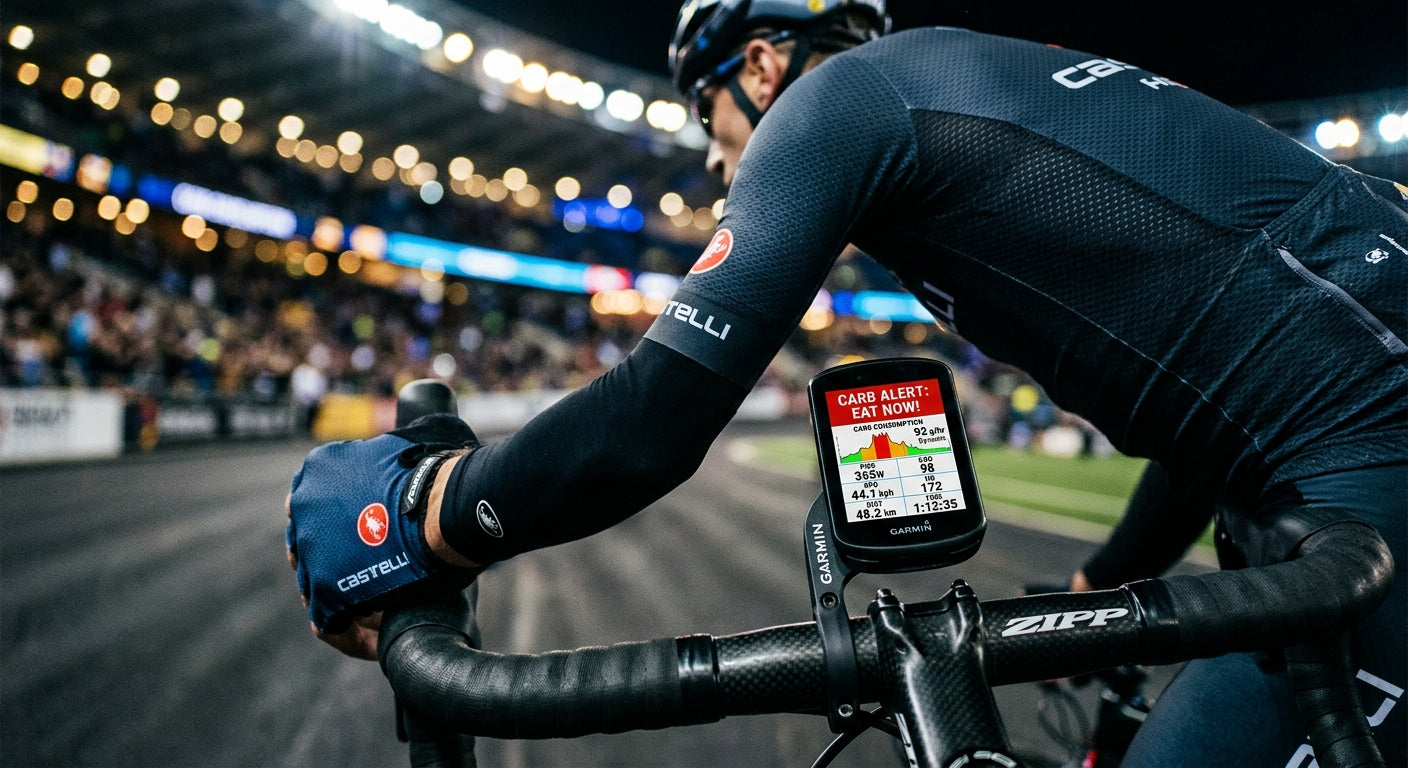
Connectivity is another pillar of success. Your device should seamlessly sync with smart bottles and hydration systems if you are using integrated sensors. Furthermore, ensure the display is high-contrast, allowing for instant recognition of fueling prompts during high-speed descents or intense sprint efforts in bright sunlight.
Evolution and History
Historically, athletes relied on 'eat every 45 minutes' mantras, a blunt tool that failed to account for varying intensity. The evolution of power meters changed the landscape, allowing riders to measure work done in kilojoules. However, the data remained siloed until recently.

Need a clear race fuelling strategy?
Get instant, practical advice on hydration and race-day nutrition directly on this page for free. Try asking Raye: 'How many grams of carbs should I take per hour during a half marathon?' Ask for fuelling advice
The current generation of hardware has bridged this gap. By mapping kilojoules to metabolic cost, engineers have created a feedback loop that responds to the athlete's actual exertion. This shift from static timing to dynamic telemetry represents a fundamental change in how we approach endurance sports, moving away from intuition toward empirical precision.
What to Expect in the future?
The future of fueling alerts lies in biometric integration. We anticipate the arrival of continuous glucose monitoring (CGM) sensors that link directly to bike computers, providing real-time blood sugar feedback. This will allow for hyper-personalised nutrition, where the computer alerts the rider not just on expenditure, but on actual physiological state.

Furthermore, machine learning algorithms will likely predict fatigue before it occurs. By analysing historical data and current power profiles, these systems will suggest when to increase hydration intake to stave off cramping, effectively turning the bike computer into a virtual coach.
Special Features & Technical Specifications
Material Composition and Engineering
Modern bike computers utilise high-impact polycarbonate housing with scratch-resistant gorilla glass displays. The internal processors have been upgraded to handle complex telemetry algorithms with zero latency, ensuring that power-to-calorie calculations are updated every second.
Physical Dimensions and Weight
The standard race-ready head unit maintains a slim profile, typically measuring 50mm x 80mm with a depth of 15mm. Weight has been stripped down to a mere 70-80 grams, ensuring that aerodynamic performance remains uncompromised even on the steepest climbs.
Generational Advancements
Compared to previous iterations, the latest hardware features a 30% increase in battery life, essential for ultra-endurance events. The transition to dual-frequency GNSS tracking ensures that data remains accurate even in dense urban environments or deep valleys, providing a reliable foundation for all metabolic calculations.


