

Mental Resilience Hacks for Training


Trying to beat your local Strava segment goals?
Fine-tune your training strategies to hit your target stats without downloading another app. Try asking Raye: 'How can I structure hill repeats to build short-segment power?' Ask how to hit your target
The athletes guide to bio-hacking mental resilience.
To be honest the old School way of training has long since disappeared. When I was growing up, it was all about having a big Arnold Schwarzenegger poster on the wall and reading articles about how to get big arms. Weight training split up, where you have physical conditioning in one corner and mental conditioning along with your thoughts in another. Maybe nutrition in the third and maybe even a gentle nod towards Sports psychology tucked out the back. That model is pretty obsolete and if you look at any high performing athlete in a professional space you know that they treat the Sports psychology side of their training like they do the physical side.
Looking forward to the New Year 2026 and beyond, it's time to look at integrated performance. This is aimed at high-performance people who may be running a business managing staff commuting to London. Your time is just as valuable as your VO2 max. You don't have the luxury to separate out all the aspects into separate camps. You need to integrate and blend in brain power, your body and system control and your physical grit. Everything needs to join the same camp.

No pain, no gain type of training mentality that implies brute force will get you through your session and let you hit your goals. But the reality is you're probably already working over 60 hours a week. You've got kids you've got outside work commitments you've got to keep your clients happy. The last thing you want to do is add more stress to your week with the no pain no gain mentality. True longevity comes from having psychological flexibility that gives you the ability to handle high stress environments without losing your head.
Do you have to stop looking at yourself as a project that you can start with a beginning, middle and an end? It's not a project that you're going to finish. This isn't about motivation. Motivation is a feeling that comes and goes. You need a strategy for your mental fitness that keeps you performing at peak and it needs to perform and deliver. Until your body one day gives up
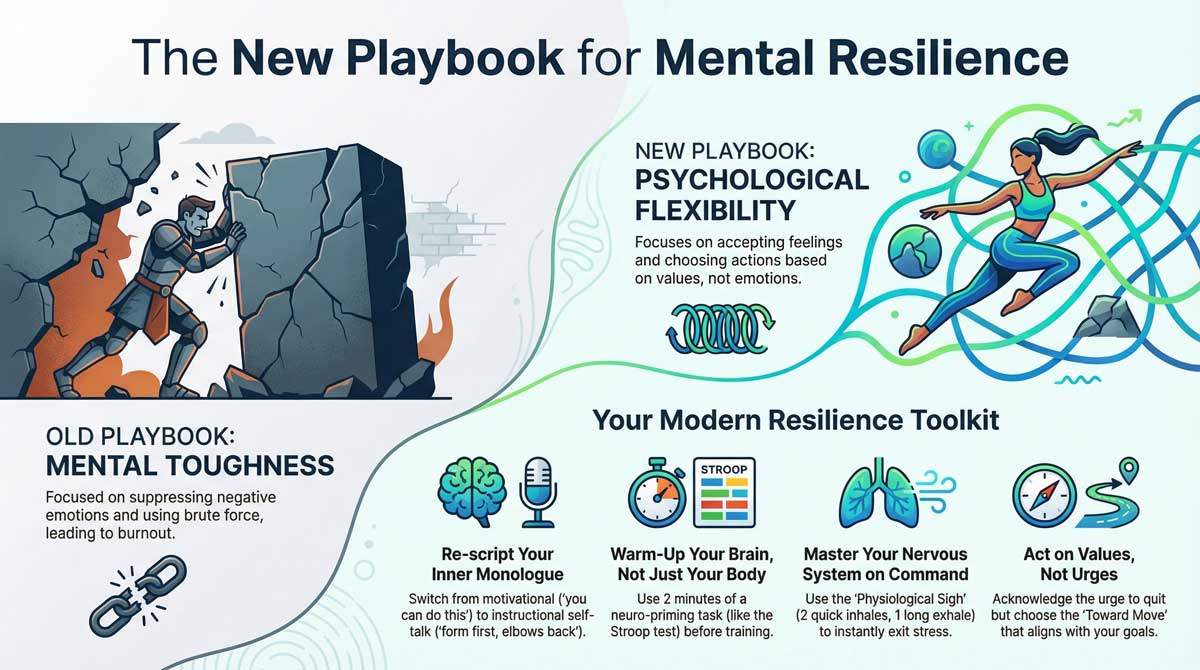
Beyond toughness: the rise of psychological flexibility
Historically training was all about mental toughness. It meant you had to bury your negative emotions and bury them with the pain that your body is going through. Yes this might give you a short-term personal best but it's a strategy that is pointing towards burnout and fatigue.

Hit a wall with form, pacing, or fatigue?
Skip searching forums. Chat directly on this page with our performance coach to solve training issues in seconds: 'How do I prevent side stitches on long runs?' Troubleshoot your run
If you or anyone you know suffers from anxiety, then think about the feeling of feeling anxious, the racing heart, the butterflies. These feelings are nearly identical to the feelings of excitement. To be a resilient athlete, you shouldn't waste energy trying to eliminate that anxiety. Accept the sensation rather than trying to fight it. When you expend energy trying to fight negative thoughts time thinking I'm too tired to do this, you're creating a second workload to your day. You're effectively fighting yourself rather than your structured workout plan
The science of instructional self-talk.
So if you want to know how to actually do this and improve your mental resilience, it comes down to something that's called cognitive reframing. It doesn't mean that you have to look on the bright side. It's a structured restructuring of your internal narrative.
You need to know the difference between two types of internal monologue.
The motivational self talk is things along the lines of keep pushing it you can do this one more
Instructional self talk. Elbows back, smooth rhythm, cadence up.
If you are an analytical athlete, instructional self talk is vastly superior. It's going to direct your mindset towards technical cues and at the same time it's going to bypass the emotional sense of the brain engaging the motor cortex directly. It's like having your own personal calming project manager in one ear rather than a hysterical cheerleader
Instead of vague encouragement, prepare your script as situational alternatives.
The fatigue trigger. Instead of thinking, 'don't stop' switching to 'form first' this is going to shift focus from the internal pain to the external process.
The trigger. If you miss a split time, then you can use things called reset cues. A simple word like Next will help sever the emotional link to the past event and anchor you back into the present.
The third wave approach. Actions over emotion
There is a massive shift towards acceptance and commitment therapy known as ACT. ACT suggests that by trying to suppress thoughts it often makes them louder.
The ACT involves mapping your actions into two categories.
Away Moves and Towards Moves
Away moves. These are actions you take to avoid difficult feelings. A difficult feeling may be quitting a set too early so you avoid the burn or skipping a run session because it's raining outside.
The Toward moves. These actions you take will move you towards your values and goals. E.g. finishing the rep despite how tired you feel, or training or whatever the weather.
The goal is definitely not trying to eliminate the urge to quit because that urge is natural and we are all going to feel it. The goal is to notice when the urge starts to arise and choose to move regardless. This will help build a capacity to act independently of how you actually feel. And that is then building your resilience.

Neuro Priming. Training your brain as a muscle.
Some people say that we are moving towards removing the line between a physical warmup and a mental warmup. The cutting-edge performance is neuro cognitive conditioning. This involves neuro priming.
What it means is you need to wake up the motor cortex before you train. The science tells us that neuro priming can improve your physical performance by reducing the rate of your central fatigue. And central fatigue is basically your brain trying to put on the handbrake to prevent damage to yourself. Basically by keeping the brain in a state of high excitability you are keeping the handbrake off letting the wheels run.
The strategy is brain endurance training known as BET.
The Stroop warm-up. This is said to be a highly effective and equipment free method of training. Involves identifying the colour of a word with the text differs from the colour. So when you see the word red but it is written in blue ink. Apparently doing this for just two minutes before a run or bike ride will prime your impulse control and decision-making. This is something I'm gonna be testing out for the next few weeks and I'll report back.
Dual-Tasking: during easier long runs or indoor training sessions Dual tasking as you engage in verbal fluency tasks. This is things like naming as many animals as you can in a 30 second period or counting backwards in sevens from 100 or even saying the alphabet backwards. It will force your body to rely on automatic pathways for movement and improve your efficiency.
Somatic regulation. Mastering your nervous system.
The so-called mental game isn't just in your head. It is stored in your nervous system. To have what we know as resilience will require you to regulate your autonomic nervous system ANS, specifically shifting between fight and flight or rest and digest on command
The psychological sigh. This is to rapidly exit a stress spike. If you've taken part in a race or you're about to give a big speech the pre-race nerves can be combatted with a psychological sigh.
The technique to engage the psychological sigh. Take two quick inhales through the nose, use the 1st to fill the lungs and the 2nd to top them off. Follow this by a long extended exhale through the mouth.
Why does this work? This mechanically offloads carbon dioxide and signals safety to your brain stem and it resets your baseline instantly.
Somatic shaking. Animals naturally will shake off trauma after a threat. Humans are conditioned to be composed in the Office, and you're gonna suppress this trapping tension in your body.
The technique you can do for somatic shaking. Post training stand with your knees soft and gently bounce on your heels. Allow the vibration to travel up through your legs for two minutes. This will disengage residual energy and accelerate recovery. When I've tried this, I have found keeping the balls of your feet on the floor to avoid unnecessary crunching at the knees.
The Physiology of Resilience: Nutrition and Biohacking
Your brain is an organ with high fuel demands. Its ability to withstand stress is directly correlated with its supply.
The Cognitive Stack
-
Adaptogens: Herbs like Ashwagandha have robust backing for their ability to lower cortisol, acting as a buffer against the stress of heavy training volumes.
-
Ketone Esters: These are becoming a secret weapon for mental endurance. They provide a "clean" fuel for the brain, bypassing the ups and downs of sugar. This is particularly effective for preventing "brain fog" during long endurance events.
The Sleep Bank Sleep deprivation degrades accuracy and emotional stability faster than it degrades physical strength. A strategy for the busy professional is Sleep Banking-extending sleep duration in the weeks leading up to a heavy training block or travel to build a resilience buffer.
When sleep is disrupted, utilise Non-Sleep Deep Rest (NSDR) protocols, such as Yoga Nidra. A 20-minute NSDR session can replenish dopamine levels and reduce cortisol, serving as a "system reboot" during a busy day.

Periodisation: The Mental Game Plan
Just as you plan your physical training, you must plan your mental protocols. Treat it like your professional CV-have your objectives written out.
-
General Prep (Off-Season): Focus on acquisition. Learn the breathwork techniques and map your ACT Matrix.
-
Specific Prep (Pre-Season): Integration. Use neuro-priming during warm-ups and practice instructional self-talk during key sessions.
-
Competition Phase: Execution. Do not try new psychological tricks. Rely on your "Reset" cues and established routines.
Conclusion: The Anti-Fragile Athlete
The definition of the elite athlete has expanded. It now includes mastery of the internal environment.
Resilience is not merely bouncing back to baseline; it is getting stronger because of the stressor. By integrating neuro-priming, somatic regulation, and value-driven psychology, you build a system that thrives under the chaotic demands of modern life and sport. The tools are here; the challenge now is integration.
The Sundried Roundup
What are the pros doing? The elite are moving away from "positive thinking" toward Acceptance and Commitment Therapy (ACT) and Neuro-Priming. They aren't trying to feel good; they are training to perform regardless of how they feel. They are also heavy adopters of data-driven recovery, tracking HRV (Heart Rate Variability) to guide their training intensity.
How can I build this into my life? Use Habit Stacking. Anchor a new mental habit to an existing physical one.
-
Before you put on your running shoes: Do 2 minutes of the Stroop task (there are free apps for this).
-
During your warm-up: Practice your instructional self-talk cues.
-
In the shower after training: Finish with 30 seconds of cold water to spike dopamine.
The budget approach? Breathwork and Somatics are free. Mastering the Physiological Sigh for stress reduction and Box Breathing for focus costs nothing but attention. Somatic shaking post-run is also a zero-cost tool that drastically improves recovery by down-regulating the nervous system.
Middle of the road approach, I am serious but not all in yet? Invest in a quality Adaptogen supplement (like Ashwagandha) to help manage cortisol levels. Combine this with a structured training plan that includes Dual-Task drills-simply doing mental math while on your turbo trainer or treadmill creates a massive cognitive benefit.
Pushed for time, how can I keep up? Focus on NSDR (Non-Sleep Deep Rest). If you can't get 8 hours of sleep because of work deadlines, a 20-minute Yoga Nidra track (widely available online) can mimic the restorative effects of slow-wave sleep. It is the most time-efficient recovery tool available.
I have 3 hours a week, what can I do? Prioritise Brain Endurance Training (BET). If you have limited time, make every minute count by increasing the cognitive load. A 30-minute run where you are actively engaging in reaction drills or maintaining a specific, complex cadence structure is worth 60 minutes of "zoning out." Quality over quantity.
I can fit in training 7 days a week. How can I maximise this? If you have the volume, you must prioritise Periodisation. You cannot be in a high-arousal state 7 days a week. Dedicate at least two sessions purely to Parasympathetic Recovery-low intensity, nose-breathing only, focusing on fluidity and relaxation. This prevents the "accumulated fatigue" that leads to burnout.
The premium approach? I want to chuck everything at this. Full integration. Utilise a wearable (Whoop/Oura) to track HRV and sleep stages. Incorporate Ketone Esters for long sessions to fuel the brain. Hire a coach who understands Psychological Flexibility and can help script your instructional self-talk. Use reaction-light training systems (like BlazePod) for your neuro-priming.
Top 10 Hacks
Switch to Instructional Self-Talk
Use technical cues ("Knees up"), not emotional ones ("Don't quit").
Master the Physiological Sigh
Two inhales, one long exhale to reset stress immediately.
Neuro-Prime Before Training
Wake up the brain with 2 minutes of cognitive drills before you move.
Practice Acceptance
Don't fight fatigue; acknowledge it, accept it, and focus on form.
Use the Stroop Task
Train impulse control during your warm-up.
Bank Sleep
Get extra sleep before heavy training blocks or travel.
Shake it Off
Use somatic shaking post-workout to release tension.
Fuel the Brain
Consider Adaptogens and stay hydrated to support cognitive function.
Reset with NSDR
Use 20-minute rest protocols to reboot during busy days.
Focus on the Long Game
Train for longevity and consistency, not just the next race.
Some Q&As Mental Resilience
Q&A: Redefining The Mental Game
How does modern training actually change the concept of "Mental Resilience"?
Let's be honest, the old school idea of resilience was basically "suck it up." It was about brute force-burying your feelings and grinding until you either succeeded or burned out.
Modern training flips that on its head. We don't have the luxury of compartmentalising anymore. You can't put your physical training in one box and your high-stress job in another; your nervous system handles it all as one load.
We define modern resilience as Anti-Fragility. Think of a concrete sea wall. It's tough, sure, but if the waves (stress) get too high, it cracks and collapses. That's the old way. The new way is like a mangrove forest. It lets the water flow through, it bends, and it actually grows stronger the more pressure you put on it. It's not about blocking stress; it's about having the flexibility to handle the chaos-whether that's a tough commute or a heavy deadlift-without losing your head.
What are the practical "Mindset Hacks" I can actually use?
Forget trying to "pump yourself up" in the mirror. Motivation is a feeling, and feelings are unreliable. We want systems. Here are the protocols that actually work when the going gets tough:
-
Swap Cheerleading for Coaching: Stop shouting vague things at yourself like "You can do this!" or "Don't quit!" It's emotional and exhausting. Switch to Instructional Self-Talk. Act like a project manager. Use boring, technical cues like "Elbows back," "Smooth rhythm," or "Chin down." It bypasses the panic button in your brain and gets you back to work.
-
The "Toward Move" (ACT): When your brain screams at you to stop, don't fight it. Acknowledge the feeling ("I really want to quit right now") and then do the rep anyway. That is a "Toward Move"-an action that takes you toward your goal regardless of how you feel in the moment.
-
The Physiological Sigh: If you feel your stress spiking-maybe before a big lift or a big presentation-hit the manual reset button. Two quick inhales through the nose, one long exhale through the mouth. It physically forces your nervous system to calm down.
-
Neuro-Priming: Treat your brain like a muscle. Before you train, do two minutes of a "Stroop task" (a colour-word puzzle app). It wakes up the connection between your brain and body so you aren't asleep at the wheel.
What is the point of "Neuro-Priming"?
Think of your body like a high-performance sports car. If you jump in and floor it immediately, the onboard computer (your brain) panics and leaves the parking brake on to stop you from crashing.
Neuro-priming is simply taking the handbrake off.
By doing a few minutes of cognitive drills before you workout, you are signalling to your brain that you are alert, awake, and ready to go. It reduces "central fatigue"-which is just your brain trying to protect you-and lets you access the physical fitness you actually have, rather than being limited by a sleepy nervous system.
So, what does "Mental Fitness" actually mean?
It means we stop treating the head and the body like two different departments.
For the high-performing individual, Mental Fitness isn't a personality trait you're born with; it's a biological resource you manage. It's like a hybrid engine.
-
Old motivation is a battery-it works for a bit, but eventually, it runs flat.
-
Mental Fitness is the engine that regenerates power while it runs. It has a fuel system (proper nutrition and sleep), a cooling system (breathwork to manage stress), and an autopilot (instructional self-talk).
It's about longevity. It's not a 6-week challenge; it's a strategy to keep you performing at a high level without breaking down.
How is "Mental Toughness Training" different now?
We used to think toughness meant suppression-ignoring the warning lights on the dashboard. But fighting your own anxiety just creates a "second workload." You waste energy fighting yourself that you should be using to lift the weight or run the business.
Modern training focuses on Psychological Flexibility. Instead of being a rigid wall, you become a hydroelectric plant. You don't block the water (stress); you accept the flow and channel it through turbines to generate power. You use the pressure to perform.
It involves:
-
Reframing the narrative: Moving from "I have to survive this" to "I am managing this."
-
Hardware upgrades: Using breathing and "somatic shaking" (literally bouncing on your heels to shake off tension) to reset your nervous system after a stressful event so you don't carry that baggage home to your family.


