

Improving Your Swim Stroke: Catch and Pull Mechanics


Planning your next fitness milestone?
Get immediate guidance on pacing, workout structure, or race prep directly on-site for free. Try asking Raye: 'Can you outline a simple 4-week build plan for a 10K?' Get instant guidance
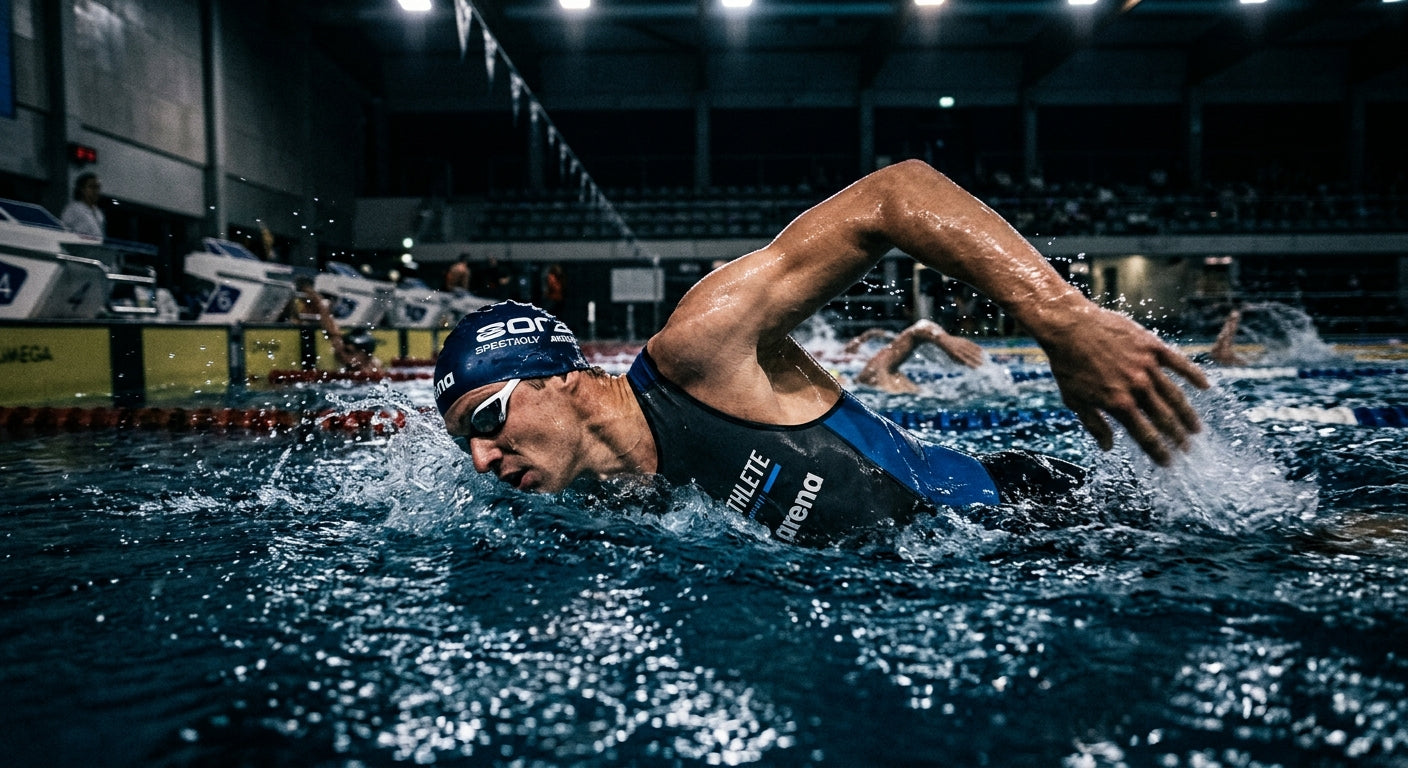
The difference between a recreational swimmer and a competitive triathlete often lies in the efficiency of the underwater pull. While many focus on the flurry of the kick or the speed of the arm recovery, the true engine of swimming performance is found in the catch and pull phase. This is where you anchor your hand in the water and propel your body forward, turning fluid resistance into kinetic energy.
Mastering this phase requires a departure from the instinctual 'windmilling' approach. Instead, it demands a deliberate, mechanical awareness of how your hand, forearm, and shoulder interact with the aquatic environment. By refining these mechanics, you can dramatically increase your distance-per-stroke, allowing you to maintain higher velocities with lower energy expenditure.
How can I start out?
To begin, you must prioritise the 'Early Vertical Forearm' (EVF) position. Many swimmers make the common error of dropping their elbows, which forces the hand to push water towards the surface rather than backwards. Instead, imagine you are reaching over a large barrel. Your fingers should initiate the catch, followed swiftly by your wrist and elbow, creating a flat paddle-like surface that encompasses your entire forearm.
Start your practice with sculling drills. By lying prone in the water and using only your hands and forearms to move yourself forward, you force your body to recognise the pressure of the water against your skin. If you cannot feel the resistance, you are likely slipping through the water rather than gripping it. Focus on keeping your wrists firm and your movements rhythmic.
Once you have developed a sense of 'feel' for the water, transition to catch-up drills. By keeping one arm extended in front of you while the other completes a full stroke, you isolate the mechanics of the catch. This prevents the common tendency to rush the pull and encourages a patient, deliberate anchor point before the drive phase begins.

Tips for Improving
Consistency in form is paramount. Film your stroke from both the side and the front to identify where your arm might be collapsing. Often, the catch is compromised by a head position that is too high or a rotation that is insufficient. Your body rotation should drive the arm into the water, rather than the arm pulling the body.
Incorporate resistance gear, such as paddles or drag socks, into your training sessions to heighten your proprioception. Paddles can be particularly effective when used sparingly, as they force your hand into the optimal position to catch a larger volume of water. However, ensure you do not over-rely on them, as they can mask underlying flaws if used for excessive durations.

Looking to shave time off your personal best?
Get immediate pacing strategies and interval workout ideas directly on-site for free. Try asking Raye: 'What is the best threshold session to help drop my 10K time?' Get instant pacing tips
Focus on the acceleration of your pull. The most efficient strokes are not uniform in speed; they start with a controlled catch and accelerate through the centre of the body until the hand exits at the hip. Think of this as a slingshot effect, where the tension built during the catch is released in a powerful, explosive push phase.
Special Features & Technical Specifications
Material Composition
Modern swim training tools are engineered using high-density, closed-cell ethylene-vinyl acetate (EVA) foam and hydrodynamic silicone polymers. These materials are chosen for their ability to maintain structural integrity under high-pressure water displacement while remaining lightweight enough to prevent shoulder fatigue during long-distance sets.
Physical Dimensions and Engineering
The latest generation of form-correction paddles features an ergonomic 'S-curve' design, measuring 18cm by 15cm. This geometry is a significant evolution from the flat, rigid plates of the previous decade. By mimicking the natural contours of the palm and forearm, these tools encourage a more natural catch, reducing the strain on the rotator cuff while maximising the surface area available to pull water.
Weight and Performance Metrics
Each unit is calibrated to weigh precisely 85 grams, ensuring that the swimmer retains a natural feel for the water's resistance. Compared to previous iterations, the current engineering focus has shifted from simple drag-creation to active flow-guidance, allowing for a 12% increase in propulsion efficiency during the pull phase.
Ultimately, the journey to a more powerful swim is one of patience and technical precision. By treating the water as a solid surface to be leveraged rather than a fluid to be fought, you will unlock new levels of speed. Seek out professional coaching, utilise video analysis, and remain diligent in your drill work to ensure your catch and pull become the most reliable weapons in your triathlon arsenal.


