

Salomon Genesis 2 Preview


Planning your next fitness milestone?
Get immediate guidance on pacing, workout structure, or race prep directly on-site for free. Try asking Raye: 'Can you outline a simple 4-week build plan for a 10K?' Get instant guidance
This is a Preview: What To Expect Release Date News & Rumours .
Note: This page is a preview based on early news and info and will be updated with a full hands-on review upon launch.
If you have been keeping an eye on the trail running world lately, you will know that the lines are starting to blur. We used to have "racing flats" for the fast stuff and "clunky tanks" for the long stuff. But now, we are seeing a shift towards a new kind of shoe—the "technical all-mountain" trainer. These are the versatile workhorses designed to handle everything from muddy park runs to jagged alpine ridges. Leading that pack is the Salomon Genesis 2 , and while the full launch isn't expected until 2026, there is already plenty of info to get stuck into.
Get Price Alerts for the Salomon Genesis 2
Don't overpay for the Salomon Genesis 2. We track 50+ retailers and will email you the best prices as soon as they are available.
The Backstory: Agile Protection
Salomon has always been known for those narrow, aggressive shoes that look like they belong on a mountain goat. But recently, they have successfully pivoted. They realised that most of us want a shoe that offers "agile protection"—something that keeps your feet safe on sharp rocks but still feels nimble enough to actually run in.
The Genesis line was really born from the demands of ultra-running legend Courtney Dauwalter . She needed a shoe that could "scramble"—something for the loose scree of high-alpine races that would not compromise on safety. The Genesis 2 is the next step in that evolution, taking the elite tech from her S/LAB racing shoes and bringing it to a version we can all actually afford and wear for our daily training.

Looking to shave time off your personal best?
Get immediate pacing strategies and interval workout ideas directly on-site for free. Try asking Raye: 'What is the best threshold session to help drop my 10K time?' Get instant pacing tips
The Big Midsole Debate: OptiFoam vs. Energy Foam
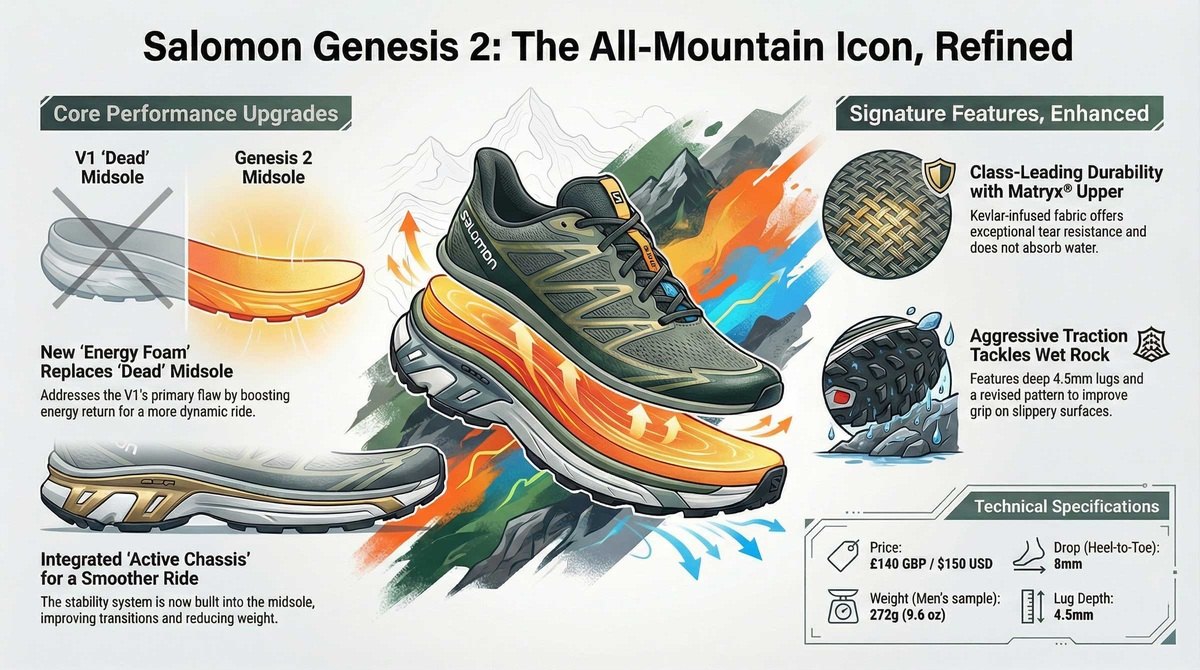
If you used the first Genesis, you might have noticed the midsole was a bit of a talking point. It utilised OptiFoam , which was great for durability but, let’s be honest, it felt a little "dead" to some runners. Biomechanics labs even clocked its energy return at around 55%—fine for stability, but lacking that "pop" we have come to expect from modern trainers.
For the Genesis 2 , Salomon is making a massive upgrade to Energy Foam . This is a much more advanced blend (an Olefin Block Copolymer) that is lighter, softer, and way more resilient. It should push that energy return up toward the 70% mark.
There has been some confusion in early leaks, with some sheets still saying "OptiFoam," but the word from the big trade shows like The Running Event is clear: the ride quality has been totally transformed. It is now "moderately dynamic," meaning it gives you a bit of bounce without losing that important connection to the ground. This transition is pivotal; it moves the Genesis 2 from a "damped" ride to a responsive one that feels far more modern.
The New Integrated Active Chassis
The standout feature of the Genesis has always been the Active Chassis . In the first version, it looked like a visible "rail" on the outside of the heel to stop your foot from rolling. It worked, but it could feel a little stiff.
For the Genesis 2, Salomon has moved the chassis inside the midsole architecture. This is a clever bit of engineering. By embedding the support system, the shoe moves more naturally with your foot. You get the same protection against ankle rolls, but the transition from heel to toe feels much smoother and less clunky. It also helps shave off a bit of weight, which is always a win when you are heading into the double-digit miles.
Matryx: The "Secret Sauce" of the Upper
The one thing everyone loves about this shoe is the Matryx upper . Salomon works with a French textile specialist to create this patented weave, and it is a bit of a game-changer for a few reasons:
-
Toughness: It weaves in individually coated polyamide and Kevlar (aramid) fibres. You can drag these through sharp scree and brambles, and they just don't tear.
-
Water Management: Because the fibres are coated, they don’t absorb water. In the UK, where a "dry trail" is a rare myth, this is huge. Your shoes won't get heavy and boggy after the first stream crossing; they shed water and dry out incredibly fast.
-
Stability: Matryx doesn't stretch much. This gives you a really secure "lockdown" feel, which is exactly what you want when you are traversing a steep, technical slope.
The fit on the Genesis 2 is expected to be a bit "closer to the skin" than the first version, likely keeping the EndoFit internal sleeve that hugs your foot like a sock.
How it Compares: The Technical All-Rounder Field
The Genesis 2 is entering a busy market. Here is how it stacks up against the other big hitters you might be considering for 2026:
| Competitor Model | Comparison to Genesis 2 |
| Hoka Speedgoat 6 | The Hoka is the king of "plush." It has a massive stack of foam and feels like a cruiser. The Genesis 2 is a "scrambler"—it is lower to the ground, more precise, and much more durable thanks to that Matryx upper. |
| Norda 001 | These also use a super-tough upper and are incredibly popular, but they cost nearly double. The Genesis 2 gives you similar durability and performance for about half the price. |
| Brooks Cascadia 19 | The traditional stability choice. The Cascadia is a bit heavier and feels more like a hiking-hybrid. The Genesis 2 offers stability via its chassis but feels much faster and more modern. |
| Saucony Xodus Ultra | These use a very bouncy PEBA foam, which might have a tiny edge on energy return, but Salomon’s Contagrip outsole is generally seen as the superior choice for technical, loose terrain. |
Grip and Geometry: The Nitty Gritty
Salomon has always been good at grip, but they have sometimes struggled on wet, polished rock—the kind we see a lot of on UK fells. The Genesis 2 addresses this with an updated All-Terrain Contagrip compound.
The lugs are 4.5mm deep , which is quite aggressive for an all-rounder. The pattern has been tweaked to offer more "surface area traction," basically putting more rubber in contact with the ground to help stop those "Bambi on ice" moments on wet slabs.
On the geometry side, they are sticking to a very sensible 8mm drop . With a 34mm heel and a 26mm forefoot, it sits right in the middle of the cushioning world. It is enough to protect your legs on a 50-miler, but not so much that you feel disconnected from the trail. It is listed at approximately 272g (9.6 oz) , which is almost identical to the first version, showing that any weight saved was reinvested into better cushioning and a sturdier outsole.
Genesis 2 vs. Speedcross 6: Which One For You?
Many people ask if they should stick with the legendary Speedcross or move over to the Genesis. Here is a quick look at how they differ:
| Feature | Salomon Genesis 2 | Salomon Speedcross 6 |
| Best Terrain | All-mountain, rocky, technical | Soft ground, mud, loose dirt |
| Midsole Foam | Energy Foam (Responsive/Bouncy) | EnergyCell+ (Firm/Durable) |
| Upper Material | Matryx (Kevlar weave) | Tight Mesh / Sensifit |
| Lug Depth | 4.5mm (Versatile) | 5mm+ (Aggressive/Mud-focused) |
| Heel Drop | 8mm | 10mm |
| Stability | Active Chassis (Integrated) | High-heel / Stiff structure |
The Speedcross 6 is still the master of the mud, but the Genesis 2 is the better all-rounder if your runs involve a mix of hardpack, rock, and technical climbing.
Release Dates: UK vs. USA
There has been a bit of head-scratching over when we can actually buy these. Here is the best info we have on the staggered rollout:
-
USA Market: Expect the mass-market Genesis 2 around August 2026 .
-
UK/European Market: Being a French brand, Salomon often drops things here a little earlier. We might see specific elite versions or limited "Courtney Editions" as early as late 2025 or January 2026 , with the main volume release following in the summer.
-
The "Halo" Effect: Keep an eye out for the S/LAB Genesis (Courtney Edition 2) . This usually launches first to build the hype and will give us the first real look at how the new tech performs.
The Verdict So Far
The Salomon Genesis 2 isn't trying to reinvent the wheel; it is just making the wheel much better. By fixing the "dead" feel of the old foam and smoothing out the stability system, they have created what many are calling a "quiver-killer."
Let us find the best price on the Salomon Genesis 2
We will find the lowest price for the Salomon Genesis 2 and email you as soon as we get them for you.
At an expected price of £140 / $150 , it is a bit of a steal when you consider the high-end Matryx materials involved. For the runner who wants one shoe to handle everything from the local muddy woods to a rocky mountain adventure, the Genesis 2 appears to be the definitive choice for 2026.
Top 10 Features
Upgraded Energy Foam
Replacing the old OptiFoam for a much bouncier, more responsive ride.
Integrated Active Chassis
Now hidden inside the midsole for a smoother feel without losing that vital ankle support.
Kevlar Matryx Upper
A weave that is incredibly tough and won't tear, no matter how many rocks you kick.
Hydrophobic Performance
The upper won't soak up water, so the shoes stay light even in the pouring rain.
4.5mm Chevron Lugs
Aggressive enough for the mud but shaped to give you more grip on flat rock surfaces.
8mm Heel-to-Toe Drop
The "sweet spot" for most runners, keeping the pressure off your Achilles during long hauls.
All-Terrain Contagrip
A revised rubber compound designed specifically to handle wet and slippery conditions better.
EndoFit Internal Sleeve
A sock-like fit that keeps your foot perfectly centred in the shoe.
Profeel Film
A clever filter in the sole that stops sharp rocks from stinging your feet.
QuickLace System
The classic one-pull lacing that never comes undone mid-run and tucks away.
