

Brooks Glycerin Flex Preview


Dealing with a nagging injury or tightness?
Get instant recovery guidance, stretching protocols, and rest advice right now without leaving the site. Try asking Raye: 'What are the best stretches to relieve tight calves after a long run?' Get recovery advice
What To Expect Release Date News & Rumors
Release Date & Initial Briefing The global release for the Brooks Glycerin Flex is currently scheduled for late January or early February 2026. Note: This page is a preview based on early news and info and will be updated with a full hands-on review upon launch.
Get Price Alerts for the Brooks Glycerin Flex
Don't overpay for the Brooks Glycerin Flex. We track 50+ retailers and will email you the best prices as soon as they are available.
For the analytical athlete, the arrival of the Brooks Glycerin Flex represents more than just a stock keeping unit update; it signals a significant shift in biomechanical philosophy. For the better part of a decade, the industry has operated under the "super shoe" paradigm: stiff plates, aggressive rockers, and maximalist stacks designed to mechanically assist the gait cycle. While effective for race-day economy, relying solely on prescriptive footwear can act as a splint, potentially weakening the intrinsic musculature of the foot over thousands of training miles. The Glycerin Flex appears to be the industry's corrective manoeuvre-a strategic tool designed to restore natural motion without sacrificing the impact protection required for high-volume training blocks.
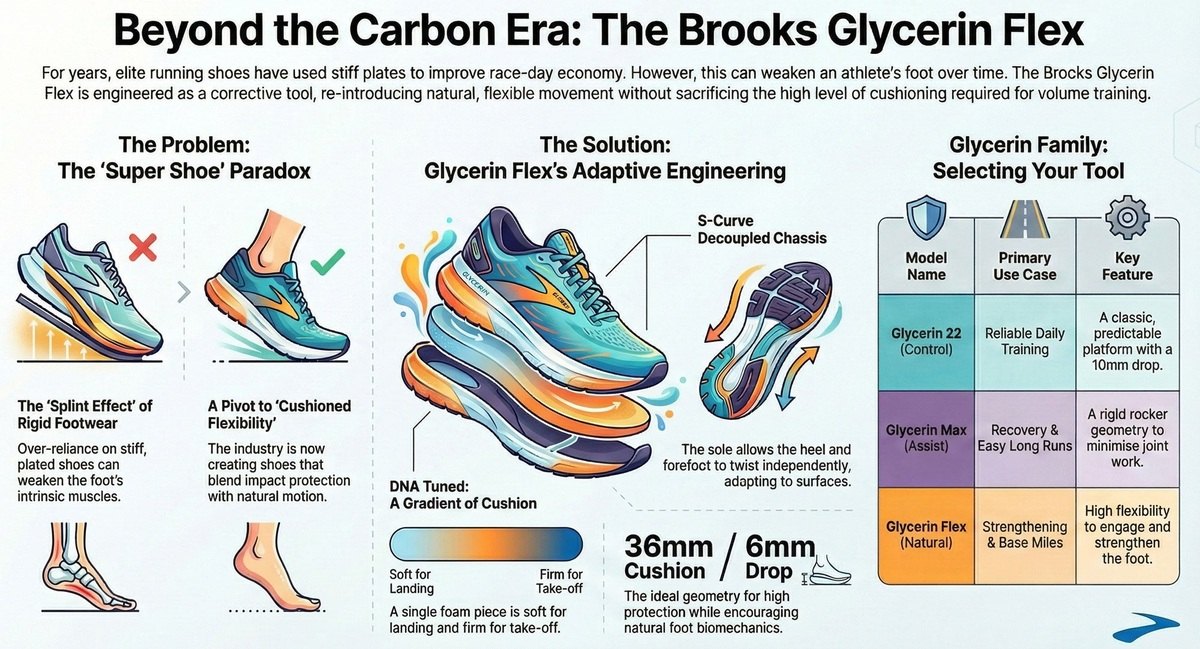
The Strategic Pivot: Beyond the Carbon Era
To understand the necessity of the Glycerin Flex, one must analyse the current state of endurance equipment. Since 2017, the prevailing logic has been to treat the foot as a lever to be stiffened. Carbon plates and nylon rods reduce the work done by the metatarsophalangeal (MTP) joints. For the high-performing athlete, this is useful data for competition, but for daily maintenance, it presents a risk. If you do not use it, you lose it.

Have a quick training or recovery question?
Get fast expert advice right here on the page—no sign-up, account, or app needed. Try asking Raye: 'What's the best way to relieve tight calves after a run?' Ask a question now
The industry is now witnessing a pivot toward "Cushioned Flexibility." This is not a regression to the harsh minimalist era of 2011, where impact protection was sacrificed for ground feel. Rather, it is a synthesis. The Glycerin Flex aims to occupy the "white space" between the proprioceptive freedom of a barefoot-style shoe and the necessary shock absorption of a maximalist trainer.
For the athlete managing a body that is a high-value asset, this distinction is critical. The goal is not just to survive the next marathon season, but to maintain structural integrity for decades of performance. The Glycerin Flex is engineered to be the tool that re-engages the foot's natural stabilisation mechanisms, treating pain not as drama, but as data indicating where strength is required.
Technical Architecture: The DNA Tuned Midsole
The core of the Glycerin Flex's value proposition lies in its material physics. Brooks has introduced "DNA Tuned," a nitrogen-infused foam that solves a specific engineering problem: how to create a dual-density ride without the weight and stiffness of adhesives.
In traditional manufacturing, creating a shoe with a soft heel and a responsive forefoot required gluing two different density foams together. The glue lines created rigid points that inhibited natural flex. The DNA Tuned process utilises a supercritical fluid foaming technique to create a gradient density within a single continuous piece of material.
The Physics of the Gradient:
-
The Heel (Compliance): The rear of the midsole is engineered with larger nitrogen cells. Physics dictates that larger bubbles possess a lower spring constant, making them more compliant. This creates a deep compression zone for impact absorption during the heel strike phase, essential for mitigating the cumulative stress of high-mileage weeks.
-
The Forefoot (Resilience): As the material transitions to the forefoot, the nitrogen cells become smaller and more tightly packed. These denser cells resist compression, creating a firmer, more responsive platform.
This gradient ensures that energy is directed into propulsion rather than lost to foam deformation during toe-off. It provides a ride that is analytically "tuned" to the gait cycle-soft where you land, firm where you launch-without the artificial stiffness of a plate.
The Chassis: S-Curve Decoupling and Natural Biomechanics
If the foam is the engine, the chassis is the "S-Curve" outsole. This is the feature that separates the Glycerin Flex from its maximalist peers.
Most modern shoes utilise a "block" midsole. If your heel lands on a cambered road or uneven surface, the entire shoe tilts, applying torque to the ankle and knee. The Glycerin Flex features a deep, S-shaped channel running diagonally from the lateral heel to the medial forefoot. This effectively decouples the rearfoot from the forefoot, mimicking the function of the subtalar joint.
Dynamic Stability vs. Forced Correction This design philosophy offers "dynamic stability." Upon landing, the groove allows the heel to rotate independently, absorbing irregularities in the tarmac while the forefoot remains planted. The groove splays open to increase surface area and dissipate impact forces. As the foot transitions to mid-stance, the geometry forces the groove to close and lock, creating a solid rail for push-off.
For the serious runner, this means the shoe adapts to your biomechanics rather than forcing you to comply with a pre-set geometry. It demands that your stabiliser muscles fire, ensuring that your training load confers strength benefits to the foot and ankle complex, not just the cardiovascular system.
Heritage and Evolution: The Lineage of the Flex
The Glycerin Flex is not a spontaneous invention; it is the phylogenetic successor to the Brooks "BlueLine" lab experiments. It traces its DNA back to the Aurora-BL (2021), a concept car of a shoe that first introduced the idea of a nitrogen-injected, decoupled midsole. The Aurora-BL proved that separating the heel and forefoot provided a unique "floating" sensation while allowing the foot to twist naturally.
Furthermore, the Flex corrects the errors of the PureProject (2011-2016). The PureFlow was a favourite among biomechanically efficient runners, but it failed due to material limitations-the EVA foam of that era died too quickly, losing its protective qualities. The Glycerin Flex resurrects the low-drop, high-flex philosophy of the PureProject but equips it with modern super-foams that offer durability without stiffness. It is the implementation of a decade of data.
The Glycerin Stratification: Choosing Your Tool
In 2026, the "Glycerin" name no longer refers to a single shoe, but a triad of tools. Understanding the distinction is vital for your equipment strategy.
1. Glycerin 22 (The Control)
-
Profile: Traditional 10mm drop, moderate flexibility.
-
Use Case: The reliable standard. For runners who prefer the classic heel-to-toe transition and a stable, predictable platform.
2. Glycerin Max (The Assist)
-
Profile: 45mm stack height, rigid GlideRoll rocker.
-
Use Case: Mechanical assistance. This is for recovery days where the goal is to minimise joint work, or for long runs where the rocker geometry does the heavy lifting for the calf and Achilles.
3. Glycerin Flex (The Natural)
-
Profile: 36mm heel / 30mm forefoot (6mm drop), high flexibility.
-
Use Case: Proprioceptive engagement. This is for the athlete who wants to feel the road and engage the windlass mechanism of the foot. It is a strengthening tool disguised as a daily trainer.
Performance Analysis: The Ride Character
Early data from wear-testing indicates a specific ride character: "Agile Flow."
Unlike rockered shoes that dictate the speed of your transition, the Glycerin Flex allows the runner to control the rhythm. Despite the substantial 36mm stack height, the podular outsole design provides a surprisingly high degree of ground feel. The forefoot is segmented into distinct pods separated by transverse grooves, aligning with the metatarsal heads.
This architecture decentralises stiffness. It allows the shoe to bend at the precise anatomical point of toe-off. At easier paces, this allows for a smooth, segmented stride where the runner can feel the phases of gait-landing, rolling, splaying. It prevents the "numb" sensation often associated with high-stack footwear.
The Stoic Reality of Flexibility It is important to acknowledge the overhead required here. Transitioning to the Glycerin Flex from a rigid, plated shoe will increase the workload on the plantar fascia and the calves. This is not a negative; it is necessary work. The initial sensation may be one of increased effort, as the shoe does not propel you forward mechanically. Pain or fatigue in these areas during the transition period should be viewed as data-evidence that dormant muscle groups are being brought back online.
Aesthetic and Construction
The upper construction utilises an Engineered Flat Knit. Brooks has wisely retreated from the compressive "StealthFit" designs that alienated some users with high arches. The Flat Knit offers the seamless, sock-like feel of a knit but retains a traditional throat opening and a separate tongue. This ensures a secure lock-down over the midfoot saddle, essential when the sole unit is designed to flex and twist.
Visually, the shoe is unapologetically modern. The deep decoupled grooves and high stack height give it an aggressive stance. Launch colourways such as "Gecko Phantom" and "Metallic Coconut" suggest a confidence in the product's visual identity, moving away from the conservative designs of the past.
Let us find the best price on the Brooks Glycerin Flex
We will find the lowest price for the Brooks Glycerin Flex and email you as soon as we get them for you.
The Long Game: Why This Matters
Why should the high-performing athlete care about the Glycerin Flex? Because longevity is the ultimate performance metric.
The "super shoe" era has undoubtedly improved race times, but it has arguably homologised the runner's stride, casting the foot in a fixed path of motion. Over time, this lack of variability can lead to overuse injuries and biomechanical weaknesses. The Glycerin Flex offers a necessary counter-stimulus.
By integrating the Flex into a rotation-perhaps using it for easy aerobic miles and base building-the athlete ensures that their feet remain capable, adaptable, and strong. It is a hedge against fragility. It is a piece of equipment that respects the complexity of human biomechanics rather than trying to override it.
The Sundried Roundup
What are the press saying? The industry press views the Glycerin Flex as a "Unicorn" release. It is being praised for reconciling two historically antagonistic philosophies: the high-volume cushioning of the maximalist era and the torsional freedom of the minimalist era. Editors are calling it "Cushioned Flexibility," noting that it fills a void for runners who want protection without the "cast-like" rigidity of carbon-plated trainers.
What are the review sites saying? Early feedback from wear-testers and forums like Reddit highlights the "flow" state of the ride. Reviewers appreciate that the shoe doesn't "boss them around" like a rockered shoe. There is a consensus that it feels agile and grounded, handling corners and uneven pavement better than stiff competitors. However, some note that it requires more muscular work at high speeds compared to plated shoes, positioning it firmly as a daily trainer rather than a racer.
What's the history of the shoe and how has it evolved? The Flex is the spiritual successor to the PureProject line (specifically the PureFlow) and the Aurora-BL concept shoe. It evolves the PureProject's natural motion philosophy by solving its durability issues with new nitrogen-infused foam. It takes the radical decoupled chassis of the Aurora-BL and refines it for a mainstream, high-durability package.
What can you expect in terms of performance improvement? Do not expect "free speed" in the form of mechanical propulsion. Expect biomechanical optimisation. The performance improvement here is intrinsic: stronger feet, better proprioception, and improved durability of the athlete. It is designed to improve running economy over the long term by encouraging a more natural, efficient stride path.
Special features
-
DNA Tuned Midsole: A single-piece, dual-cell nitrogen foam that is soft in the heel and responsive in the forefoot without glue lines.
-
Decoupled S-Curve Chassis: Allows independent movement of the heel and forefoot for dynamic stability.
-
Podular Forefoot: Segmented outsole pods that allow the shoe to flex with the metatarsals.
Comfort features? The 36mm heel stack places this firmly in the high-cushion category, ensuring excellent impact absorption. The Engineered Flat Knit upper provides a seamless, breathable fit that accommodates foot swelling on long runs without the constriction of a bootie liner.
Top 5 Features
The S-Curve Decoupling
For genuine torsional freedom.
DNA Tuned Nitrogen Foam
For a gradient of cushion and response.
36mm/6mm Geometry
The sweet spot for natural midfoot striking with maximal protection.
Podular Outsole
For ground feel and grip on varied surfaces.
Anatomical Flat Knit Upper
For a secure, non-restrictive fit.
When can I get a pair? The Global Release Date is set for January 30 / February 1, 2026. Pre-orders at select specialist retailers are rumoured to begin as early as January 7, 2026.


