

Brooks Cascadia 20 Preview


Planning your next fitness milestone?
Get immediate guidance on pacing, workout structure, or race prep directly on-site for free. Try asking Raye: 'Can you outline a simple 4-week build plan for a 10K?' Get instant guidance
Preview: What To Expect Release Date News & Rumours
Note: This page is a preview based on early news and info and will be updated with a full hands-on review upon launch.
If you have been following the trail running world for any length of time, you likely know the Brooks Cascadia. For two decades, it has been the "Swiss Army Knife" of the trails—reliable, steady, and ready for just about anything. But if the rumours and early reports for 2026 are anything to go by, everything is about to change.
We are looking at a massive shift in how Brooks approaches the trail. Based on a deep dive into press releases, insider whispers, and early prototype feedback, the "Cascadia 20" isn’t just a single shoe anymore. It is evolving into two distinct paths to suit very different needs.
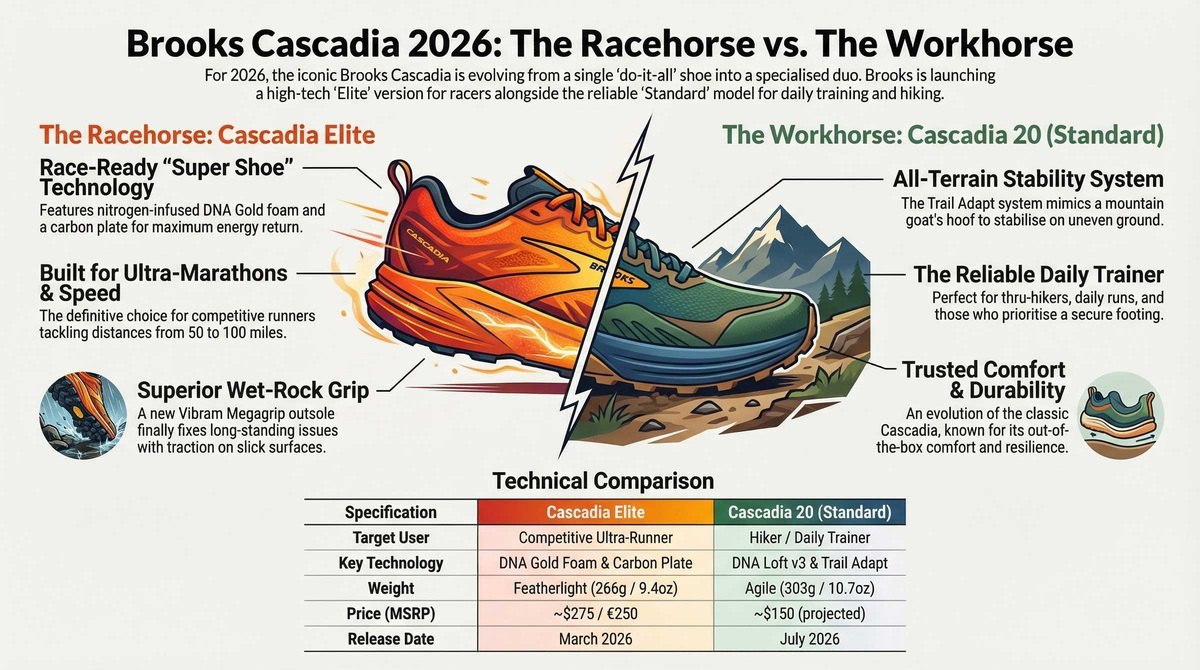
In 2026, we are expecting an ecosystem of two different footwear architectures: the radical new Brooks Cascadia Elite , arriving around March, and the trusty Brooks Cascadia 20 (Standard) , expected to follow in July.
This preview is going to break down everything you need to know about this split. We will look at the futuristic tech inside the Elite—like nitrogen-infused foams and carbon plates—and compare it to the refined reliability of the Standard model. Whether you are looking to tackle your first ultra or just want a dependable shoe for your weekend hikes, here is the lowdown on the future of Brooks Trail.
The Big Picture: Why the Change?
To really understand why this launch is such a big deal, we have to look at what has been happening in the running world. For a long time, trail shoes were a bit behind the times. While road running shoes saw a massive revolution back in 2017 with "super foams" and carbon fibre plates, trail shoes stuck to the traditional materials. Manufacturers were worried about stability, so they kept using standard foams that were safe but didn't offer much "pop."
The 2026 Cascadia launch is Brooks catching up and overtaking that narrative. They are finally bringing that high-performance, super-shoe technology to the dirt. It signals that they are willing to trade a little bit of that "safe and steady" image for some serious performance innovation.
The Science of the Foam (Simply Put)
The biggest talking point for 2026 is the introduction of DNA Gold . This is a nitrogen-infused midsole material that was previously reserved for Brooks' top-tier road racing shoes.
Here is the easiest way to understand the difference: Traditional foam (like you find in most hiking shoes) works like a dampener. It absorbs the shock of your step to protect your body, but that energy just dissipates as heat. It is great for protection, but it doesn't give you much back.

Looking to shave time off your personal best?
Get immediate pacing strategies and interval workout ideas directly on-site for free. Try asking Raye: 'What is the best threshold session to help drop my 10K time?' Get instant pacing tips
DNA Gold (PEBA foam) is different. It functions more like a propellant. It is springy. When you compress it, it wants to snap back to its original shape, returning a huge chunk of that energy to you. It is not just about running faster; it is about efficiency. Early testing suggests this foam helps your legs feel fresher for longer, specifically aiming to reduce muscle fatigue when you are going over long distances. It shifts the conversation from "how much protection do I have?" to "how much energy can I save?"
The Rise of the Stack Height
You might notice shoes getting taller these days, and the new Cascadia is no exception. We call this "maximalism." A few years back, the Cascadia sat lower to the ground, which gave you a good feel for the trail. The new models are pushing upward.
The Cascadia 19 sat at about 35mm off the ground in the heel. The new Cascadia Elite is reported to jump up to 40mm. Why the extra height? It is simple physics. The new super foam is softer and more compliant. To make sure you don't bottom out and feel every sharp rock, you need a thicker slab of it.
This confirms that the "Elite" isn't just a fancy version of the normal shoe; it is a completely different species sharing the same name.
The Game Changer: Brooks Cascadia Elite (March 2026)
Let’s talk about the shoe that everyone is whispering about. The Brooks Cascadia Elite is the brand's answer to high-performance racers from competitors like Hoka and Nike. It breaks the mould of the "steady reliable" Cascadia to offer something built for speed and efficiency.
The Cost and the Build First, the elephant in the room: the price. The Elite is rumoured to land with an MSRP of around $275 (€250). That places it firmly in the ultra-premium category. It is not a budget shoe; it is a piece of high-tech equipment.
Despite looking huge, it is incredibly light. A men’s sample size is weighing in at just 266g (9.4 oz). That is seriously light for a trail shoe, achieved by using that airy DNA Gold foam and a very high-tech upper material.
The "Magic" Inside The midsole is 100% PEBA foam. Testers are describing it as having a "tuned fit" and "supreme comfort." It resists that dead, flattened-out feeling that traditional shoes get after a long day on the trail.
Buried inside that foam is the SkyVault Plus plate . In the past, Cascadias had a "rock shield" which was basically a plastic guard to stop sharp stones from bruising your foot. The SkyVault is different. It is a carbon-infused plate that is curved to act as a lever. It stabilises the soft foam and gives you a distinct "pop" as you push off your toes.
Finally: A New Outsole For years, loyal Brooks fans have had one major complaint: the grip on wet rock wasn't great. The in-house rubber just didn't stick well in slippery conditions.
The Cascadia Elite fixes this in a big way. It is ditching the proprietary rubber for Vibram Megagrip Elite . This is the gold standard in the industry. It is a massive upgrade that transforms the confidence you will have on wet, technical descents. If you run in rainy climates like the UK or the Pacific Northwest, this alone might be worth the price of admission.
The Ride Early reviews from insiders describe the ride as "efficient" and "lively." It is a sensation of energy return rather than impact absorption. One tester mentioned that if they were tackling a 50 to 100-mile distance, this is absolutely the shoe they would choose.
However, there are trade-offs. Because of the stiff plate and the high stack of foam, you lose "ground feel." It might feel a bit like overkill or disconnected if you are just doing a short, technical 5k. It is a race car, not a daily commuter.
The Reliable Standard: Brooks Cascadia 20 (July 2026)
While the Elite gets all the headlines, the standard Cascadia remains the bread-and-butter for most of us. The Cascadia 20 is expected to be the direct descendant of the Cascadia 19.
The "Zipper" Feel The Cascadia 19 made a great move away from the "clunky" feel of the older models. It introduced nitrogen-infused DNA Loft v3 foam, which is lighter and more responsive than the old stuff. It feels zippier and less like you are dragging a tank on your feet.
The drop (the height difference between your heel and toe) sits at 6mm. This is a nice middle ground—it feels natural and encourages a good stride without putting too much strain on your calves.
Stability is King The core technology here is the Trail Adapt System . Unlike the propulsion plate in the Elite, this system is all about stability. It mimics the hoof of a mountain goat. The outsole is split into independent pods that can move separately, allowing the shoe to mould itself over uneven terrain rather than tipping over. This makes it incredibly stable, which is perfect if you are hiking with a backpack or just want a secure footing.
The Durability Question We have to be honest about the feedback on the Cascadia 19. While the shoe feels great, users noted that the tread lugs were a bit shallow (reduced to 4.0mm). This meant they wore down faster and didn't grip as well in deep mud. There was also some frustration that the Velcro gaiter trap—a favourite feature for hikers to keep debris out—was removed.
We are hopeful that the Cascadia 20 will address these points. Brooks often listens to community feedback, so seeing deeper lugs or a more aggressive tread pattern on the standard model would be a very welcome return to form.
Comparing the Two: Which One is For You?
The split in the product line actually makes choosing easier, because the shoes are designed for different jobs.
Choose the Cascadia Elite If:
-
You are training for an ultra-marathon or a long-distance event.
-
You want the absolute best energy return to keep your legs feeling fresh.
-
You live in a wet climate and need the superior grip of the Vibram outsole.
-
You are happy to invest in top-tier equipment.
Choose the Cascadia 20 (Standard) If:
-
You are a thru-hiker or spend long days walking on the trail.
-
You value stability and ground adaptation over pure speed.
-
You want a durable daily trainer for dry or rocky conditions.
-
You want a reliable shoe at a more accessible price point.
A Quick History Lesson
To appreciate where we are going, it helps to look back.
-
The "Tank" Era: For a long time, the Cascadia was heavy, stiff, and indestructible. Hikers loved it because it lasted forever, but runners found it a bit clunky.
-
The Modern Era: Around the Cascadia 16, they started softening the foam and making it run more like a road shoe.
-
The Agile Era: Now, with the 19 and the upcoming 20, the focus is on agility. They have cut the weight significantly, making the shoe feel nimble. The Elite is just taking that agility to the extreme.
What the Community is Saying
We have scoured the forums and comment sections to see what real users are saying about the current platform (which the 20 will be based on).
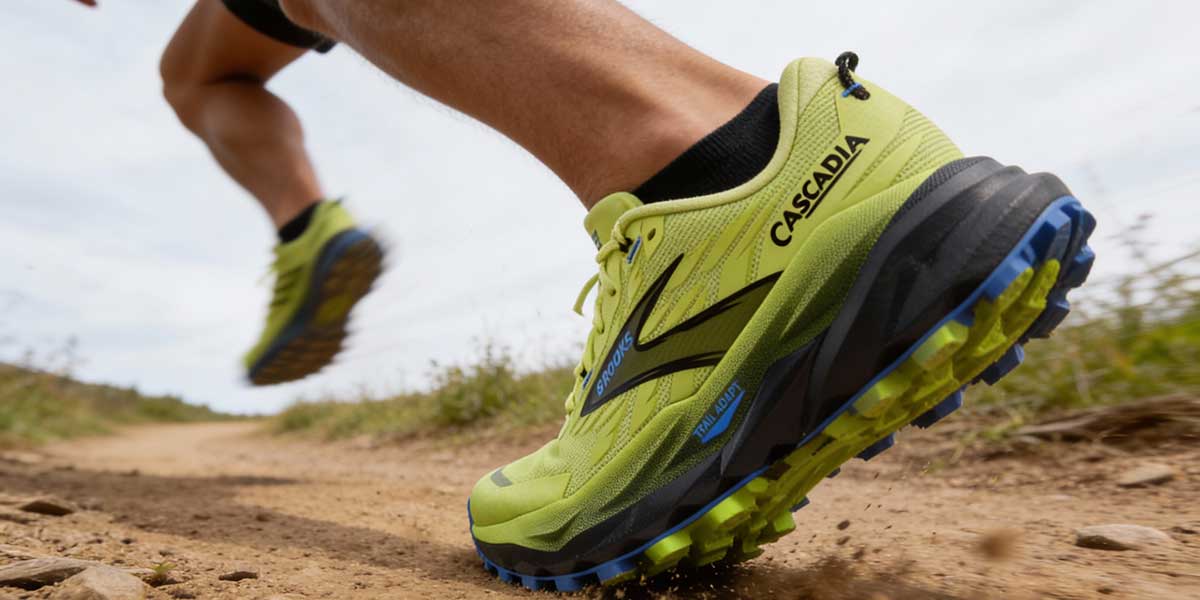
The Good: People love the fit. It occupies a "Goldilocks" zone—not as wide and sloppy as some brands, but not as narrow and constricting as others. The fact that Brooks offers a dedicated Wide (2E) version is a huge plus for many. Users also report that there is almost no break-in period; they are comfortable right out of the box.
The Not-So-Good: The removal of the gaiter trap on the heel really annoyed the hiking community. It was a small feature, but a useful one. And, as mentioned, the traction on the standard model needs to be a bit deeper for muddy days.
The Competition
The Cascadia 20 isn't alone out there.
-
Vs. Hoka: The Elite is going toe-to-toe with the Hoka Tecton X. The Brooks advantage here might be the "spine" construction of the plate, which could offer better stability than the carbon plates found in Hoka.
-
Vs. Altra: For hikers, the Altra Lone Peak is the main rival. The Cascadia generally wins on durability and cushioning. The foam in the Cascadia tends to last longer before collapsing, and the heel-to-toe drop is often friendlier on the Achilles tendon for people who aren't used to zero-drop shoes.
Summary
The release of the Brooks Cascadia 20 and the Cascadia Elite marks the end of the "one shoe fits all" era for this franchise. Brooks has correctly realised that a runner racing 100 miles and a hiker tackling the Pacific Crest Trail have different needs.
If you have been waiting for Brooks to produce a shoe that can really compete with the "super shoes" of the world, your wait ends in March 2026 with the Elite. It fixes the two main complaints of the past: "dead" foam and slick traction.
For the rest of us looking for a reliable daily partner, the standard Cascadia 20 in July remains the logical choice. It keeps the stability we love but hopefully brings back some of the durability features we missed in the 19.
Whether you choose the reliable mule or the racehorse depends entirely on your goals. Are you heading for a trailhead or a podium?
Top 10 Features
DNA Gold Midsole (Elite)
A nitrogen-infused PEBA foam that returns energy like a spring rather than just absorbing shock.
Vibram Megagrip Elite (Elite)
Finally, industry-leading sticky rubber for confidence on wet and slippery rocks.
SkyVault Plus Plate (Elite)
A carbon-infused propulsion plate that provides a snappy toe-off and stabilises the soft foam.
Trail Adapt System (Standard)
A clever outsole and rock shield combo that mimics a mountain goat’s hoof for superior stability.
Weight Reduction
Both models are shedding ounces, with the Elite coming in at a featherlight 266g.
Matryx Upper (Elite)
A super-strong, Kevlar-infused material that is highly resistant to abrasion and doesn't absorb water.
Increased Stack Height
More cushioning underfoot (up to 40mm on the Elite) to protect you over ultra distances.
6mm Drop
A biomechanical sweet spot that balances calf relief with a natural stride.
Wide Fit Availability
The Standard model continues to support different foot shapes with a dedicated 2E Wide option.
Zonal Outsole Pods
Independent movement in the outsole allows the shoe to conform to the terrain, keeping you upright.


