

Optimising Performance with Amino Acid Strategy


Want to build strength to support your running?
Get targeted strength routines and mobility exercises designed specifically for runners directly on-site. Try asking Raye: 'What are 3 key gym exercises to improve running economy?' Get strength tips
The Operator's Guide to Amino Acids: Engineering Structural Integrity
The high-performing individual understands asset management. Financial assets require diversification, risk mitigation, and strategic allocation to ensure long-term yield. Your physical structure-your skeletal muscle and metabolic efficiency-is your primary biological asset. Maintaining this asset is not a matter of motivation; it is a matter of precise biological strategy....
On the go? Just hit play on our supporting podcast episode below
For the executive athlete, the objective shifts from achieving temporary aesthetic peaks to ensuring long-term operational readiness and resilience. Training is a calculated application of stress designed to elicit adaptation. However, adaptation is not guaranteed by effort alone. It requires the availability of specific raw materials at critical junctures.
This requires moving beyond macroscopic caloric management (simply "eating protein") and into the precise manipulation of metabolic pathways. At the centre of this strategy is the deployment of amino acids.
While dietary protein provides these components, reliance solely on whole foods presents a logistical bottleneck: digestion latency. The modern performance landscape requires a more sophisticated approach. Isolated amino acid supplementation offers a distinct kinetic advantage. These are not motivational aids; they are precision tools designed to bypass digestive overhead and deliver the necessary components directly into the system when they are most required.
This brief will outline the mechanics of amino acid utilisation, the distinctions between formulations, and the protocols for deploying them to secure the longevity of your physical performance.
The Biochemistry of Resilience
Your body exists in a constant state of flux, balancing anabolism (tissue construction) and catabolism (tissue degradation). When you execute structural loading (resistance training) or prolonged endurance efforts, you create micro-trauma within muscle fibres. This is the necessary overhead for adaptation.
The body's response is to repair this trauma, resulting in a more robust structure. This process, known as Muscle Protein Synthesis (MPS), requires protein. Proteins, in turn, are constituted of twenty distinct amino acids.

Have a specific performance goal in mind?
Get direct feedback on your training targets right here on the page—no sign-up or account required. Try asking Raye: 'How should I adjust my weekly mileage for a sub-20 minute 5K?' Ask about your goals
Nine of these are classified as "Essential" (EAAs) because the human body cannot synthesise them internally; they must be acquired exogenously. Within this essential subset are the Branched-Chain Amino Acids (BCAAs): Leucine, Isoleucine, and Valine. These three are unique because they are metabolised directly within skeletal muscle rather than the liver, making them critical substrates for energy production during activity.
During periods of physiological stress, if the availability of EAAs in the bloodstream is insufficient, the body will enter a negative nitrogen balance, effectively cannibalizing its own muscle tissue to support vital functions. Strategic supplementation is the primary countermeasure to this deficit.
The Kinetic Advantage: Speed as Strategy
If the objective is to initiate repair rapidly and mitigate muscle breakdown during training, the speed of nutrient delivery is a critical variable.
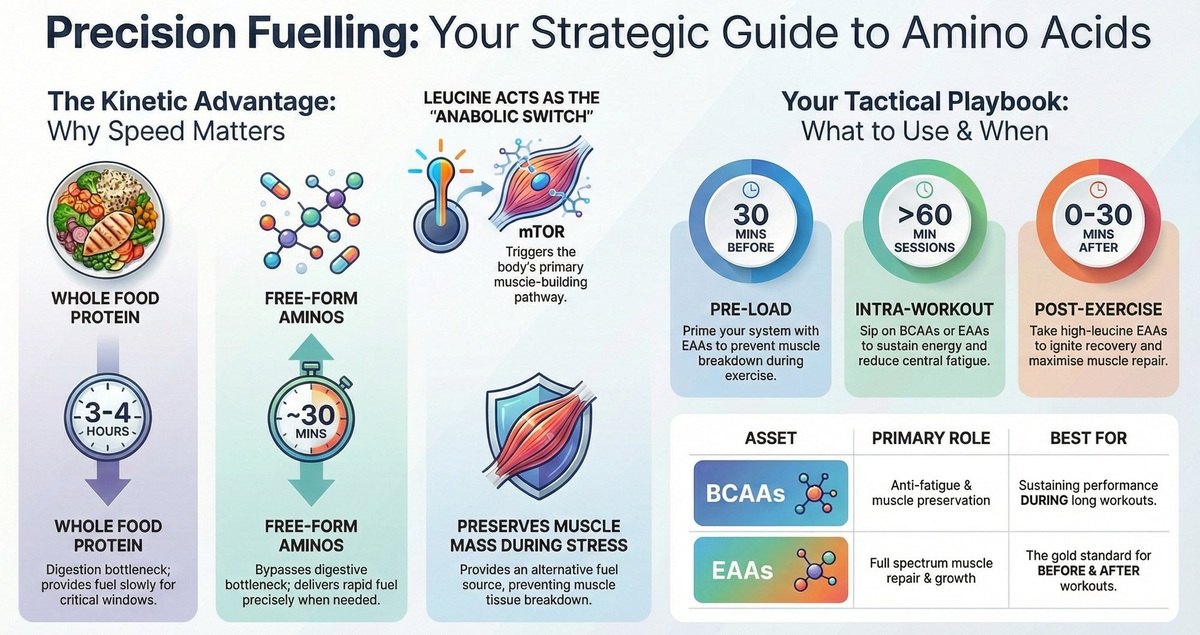
Whole food sources of protein (chicken, eggs, whey) are effective, but they require significant digestive processing. The proteins must be broken down into their constituent amino acids before they can enter the bloodstream. This process typically takes three to four hours.
During the critical windows immediately before, during, and after training, this latency is suboptimal.
Isolated, free-form amino acids (found in powders and complexes) bypass this digestive bottleneck. They do not require complex breakdown and are absorbed rapidly, entering the bloodstream within approximately 30 minutes.
This kinetic advantage allows the operator to precisely time the availability of amino acids to coincide with peak physiological demand.
The Anabolic Switch: Leucine Signalling
It is critical to understand that amino acids are not just passive building materials. One specific amino acid, Leucine, acts as a potent signalling molecule.
Leucine is the primary trigger for the mTOR pathway, the body's central regulator of cell growth and protein synthesis. Think of mTOR as the foreman on a construction site. If Leucine levels are insufficient, the foreman does not initiate the building process, regardless of how many other materials are available.
There appears to be a "Leucine Threshold" required to flip this switch. Whole proteins release Leucine slowly. Ingesting an EAA or Amino Complex causes a rapid spike in plasma Leucine, ensuring this threshold is met immediately post-exercise. This is particularly crucial for the 40+ athlete, who may experience "anabolic resistance"-a reduced sensitivity to the growth signals from standard protein intake. A rapid, potent dose of Leucine is the strategy to overcome this resistance.
Decoding the Formulations: Selecting the Right Asset
The terminology in the supplementation sector can be opaque. Precision requires defining the tools available.
Amino Acid Powders (BCAAs and EAAs)
This is the most common format, typically mixed with water. The critical distinction here is between BCAAs and EAAs.
BCAAs (Branched-Chain Amino Acids): BCAA powders contain only Leucine, Isoleucine, and Valine. Historically, these were promoted for muscle growth due to Leucine's role as the anabolic trigger. However, the current understanding is that while BCAAs provide the signal to build (the "switch"), they do not provide the full spectrum of materials (the "bricks"). If the other six essential amino acids are not available, synthesis cannot occur.
Primary Utility: Anti-catabolism (preventing muscle breakdown during exercise) and fatigue mitigation.
EAAs (Essential Amino Acids): EAA formulations represent a more sophisticated approach and are the current gold standard for structural adaptation. They contain all nine essential amino acids, including the BCAAs. By providing the complete spectrum of required components, EAAs support a robust and sustained anabolic response.
Primary Utility: Superior to BCAAs for actual tissue construction (hypertrophy) and comprehensive recovery. They offer maximal nitrogen retention with a negligible caloric load.
Amino Complexes
An "Amino Complex" typically refers to a full-spectrum blend that goes beyond the nine EAAs. These are often presented as tablets or liquids, acting as "pre-digested protein." They are designed for systemic support rather than just muscle tissue accretion.
Complexes frequently include:
-
Conditionally Essential Amino Acids: Such as Glutamine (for immune function and gut integrity) and Arginine or Citrulline (for blood flow and nitric oxide synthesis). L-Glutamine is particularly relevant as heavy training depletes it, impacting immune response and glycogen replenishment.
-
Metabolic Co-factors: Often including Vitamin B6 and B12, which are necessary enzymes for the body to actually utilise the ingested amino acids.
Specialised Formulations
Certain brands offer highly engineered solutions. For example, Amino Vital, produced by Ajinomoto (a leader in amino acid fermentation science), is notable. They utilize precise, researched ratios of plant-based, fermented amino acids formulated for rapid absorption. They are distinct for their delivery systems (such as "Jelly Drinks" or granule pouches) designed for endurance athletes who require instant energy without digestive burden during long operational durations. Their formulations often prioritise Leucine-enriched blends to maximise the mTOR response.
Performance Dividends: The Strategic Advantages
The strategic deployment of amino acids yields measurable improvements in performance and recovery metrics.
Preservation of Lean Mass (Anti-Catabolism)
If you train in a fasted state, during prolonged sessions, or whilst in a caloric deficit, the body may catabolise its own muscle tissue to harvest amino acids for fuel. This is counterproductive to long-term performance. Supplementing with amino acids provides an alternative fuel source, sparing your structural assets. This is termed the "protein sparing" effect.
Mitigation of Central Fatigue
Performance is often limited not by muscular failure, but by central (neurological) fatigue. During intense or prolonged training, serotonin levels rise in the brain, increasing the perception of exertion and lethargy.
BCAAs compete with Tryptophan (the precursor to serotonin) for transport across the blood-brain barrier. By maintaining high plasma BCAA levels during training, you can effectively limit the amount of Tryptophan entering the brain, thereby delaying the onset of central fatigue and preserving cognitive acuity.
Accelerated Recovery (Reduced DOMS)
Delayed Onset Muscle Soreness (DOMS) is a byproduct of the inflammatory response to tissue micro-trauma. By providing the necessary substrates for repair immediately, amino acids help modulate this response and clear metabolic waste products faster. This reduces downtime and allows for a faster return to peak operational readiness.
Enhanced Blood Flow and Nutrient Delivery
Specific amino acids found in complexes, such as L-Citrulline or Arginine, enhance vasodilation (the widening of blood vessels). This improves the delivery of oxygen and nutrients to working muscles, supporting endurance and the efficiency of the recovery process.
Strategic Deployment Protocols
Amino acids are tactical tools. Efficacy is determined by timing the deployment to manipulate acute physiological states.
Pre-Loading (The Priming Phase)
-
Objective: Saturate the amino acid pool before the catabolic stimulus begins. This buffers the breakdown of muscle tissue for energy.
-
Timing: 30 minutes prior to the session.
-
Asset: EAA powder or Amino Complex (5-10g).
Intra-Workout (The Sustaining Phase)
-
Objective: Combat central fatigue (via the Tryptophan mechanism) and provide a readily oxidisable fuel source.
-
Timing: Throughout sessions lasting longer than 60 minutes.
-
Asset: BCAA or EAA powder (5-10g) mixed into the hydration source and sipped continuously. For extreme endurance events (e.g., marathons or long cycles), specialised formats like Jelly Drinks provide energy without digestive distress.
Post-Exercise (The Recovery Audit)
-
Objective: Maximise Muscle Protein Synthesis by rapidly activating the mTOR pathway.
-
Timing: Immediately upon cessation of exercise (0-30 minutes).
-
Asset: EAA Complex with high Leucine content.
Note: This initial spike should be viewed as the "ignition." It should ideally be followed by a whole-food protein meal 30-60 minutes later to provide a sustained release of amino acids to support the ongoing repair process.
Risk Management: A Cost-Benefit Analysis
The decision to integrate these tools requires a detached assessment of the advantages and overhead.
The Advantages:
-
Speed: Absorption in ~30 minutes versus hours for food provides an undeniable kinetic advantage.
-
Digestive Efficiency: Very light on the stomach; will not cause bloating or gastric distress during training.
-
Caloric Precision: Delivers anabolic signalling with virtually zero calories (unless sugars are added), essential for precise body composition management.
-
Convenience: Powders and pouches are logistically superior to carrying prepared food during endurance activities.
The Disadvantages:
-
Cost: Isolated amino acids are significantly more expensive per gram than standard protein sources like whey or chicken. The investment is in speed and precision, not bulk nutrition.
-
Palatability: Unflavoured amino acids can be bitter or chemical-tasting. Flavouring systems are often necessary.
-
Redundancy Factor: If the athlete already maintains a very high daily protein intake (e.g., 2g per kg of body weight), the marginal benefit of additional amino acids is reduced, though the timing advantage remains relevant.
Conclusion
The integration of amino acid complexes and powders into your regimen is a move towards precision nutrition. They are not a replacement for a sound dietary protocol; they are potent tools that exploit specific biochemical pathways to enhance adaptation and recovery. By understanding the kinetic limitations of whole food digestion and the elevated metabolic demands of high performance, the executive athlete can deploy free-form amino acids to secure their biological assets and ensure operational readiness for the long game.
The Sundried Roundup
I'm operating on a restricted budget. How can I increase my consumption?
If resources are limited, prioritise whole-food protein timing. Consuming a rapidly digesting protein source, such as whey protein concentrate, immediately post-training is the most cost-effective strategy to elevate amino acid levels. If choosing an amino supplement, a basic BCAA powder used only during training will offer the most noticeable benefit (fatigue reduction and anti-catabolism) for the lowest investment. However, understand that BCAAs alone are suboptimal for tissue repair compared to EAAs.
I don't want to invest too much, but I am on board. Give me a plan.
Invest in a quality Essential Amino Acid (EAA) powder. This provides the full spectrum required for repair, including the BCAAs for energy and fatigue mitigation.
The Protocol:
-
Mix 10g of EAAs in your water bottle.
-
Begin sipping 15 minutes prior to your training session.
-
Continue sipping throughout the session (Intra-workout). This single intervention covers both the priming and sustaining phases, offering a significant advantage over relying solely on post-workout nutrition.
I'm all in. With no budget to worry about, what can I do to maximise this?
For the athlete seeking maximal optimisation, deploy a multi-phasic strategy using clinical-grade formulations:
-
Pre-Training (30 mins prior): Utilise a sophisticated Amino Complex containing EAAs, metabolic co-factors (like Vitamin B6), and potentially L-Citrulline for blood flow.
-
Intra-Training: Sip on a high-quality EAA formulation mixed with an electrolyte blend to sustain performance, hydration, and cognitive function.
-
Post-Training (Immediate): Consume a high-Leucine EAA formulation immediately upon completion to maximally activate the mTOR pathway.
-
Post-Training (60 mins later): Consume a high-quality whole-food meal or whey/casein blend to sustain the anabolic response.
-
Quality Control: Ensure all products are third-party tested (e.g., Informed-Sport) to guarantee purity.
Top 10 Things
Prioritise EAAs over BCAAs
Ensure you are providing all the necessary components for tissue repair, not just the signal.
Identify the Leucine Content
Ensure your post-workout serving contains at least 1.5-2g of Leucine to effectively trigger the mTOR pathway.
Utilise the Intra-Workout Phase
Sip amino acids during sessions longer than 60 minutes to mitigate central fatigue.
Time Your Intake
Leverage the rapid absorption kinetics. Take them 30 minutes pre-training or immediately post-training.
Assess Your Total Protein Intake
Ensure your foundational diet provides 1.6-2.0g per kg of body weight before relying heavily on supplements.
Consider Glutamine for Recovery
Look for complexes that include L-Glutamine to support immune function and glycogen replenishment.
Hydrate Adequately
Amino acid powders increase the osmotic load; ensure sufficient fluid intake.
Verify Sourcing
Favour fermented, plant-based amino acids for better digestibility and purity.
Look for Metabolic Co-factors
Quality complexes should include B-Vitamins (especially B6) to aid in metabolism.
Maintain Consistency
The benefits of amino acid deployment compound over time through consistent application.


