

The Digital Lane Rope: A Comprehensive Review of the FORM Smart Swim Goggles


Trying to beat your local Strava segment goals?
Fine-tune your training strategies to hit your target stats without downloading another app. Try asking Raye: 'How can I structure hill repeats to build short-segment power?' Ask how to hit your target
For decades, the solitary nature of swimming remained largely untouched by the digital revolution. While runners and cyclists embraced GPS watches and power meters, swimmers were left counting tiles and relying on unreliable pace clocks. That paradigm shifted with the arrival of the FORM Smart Swim Goggles, a device that effectively merges consumer electronics with aquatic sports, turning the mundane black line at the bottom of the pool into a high-tech data dashboard.
As fitness technology continues to infiltrate every facet of our training, FORM has positioned itself as the gold standard for pool-based metrics. By integrating a heads-up display (HUD) directly into the goggle lens, the company has solved the age-old problem of mid-session data fragmentation. But does it truly enhance the athlete’s experience, or is it merely an expensive distraction?
What are the press saying?
Industry critics have been largely unanimous in their acclaim. Tech publications and endurance sports journals have praised the goggles for their seamless integration of augmented reality. Most reviewers highlight the 'game-changer' status of seeing real-time split times and stroke rates, noting that it eliminates the need for the guesswork that plagues long-distance swimming sessions.
However, the critique isn't entirely glowing. Some seasoned competitive swimmers have raised concerns regarding the bulk of the module and the learning curve associated with focusing one's eye on the projected display during high-intensity threshold sets. Despite this, the consensus remains that FORM has successfully bridged the gap between raw data and fluid aquatic motion.
Comfort & Fit
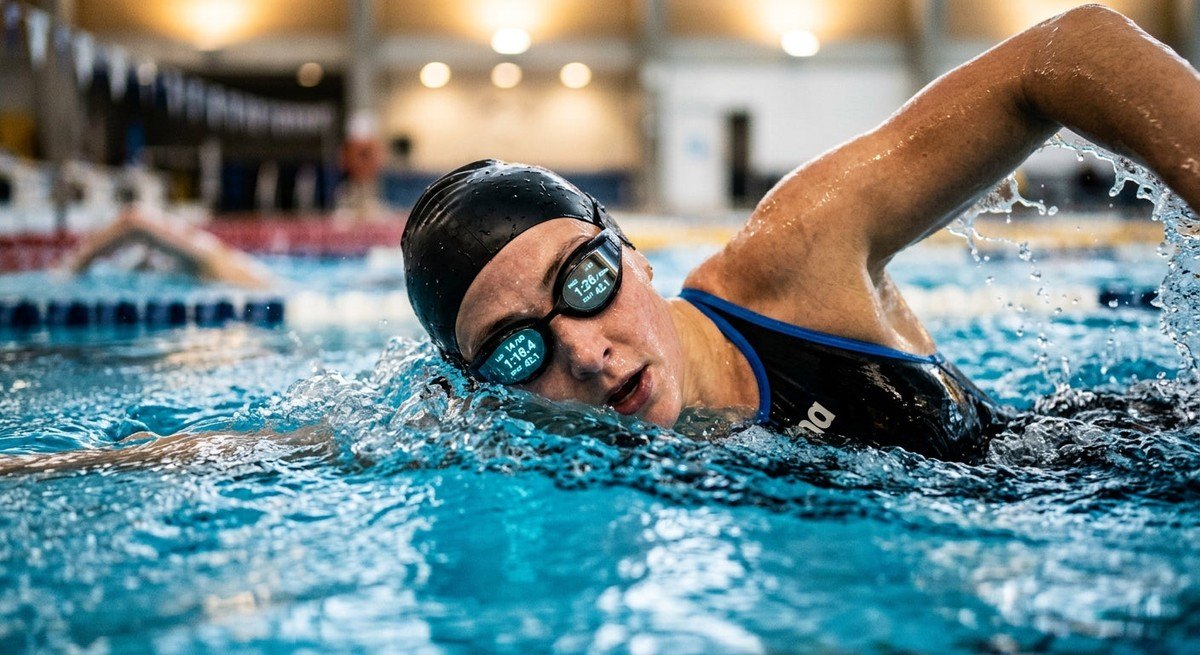
Engineering a piece of electronics to be waterproof while maintaining the ergonomics of a racing goggle is no small feat. The FORM goggles provide a surprisingly low-profile fit, despite the presence of the waveguide display module on the right side. The silicone seals are medical-grade, ensuring a tight, suction-based fit that prevents water ingress even during aggressive flip turns.
The weight distribution is intelligently managed to prevent the goggles from dragging or slipping during a push-off. Users can choose from several nose-bridge sizes to customise the fit, which is crucial for preventing leaks. While the module adds a marginal amount of weight compared to standard racing goggles, most athletes find the trade-off for real-time biometric feedback to be entirely justifiable.
Features to Look out For
The standout feature is undoubtedly the augmented reality display. It provides crystal-clear metrics—including time, distance, stroke rate, and pace per 100m—without obscuring the athlete's vision. Beyond the hardware, the FORM Swim App is the true engine of the system. It allows users to download structured workouts directly to the goggles, guiding them through complex interval sessions with on-screen prompts.

Hit a wall with form, pacing, or fatigue?
Skip searching forums. Chat directly on this page with our performance coach to solve training issues in seconds: 'How do I prevent side stitches on long runs?' Troubleshoot your run
Connectivity is another high point. The goggles sync effortlessly with popular multisport watches, such as those from Garmin and Apple, allowing for seamless integration into a broader fitness ecosystem. The data visualisation within the app after the swim is granular, providing a professional-grade analysis of every length swam.
Evolution and History
FORM emerged from a desire to democratise high-performance coaching. The founders observed that while professional swimmers had coaches on deck to track every split, the average triathlete or fitness enthusiast was left to their own devices. The evolution from the original prototype to the current generation has been marked by significant reductions in size and improvements in battery efficiency.
Early iterations faced challenges with display brightness and synchronisation stability. Through rigorous iteration and consumer feedback, the current hardware is significantly more robust. We have witnessed a transformation from a 'proof of concept' device into a reliable, enterprise-grade training tool that has now become a staple in modern aquatic centres across the UK.
What to Expect in the future?
The roadmap for augmented reality in swimming is vast. As sensor technology continues to shrink, we expect to see deeper integration with heart rate monitors that do not require external chest straps. Furthermore, there is significant potential for real-time stroke technique coaching, where the goggles could use motion sensors to provide haptic feedback or visual cues if an athlete’s elbow drops or their body position drifts.
The future likely holds a more 'invisible' display, where the module integrates even further into the frame, making the hardware nearly indistinguishable from high-end racing goggles. As cloud computing allows for more intensive post-swim analysis, the FORM app will likely evolve into a virtual AI coach that adapts your training plan based on your fatigue levels and physiological recovery data.
Special Features & Technical Specifications
Material Composition
The lenses are manufactured from shatter-resistant polycarbonate with an anti-fog coating, while the seals are crafted from premium soft silicone for maximum comfort. The frame is reinforced with high-density polymer to house the internal electronics securely.
Physical Dimensions & Engineering
The device measures approximately 16cm in width. The optical module uses a patented waveguide technology to project data into the swimmer's line of sight. Compared to previous generations, the current model has seen a 20% reduction in module size, significantly improving hydrodynamic performance.
Weight Specifications
The total weight of the goggles stands at just 72 grams, ensuring they remain comparable to standard training equipment. The weight is balanced to ensure zero drag during acceleration phases.
Verdict: For the dedicated fitness enthusiast, the FORM Smart Swim Goggles represent the most significant advancement in swimming technology of the last decade. By prioritising actionable data over flashy gimmicks, they provide the structure necessary to improve speed, efficiency, and motivation. Whilst the price point reflects the advanced engineering involved, the return on investment in the form of accelerated progress is substantial.

