

Treadmill vs Road Running: Biomechanical Differences and Workout Translation


Planning your next fitness milestone?
Get immediate guidance on pacing, workout structure, or race prep directly on-site for free. Try asking Raye: 'Can you outline a simple 4-week build plan for a 10K?' Get instant guidance
Understanding the Mechanical Shift
As the winter climate forces athletes indoors, the transition from road running to treadmill training presents a distinct biomechanical shift. While the fundamental gait cycle remains similar, the mechanical assistance provided by a motorised belt fundamentally alters how force is applied to the surface. Understanding these nuances is essential for maintaining fitness without compromising your structural integrity.
Road running requires the athlete to generate horizontal propulsion by pushing against a static surface. Conversely, a treadmill belt moves beneath the feet, which can create a subtle 'pulling' effect. This reduces the eccentric load on the hamstrings and calves, potentially masking weaknesses that would otherwise manifest on unforgiving tarmac or concrete.
Furthermore, the absence of ambient wind resistance on a treadmill leads to a significant decrease in energy expenditure at higher speeds. Without the need to overcome air drag, your relative effort feels lower. To bridge this gap, sports scientists often recommend a one per cent incline adjustment to better simulate the aerobic cost of outdoor running.
How can I start out?
Initiating your indoor training block requires a systematic approach to acclimatisation. Begin by setting your treadmill to a neutral gradient, but resist the urge to immediately replicate your outdoor tempo. Instead, utilise the first two weeks to recalibrate your internal pacing clock against the digital feedback of the machine.
Prioritise consistency over intensity during these initial sessions. Focus on maintaining a cadence of 170 to 180 steps per minute, which is often easier to monitor on a treadmill. Utilise the machine's integrated displays to ensure your stride length remains symmetrical, as the confined space of a treadmill can sometimes encourage a slight lateral imbalance.
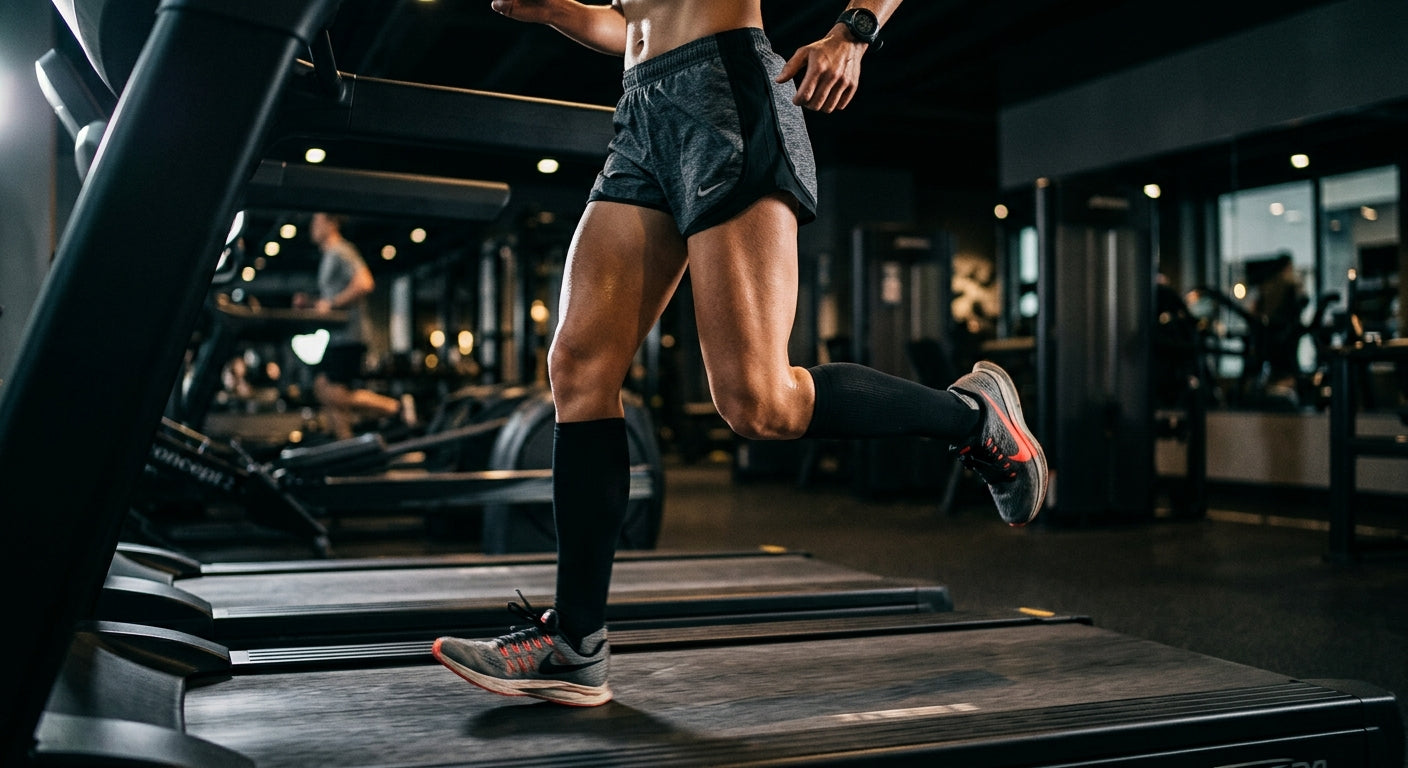
Selecting the appropriate apparel is equally vital for indoor performance. The lack of natural airflow means your body temperature rises rapidly. Opting for Sundried moisture-wicking tees and performance shorts is essential to manage perspiration effectively, preventing the dampness that often leads to chafing during high-volume indoor sessions.
Tips for Improving
To maximise the translation of your indoor gains to the road, variety is your most powerful tool. Do not simply settle into a monotonous steady-state rhythm. Incorporate interval training and hill repeats to challenge your cardiovascular system and force your muscles to adapt to varying demands.
Varying the incline is the most effective method for increasing the intensity of your treadmill workouts. By alternating between flat sections and 2 to 4 per cent gradients, you force your glutes and hamstrings to engage more actively. This mimics the undulating nature of outdoor terrain and ensures your posterior chain remains conditioned for the eventual return to the road.

Looking to shave time off your personal best?
Get immediate pacing strategies and interval workout ideas directly on-site for free. Try asking Raye: 'What is the best threshold session to help drop my 10K time?' Get instant pacing tips
Monitor your heart rate closely. Since the treadmill provides a false sense of ease, your heart rate data serves as the objective truth regarding your effort levels. Adjust your speed to ensure your zones align with your training plan, rather than relying solely on the machine's pre-programmed speed settings.
Special Features & Technical Specifications
Material Composition and Engineering
Modern treadmills utilise high-density orthopaedic belts designed to reduce impact forces by up to 30 per cent compared to asphalt. The deck is typically constructed from reinforced phenolic resin, providing a controlled level of surface compliance that balances shock absorption with energy return.
Physical Dimensions and Weight
Standard professional-grade units typically measure 200cm in length and 90cm in width, with a running surface of approximately 150cm by 55cm. These machines often weigh in excess of 130kg to ensure stability during high-speed sprint intervals, representing a significant engineering departure from the lighter, folding home-use models of previous generations.
Evolution of Design
Unlike earlier iterations that lacked sophisticated cushioning, contemporary designs feature variable-density elastomer cushions. These are strategically placed under the deck to provide firmer support at the centre for push-off and softer cushioning at the front for impact absorption, a refinement that drastically reduces the risk of overuse injuries during long-distance indoor training.
Ultimately, the treadmill is a precision instrument that, when used with intent, offers a unique environment for refining your running form. By acknowledging the biomechanical differences and adjusting your gear to account for the lack of ventilation, you can turn the winter months into a period of significant athletic growth. Prepare your kit, calibrate your incline, and use the indoor season to build a more robust, efficient version of yourself.


