

Running Coach Benefits : More than Speed


Trying to beat your local Strava segment goals?
Fine-tune your training strategies to hit your target stats without downloading another app. Try asking Raye: 'How can I structure hill repeats to build short-segment power?' Ask how to hit your target
For you to understand why a running coach is about far more than just hitting a new 5k PB, firstly you have to look at the massive gap between having a plan and actually surviving it. Most beginners treat a running programme like a flat-pack furniture instruction manual—they follow the steps, ignore the "niggles" in their knees, and wonder why the whole thing collapses after six weeks.
Ready to stop playing Russian roulette with your shins and start building a high-performance engine? Hit play on the podcast episode below.
The reality is, the transition from the sofa to the pavement is a period of massive physiological vulnerability. You are essentially trying to run a high-performance engine on a chassis that hasn't been serviced in years. Without real-time guidance, you aren't just training; you’re playing Russian roulette with your shins.
The Biomechanical Chassis: Why Real-Time Data Matters
For you to understand how a coach keeps you out of the physio's office, firstly you have to look at the mechanics of your gait. Most novices have a "jerky" stride that wastes energy and hammers the joints. They overstride, landing with their foot way in front of their body, which acts like a brake on every single step.

The 47% Injury Reduction
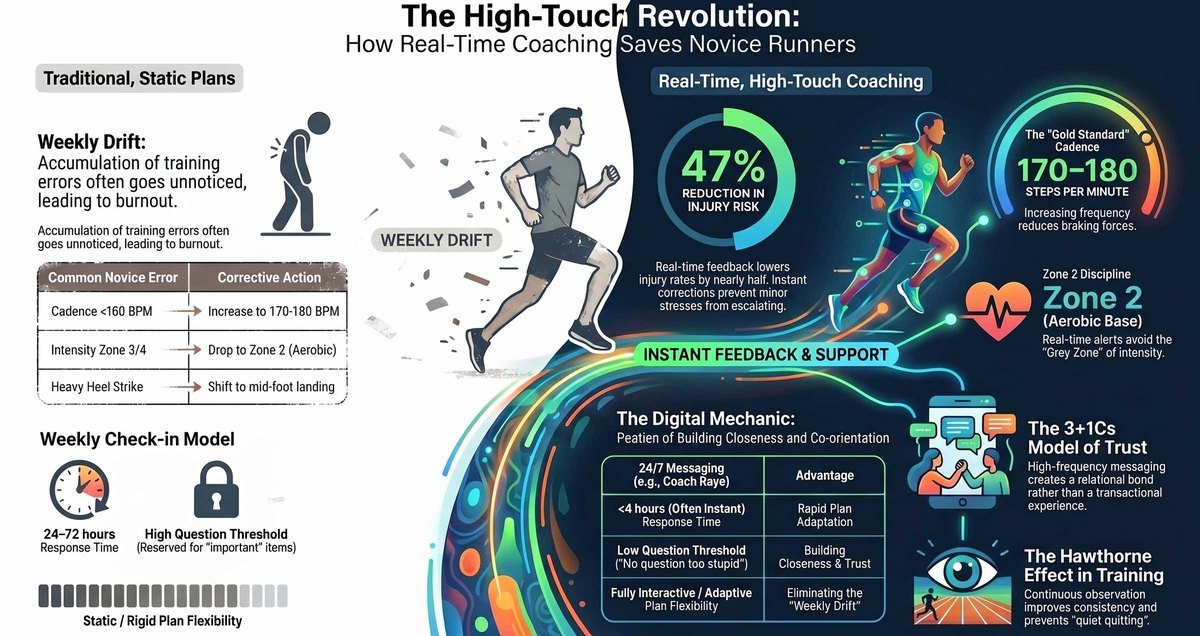
Research shows that runners who use real-time feedback—like a coach or a device telling them to fix their form mid-run—see a 47% reduction in injury risk. It’s about immediate correction. If you wait until your weekly check-in to tell your coach your calf hurts, the damage is already done.
-
The 170-180 Cadence Rule: Most beginners have a slow, heavy cadence (under 160 steps/min). A coach helps you move toward the "gold standard" of 170 to 180 steps per minute. This reduces the braking force on your knees and hips, distributing the load across your muscles rather than your bones.
-
Zone 2 Discipline: A coach acts as your external governor. Left to your own devices, you’ll likely run every session in the "Grey Zone"—too fast for recovery, too slow for speed. A coach provides that real-time alert to drop back into Zone 2, building your aerobic base and keeping cortisol levels low.

Hit a wall with form, pacing, or fatigue?
Skip searching forums. Chat directly on this page with our performance coach to solve training issues in seconds: 'How do I prevent side stitches on long runs?' Troubleshoot your run
| Biomechanical Metric | Novice Common Error | Corrective Action | Physiological Outcome |
| Step Frequency | <160 steps per minute | Increase to 170-180 range | Reduced impact; improved economy |
| Intensity | Training too fast (Zone 3/4) | Drop to Zone 2 | Aerobic base development; lower stress |
| Foot Strike | Heavy heel strike | Shift to mid-foot | Lower loading rates; reduced injury |
The Psychological Driver: The 3+1Cs Model
For you to understand why you keep skipping runs when it rains, firstly you have to look at the "Psychological Architecture" of the coach-athlete relationship. It’s not just about "being told what to do." It's about The 3+1Cs: Closeness, Commitment, Complementarity, and Co-orientation.
Let’s be honest: a static PDF doesn't care if you had a bad day at work or a sick child kept you up half the night. A high-frequency coach does. This constant connectivity eliminates ambiguity. Ambiguity breeds anxiety, and anxiety leads to burnout. When you can text your coach and ask, "Why am I running so slowly today?", and get a response that validates your fatigue, your confidence stays intact.

The "Mechanic in Your Pocket": Coach Raye
Traditional coaching often feels like a one-way street—you receive a static PDF and are left to navigate the inevitable "niggles" alone. The reality is, life doesn't happen in weekly blocks; it happens in hours and minutes.
Coach Raye (Raye.app) is the performance coach who lives at the end of your phone on WhatsApp to bridge the gap between intent and achievement. For about the price of a posh coffee, you get an expert endurance partner who is "always on."
-
The 5:00 AM Check-in: Whether you are prepping for a sunrise session or need a nudge to focus on recovery and foam rolling, Raye is there to ensure you are focused.
-
Interactive Dashboard: Your schedule is fully interactive. You can drag and drop workouts on a live dashboard. If your boss calls a late meeting, you don't "fail" your plan—you and Raye simply adjust it.
-
The Elimination of Guesswork: Wondering about calories burned or if that "twinge" in your Achilles means you should stop? Raye provides elite technical cues the moment you need them.
Tactical vs Strategic Coaching
For you to understand why a "one-size-fits-all" plan fails, firstly you have to look at the difference between tactical and strategic adjustments. A weekly check-in is strategic—it looks at the big picture. But beginners primarily require tactical support.
Tactical coaching answers the immediate questions: "My calf feels tight today, should I skip my run?" or "It’s raining heavily, should I move my intervals to the treadmill?". A static plan is a guess about what an average person needs. Real-time messaging allows for adaptive programming, where the coach sees your daily data and shifts the training accordingly. This level of flexibility is often the difference between finishing a 12-week block and dropping out due to frustration.
| Support Dimension | Weekly Check-in Model | 24/7 Messaging (Coach Raye) |
| Response Time | 24–72 hours | <4 hours (often instant) |
| Accountability | Periodic / Spiky | Continuous / Consistent |
| Question Threshold | High (only "important" items) | Low ("no question too stupid") |
| Plan Flexibility | Static / Rigid | Fully Interactive / Adaptive |

The Verdict: Economic and Physical Efficiency
Let’s be honest: paying for a single hour of in-person coaching every week is a luxury most don't need. But for a fraction of that cost, you can have a coach in your pocket for 30 days. That is 30 days of accountability, 30 days of form correction, and 30 days of mental clarity.
The "Weekly Drift" is the enemy of the beginner. It’s the three days of running too fast that leads to a stress fracture. High-frequency messaging and real-time data analysis catch those errors before they escalate. It turns the coaching experience from a transaction into a relationship.
But here is the kicker: the biggest benefit of a coach isn't the speed you gain on race day. It's the resilience you build in the twelve weeks leading up to it. By addressing the physical, cognitive, and emotional challenges of running in real-time, you stop "starting to run" and you finally become a runner.
Top 10 Tips
Be Brutally Honest
Don’t wait for a twinge to become a tear. A coach can only adjust the plan if they know the chassis is under strain.
Sync Your Data Constantly
Use a live dashboard to ensure your metrics are up to date for immediate tactical adjustments.
Trust the "Boring" Runs
Don't second-guess your coach and speed up easy days. Trust the discipline of slowness to build your aerobic base.
Use the WhatsApp Access
Don't let ambiguity breed anxiety. If you’re unsure about a pace or session, ask your coach immediately.
Report Your Feeling (RPE)
Heart rate is only half the story. Subjective biofeedback is the best way to prevent overtraining.
Ask the "Why"
Be a student of the sport. Understand the science behind the sessions to accelerate your development.
Respect the 80/20 Split
Don't be a hero on easy days. If you go too hard on the 80%, you won't have the "oomph" for the 20%.
Be Proactive with Your Calendar
Tell your coach about events early. They can only help you navigate life's chaos if they see the obstacles coming.
Focus on the "Whole Engine"
Discuss sleep, nutrition, and recovery. You can’t run a V8 engine on cheap fuel and no rest.
Look Beyond the PB
Focus on the process. Celebrate 100% consistency—the bricks that build your massive aerobic engine.
For you to understand how to actually squeeze every drop of value from your coach, firstly you have to look at the relationship as a high-performance partnership, not just a subscription. If you’re paying for expertise but only giving them half the story, you’re basically asking a mechanic to fix your engine while you keep the bonnet locked.
The reality is, the more data and honesty you provide, the better they can protect your chassis. Here are 10 tips for maximising the effectiveness of your running coach.
Top 10 Tips for Maximising Your Running Coach
-
Be Brutally Honest About "Niggles": Don’t wait for a twinge to become a tear. If your Achilles feels tight or your knee is "talking" to you, tell your coach immediately. The reality is, a coach can only adjust the plan if they know the chassis is under strain.
-
Sync Your Data Constantly: For your coach to be effective, they need the raw data from your watch the moment you finish. Use a live dashboard like Raye.app to ensure your metrics are always up to date. This allows for immediate tactical adjustments.
-
Trust the "Boring" Runs: Let’s be honest: running in Zone 2 feels awkwardly slow at first. But here is the kicker: if you second-guess your coach and "speed up" your easy days, you’re trashing your aerobic base. Trust the discipline of slowness.
-
Use the WhatsApp Access: If you have a coach like Raye who is available 24/7, use it. Don't let ambiguity breed anxiety. If you’re unsure why you’re running a certain pace, ask. Eliminating guesswork is what you’re paying for.
-
Report Your Subjective Feeling (RPE): Heart rate only tells half the story. If a run felt like a 9/10 effort but the pace was slow, your coach needs to know. This subjective "biofeedback" is the best way to prevent overtraining before it shows up in the data.
-
Ask the "Why": A good coach wants you to be a student of the sport. Ask why you’re doing 400m repeats or why your cadence needs to hit 170. For you to understand your development, firstly you have to look at the science behind the sessions.
-
Respect the 80/20 Split: Don't try to be a hero and turn every run into a hard session. Your coach has designed a polarised programme for a reason. If you go too hard on the 80%, you won't have the "oomph" for the 20% that actually builds your speed.
-
Be Proactive with Your Calendar: If you know you have a late meeting or a family event, tell your coach or adjust your live dashboard early. Life rarely goes to plan, but a coach can only help you navigate the chaos if they see the obstacles coming.
-
Focus on the "Whole Engine": Your coach isn't just for running. Discuss your sleep, your nutrition, and your foam rolling. The reality is, you can’t run a V8 engine on cheap fuel and no rest. A holistic approach is what creates a resilient athlete.
-
Look Beyond the PB: While hitting a new Personal Best is the goal, focus on the process. Celebrate the weeks where you hit 100% consistency or managed to stay in Zone 2 for an entire long run. These are the bricks that build the massive aerobic engine.
But here is the kicker: a coach provides the map, but you still have to drive the car. The more communication you give, the more personalised and effective that map becomes.
Are you ready to stop guessing and start training with a coach who actually responds to your 5:00 AM questions?


