

Resistance Band Exercises for Glute Activation Before Running


Want to get faster but hate the track?
Speedwork doesn't have to be miserable. Our AI coach, Raye, knows hundreds of fun, effective interval sessions you can do anywhere, on your own terms. Try it out instantly with no sign-up. Ask Raye: 'What's a good fartlek session I can do around my local park?' Get instant speed session ideas.
For the modern athlete, the gluteal complex is the engine room of performance. Often, however, these crucial muscles remain dormant during the initial phases of a run, leading to compensatory patterns that shift the load onto the lower back and knees. Incorporating resistance band exercises into your pre-run routine is a clinically sound strategy to ensure your posterior chain is primed for action.
Biomechanical efficiency is not merely about endurance; it is about the precise firing of muscular sequences. When the gluteus medius and maximus are underactive, the kinetic chain suffers. By introducing external resistance via elastic bands, you force these muscles to engage before you even lace up your trainers, establishing a neural pathway that carries over into your stride.
How can I start out?
Begin with basic, low-intensity movements to wake up the gluteal fibres. The lateral band walk is the gold standard for targeting the gluteus medius. Place a loop band just above your knees, assume an athletic half-squat position, and step laterally with controlled, deliberate movements. Maintain tension on the band throughout the entire range of motion to maximise recruitment.
Clamshells are another essential movement to prioritise. Lie on your side with hips stacked, knees bent at a 45-degree angle, and the band positioned above the knees. Slowly elevate the top knee while keeping your feet together. This isolates the hip abductors, which are vital for pelvic stability during the single-leg stance phase of running.
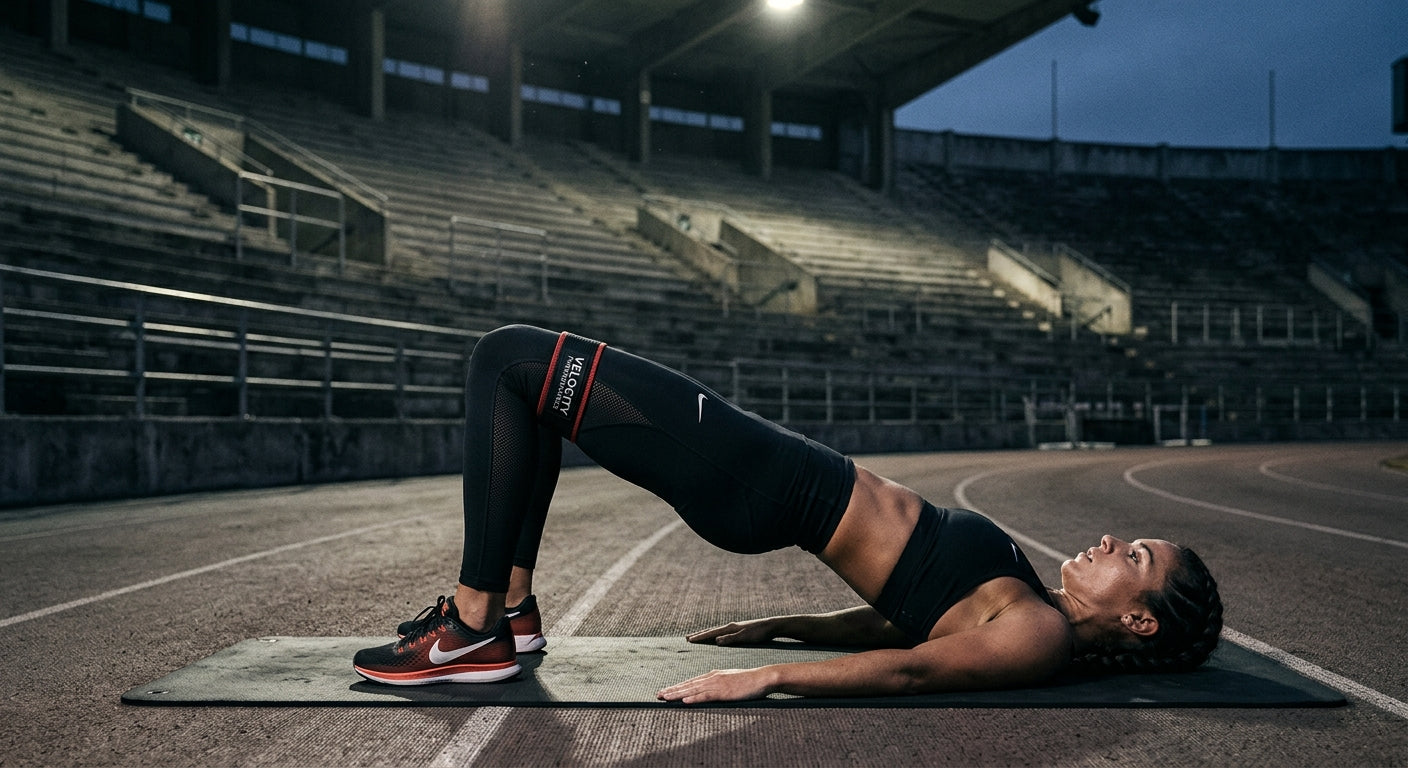
Progress to glute bridges with a band. Lie supine, feet hip-width apart, and drive through your heels to lift the pelvis. The band provides constant tension, necessitating greater stabilisation from the glutes to prevent the knees from caving inwards. Focus on a strong squeeze at the apex of the movement rather than achieving extreme range of motion.
Tips for Improving
Consistency is the cornerstone of neuromuscular adaptation. Do not rush through your activation routine; these should be performed with a focus on quality over quantity. Aim for two sets of ten to fifteen repetitions per exercise, ensuring that each movement is executed with perfect form and total muscular control.
As you become more proficient, consider the role of progressive overload. While the primary goal is activation rather than hypertrophy, increasing the resistance of your bands over time can further challenge your stabilisers. Monitor your perceived exertion; you should feel a distinct 'burn' in the glutes, not sharp pain in the lumbar spine or joints.

Pace stuck in a training plateau?
If your times haven't dropped in months, you likely need a new stimulus. We've trained our AI coach, Raye, on elite programmes to help you break through. Jump in with no sign-up and ask, for instance: 'What is the best threshold session to improve my 10K pace?' Discover ways to break your plateau.
Listen to your body with clinical precision. If you experience persistent discomfort or sharp, localised pain during these drills, it is essential to pause and seek professional medical or physiotherapy advice. Running is a high-impact sport, and ignoring underlying biomechanical imbalances can lead to chronic injury.
Special Features & Technical Specifications
Material Composition
Modern resistance bands are engineered from high-grade, latex-free thermoplastic elastomers (TPE). This ensures consistent tension profiles and superior durability compared to traditional rubber compounds, which are prone to micro-fissures and snapping under repetitive strain.
Physical Dimensions and Weight
Standard athletic bands measure approximately 30cm in length and 5cm in width. Weighing less than 50 grams, these tools are designed for portability without compromising the structural integrity required to support varied tension loads from light to extra-heavy resistance.
Engineering Evolution
Compared to previous generations of fabric-based bands, the current iteration features a non-slip internal silicone strip. This engineering change prevents the band from rolling or bunching during dynamic movement, ensuring the line of pull remains constant throughout your activation sequence.
Ultimately, by integrating these bands into your warm-up, you are investing in the longevity of your joints. A well-activated glute complex provides the centre of gravity stability required to absorb ground reaction forces, protecting your body from the repetitive stress inherent in long-distance running. Prioritise this routine to maintain a competitive edge and reduce your injury risk profile.


