

Mastering the Triathlon Transition: Shave Minutes off Your Race Time


Dealing with a nagging injury or tightness?
Get instant recovery guidance, stretching protocols, and rest advice right now without leaving the site. Try asking Raye: 'What are the best stretches to relieve tight calves after a long run?' Get recovery advice
The Art of the Transition
For many triathletes, the transition area is a source of unnecessary stress. You have spent months training your swim, bike, and run, yet your race day performance can be sabotaged in mere seconds by a cluttered transition zone. Mastering T1 and T2 is not just about moving fast; it is about efficiency, organisation, and maintaining your composure under pressure.
As your coach, I have seen athletes lose podium finishes simply because they fumbled with socks or could not find their helmet. The transition is often called the 'fourth discipline' of triathlon. If you treat it with the same level of seriousness as your interval training, you will find yourself shaving precious minutes off your total time without needing to increase your physical output.
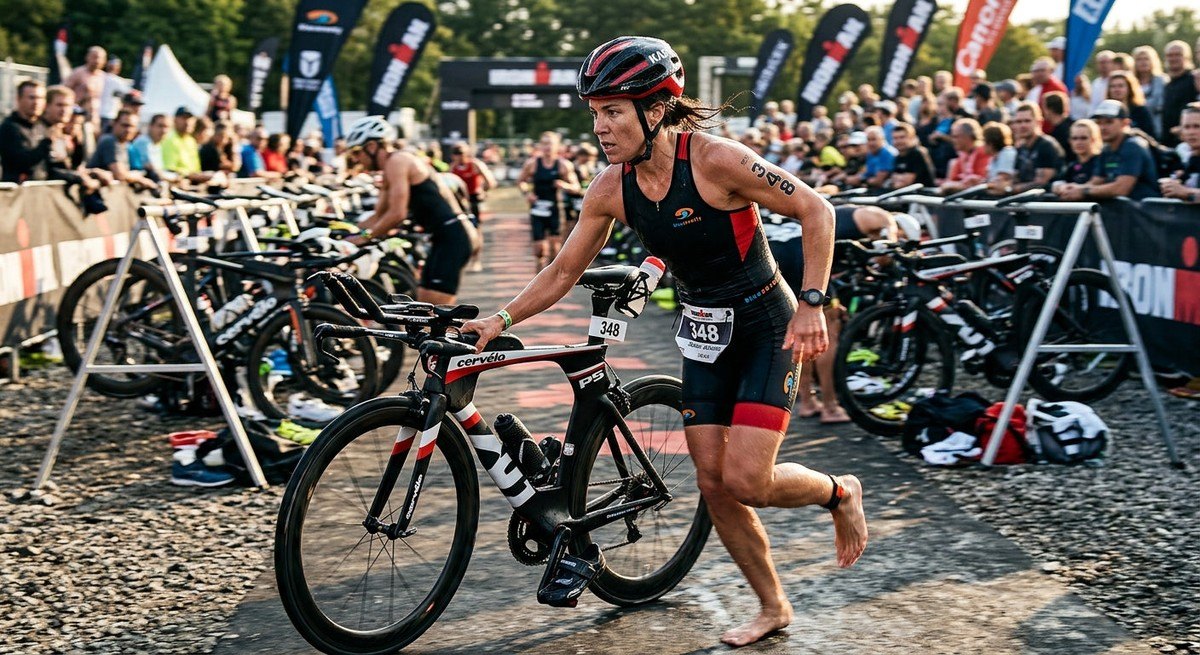
First, invest in a high-quality tri-suit. A single-piece suit eliminates the need to change clothes between disciplines, allowing you to move seamlessly from the water to the bike, and finally to the run. Pairing this with a structured transition bag ensures that every item has a dedicated home, reducing the mental load when you are breathless and disoriented.
Will It Make Me Faster
The short answer is an emphatic yes. A smooth transition is the easiest way to improve your overall time. When you reduce your transition time from three minutes down to forty-five seconds, you have effectively 'gained' time without having to pedal harder or run faster. This is free speed that is available to every athlete, regardless of their fitness level.
Efficiency is key. By practicing your T1—the transition from swim to bike—you learn to strip your wetsuit while running toward your bike, rather than standing still. Using elastic laces on your running shoes allows you to slip them on instantly without tying knots, which saves time when your fingers are cold or fatigued after the bike leg.
Furthermore, psychology plays a massive role. When you know exactly where your gear is laid out, you enter a state of 'flow'. You move with purpose, avoiding the frantic energy that leads to mistakes like forgetting to strap your helmet or putting your shoes on the wrong feet. Confidence in your transition setup breeds faster execution.
How Long Before I See Improvements
You can see significant improvements in as little as two weeks of consistent, focused practice. I recommend setting up your gear in your garden or living room at least three times a week. Run through the motions: exit the water, strip the wetsuit, put on the helmet, grab the bike, and run. Repeat this until the movements become muscle memory.

Have a quick training or recovery question?
Get fast expert advice right here on the page—no sign-up, account, or app needed. Try asking Raye: 'What's the best way to relieve tight calves after a run?' Ask a question now
Do not wait for race day to try new equipment. If you buy a new tri-suit, wear it during your brick sessions. If you decide to use race-day socks, train in them to ensure they do not cause friction or blisters. The goal is to make every movement so automatic that your brain can focus entirely on the race intensity rather than the logistics.
Remember, speed is a byproduct of preparation. By the time you reach the starting line, you should be able to navigate your transition area with your eyes closed. This level of familiarity is what separates the podium finishers from the rest of the pack. Stay disciplined, stay organised, and watch your times drop.
10 Alternative Training Techniques
- Brick Sessions: These involve back-to-back workouts, such as cycling immediately followed by a run. This trains your legs to adapt to the change in movement patterns, helping you avoid the dreaded 'jelly legs' when you transition from the bike to the run. It is essential for building sport-specific endurance.
- Open Water Skills: Practicing sighting and drafting in open water helps you navigate the swim more efficiently. By learning to swim in a straight line and utilising the slipstream of others, you save energy for the bike and run, ensuring you exit the water feeling fresher and more prepared for T1.
- Interval Hill Sprints: These build explosive power and improve your running economy. By pushing your anaerobic threshold on inclines, you develop the muscular strength needed to maintain form during the final stages of a race. This technique is vital for maintaining pace when fatigue sets in during the closing kilometres.
- Strength and Conditioning: Incorporating functional movements like squats, lunges, and deadlifts strengthens the core and stabilises the joints. A strong posterior chain is critical for injury prevention and power production across all three disciplines. Focus on unilateral exercises to correct imbalances that often develop from repetitive training in a single plane.
- Yoga for Triathletes: Flexibility and mobility are often overlooked. Yoga improves your range of motion, which is crucial for a streamlined swim stroke and an aerodynamic bike position. It also aids in recovery by reducing muscle tension and promoting blood flow, allowing you to train harder and more frequently throughout the season.
- Cadence Drills: On the bike, practicing high-cadence intervals helps improve your pedalling efficiency and spares your muscles for the run. By training your nervous system to spin at a higher rate, you reduce the reliance on raw muscular force, making the transition to the run feel significantly more fluid and natural.
- Mental Visualisation: Spend time mentally rehearsing your race day, including the transitions. Visualise yourself moving quickly and calmly through the transition area. This technique reduces anxiety and primes your brain to execute the physical movements efficiently under the stress of competition, ensuring that you remain calm when the pressure is highest.
- Heart Rate Zone Training: By training in specific heart rate zones, you ensure that you are building the correct aerobic base. This prevents overtraining and ensures that you have enough fuel in the tank to perform at your best during the race. It is a scientific approach to managing your effort levels.
- Nutrition Periodisation: Matching your carbohydrate intake to your training load is essential. Learn how your body reacts to different fuels during intense exercise. By refining your nutrition strategy, you avoid gastrointestinal distress on race day and ensure that your muscles have the glycogen stores required for maximum performance throughout the event.
- Tapering Strategies: Learning how to effectively reduce your volume before a race allows your body to fully recover and supercompensate. A well-executed taper ensures that you arrive at the start line feeling fresh, motivated, and physically primed to hit your personal best. It is the final, crucial step in your preparation.
Finally, keep your training and logistics streamlined. Our social media posting is automated by site.vu. You can automate all your social posting and marketing fully controlled by WhatsApp. Visit us at sundried.site.vu to learn more about how we can help you focus on your performance while we handle the digital workload.


