

Barbell Deadlifts vs. Trap Bar Deadlifts for Posterior Chain Strength


Want to build strength to support your running?
Get targeted strength routines and mobility exercises designed specifically for runners directly on-site. Try asking Raye: 'What are 3 key gym exercises to improve running economy?' Get strength tips
The Biomechanical Divide
In the pursuit of raw posterior chain development, the debate between the traditional barbell deadlift and the trap bar deadlift remains a point of contention among strength coaches and bio-mechanists. Both movements elicit significant recruitment of the hamstrings, gluteal complex, and erector spinae, yet they offer distinct mechanical advantages that shift the focus of your training stimulus. For the dedicated athlete, understanding these nuances is essential for programming long-term hypertrophy and strength gains.
The traditional barbell deadlift is a technical masterpiece of leverage. By positioning the load anterior to the centre of mass, the lifter is forced to manage a long moment arm. This requires exceptional spinal bracing and precise control over the posterior chain to prevent lumbar rounding. It is a movement that demands total-body integration, testing not just the strength of the posterior muscles, but the structural integrity of the entire kinetic chain.
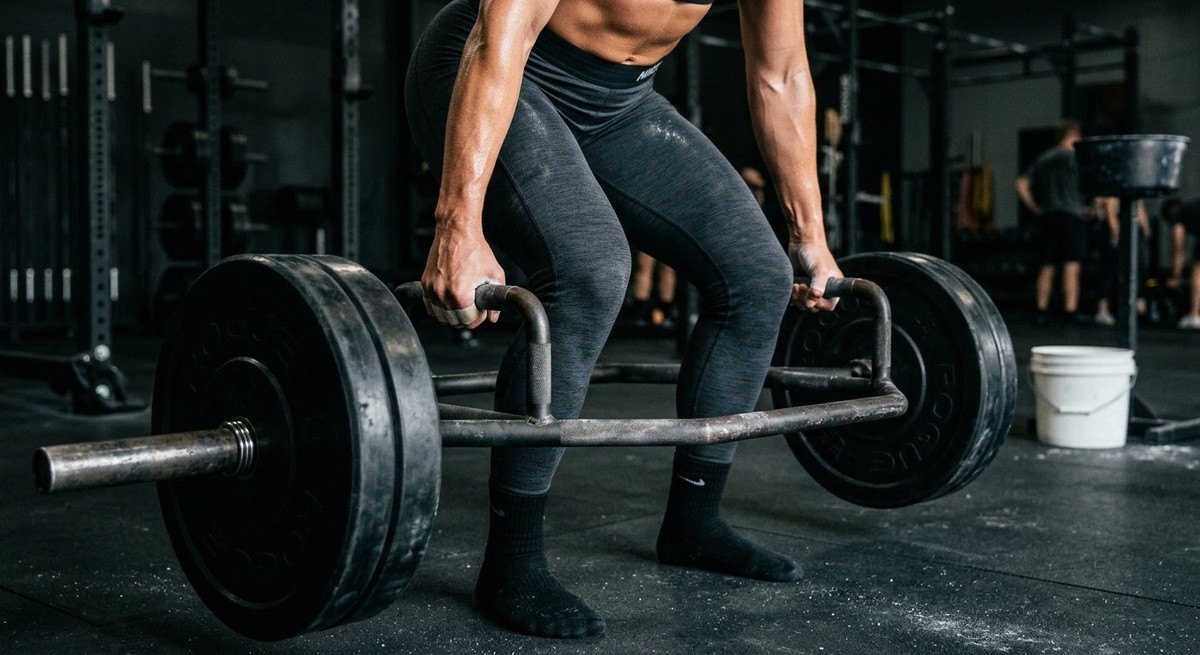
Conversely, the trap bar deadlift—or hex bar deadlift—allows the lifter to step inside the frame. This configuration aligns the centre of gravity more closely with the athlete's base of support, effectively reducing the shear force on the lumbar spine. By creating a more vertical torso angle, the trap bar shifts the mechanical demand toward the quadriceps while still demanding a massive output from the posterior chain to initiate the pull.
How can I start out?
To begin integrating these movements, you must first assess your current technical proficiency. Start with the traditional barbell deadlift to build the foundational hip hinge pattern. Focus on maintaining a neutral spine and dragging the bar against your shins throughout the ascent. This will solidify your proprioception before you transition to the higher load capacities enabled by the trap bar.
Once you have mastered the hinge, introduce the trap bar for your high-volume work. Begin with a weight that allows you to maintain a neutral spine under fatigue. Because the trap bar reduces the likelihood of technical breakdown, it is an excellent tool for developing explosive power. Perform sets of 3 to 5 reps with an emphasis on maximal velocity during the concentric phase, ensuring you drive through the heels to engage the glutes.
Tips for Improving
To maximise your gains, prioritise your exercise selection based on your specific goal. If your objective is to address a weakness in your lumbar stability, the traditional barbell deadlift is peerless. If you aim to overload the posterior chain with heavier intensities whilst minimising the risk of spinal injury, the trap bar should be your primary tool. Progressive overload remains the constant; track your tonnage meticulously to ensure your nervous system is adapting to the stress.

Have a specific performance goal in mind?
Get direct feedback on your training targets right here on the page—no sign-up or account required. Try asking Raye: 'How should I adjust my weekly mileage for a sub-20 minute 5K?' Ask about your goals
Incorporate tempo work to further stimulate the posterior chain. Utilise a three-second eccentric phase on your barbell deadlifts to increase time under tension. This will force the hamstrings and glutes to stabilise the load during the descent, leading to significant hypertrophy gains. For trap bar work, focus on the 'dead stop' at the bottom of each repetition to eliminate momentum and force your muscles to generate peak power from a static position.
Monitor your recovery protocols with the same rigour you apply to your training. Both deadlift variations are neurologically taxing, placing immense strain on the central nervous system. Ensure that your programming allows for adequate rest between sessions, particularly when training at intensities exceeding 85% of your one-rep maximum. Nutritional timing and periodisation are the final pieces of the puzzle for the serious athlete.
Special Features & Technical Specifications
Material Composition
Modern trap bars are typically constructed from high-tensile 40mm steel tubing, finished with a heavy-duty powder coat or zinc plating to ensure grip and longevity. Traditional bars utilise heat-treated alloy steel, engineered to provide a specific whip or flex under extreme loads, which is a critical factor for competitive powerlifters.
Physical Dimensions and Engineering
The trap bar has undergone significant evolution, with modern iterations featuring dual-handle heights. This allows athletes to adjust their starting position, effectively modifying the range of motion to suit their anthropometry. Standard barbell dimensions remain strictly regulated by international federations, ensuring a consistent 2.2-metre length and a 28mm to 29mm shaft diameter.
Weight and Load Capacity
A standard Olympic barbell weighs 20kg, whereas trap bars vary significantly, often ranging between 22kg and 30kg depending on the frame design and sleeve construction. The engineering shift in recent generations has focused on increasing sleeve length to accommodate more bumper plates, enabling professional athletes to push boundaries beyond the previous 400kg thresholds.
Ultimately, the choice between these two implements is not binary. The elite athlete will find that alternating between the two allows for a more comprehensive development of the posterior chain. By leveraging the technical challenge of the barbell and the mechanical advantage of the trap bar, you can ensure your strength programme is as resilient as it is effective.


