

10 Zone 2 benefits for Faster Running


Get the elite technical edge. Your first training plan is free.
Stop following generic PDF plans; get a dynamic programme that adapts as you progress through each training phase. Click here for your free custom triathlon or running training plan.
For you to understand why Zone 2 is the ultimate catalyst for speed, firstly you have to look at the "Moderate Intensity Rut." Let's be honest: most runners are stuck in a physiological no-man's-land. You go out, you run at a pace that feels "satisfyingly hard," your lungs burn a bit, and you finish feeling like you’ve done a proper shift.
Stop wasting miles in the "Grey Zone" and discover why running slow is your new secret weapon—hit play below to learn more.
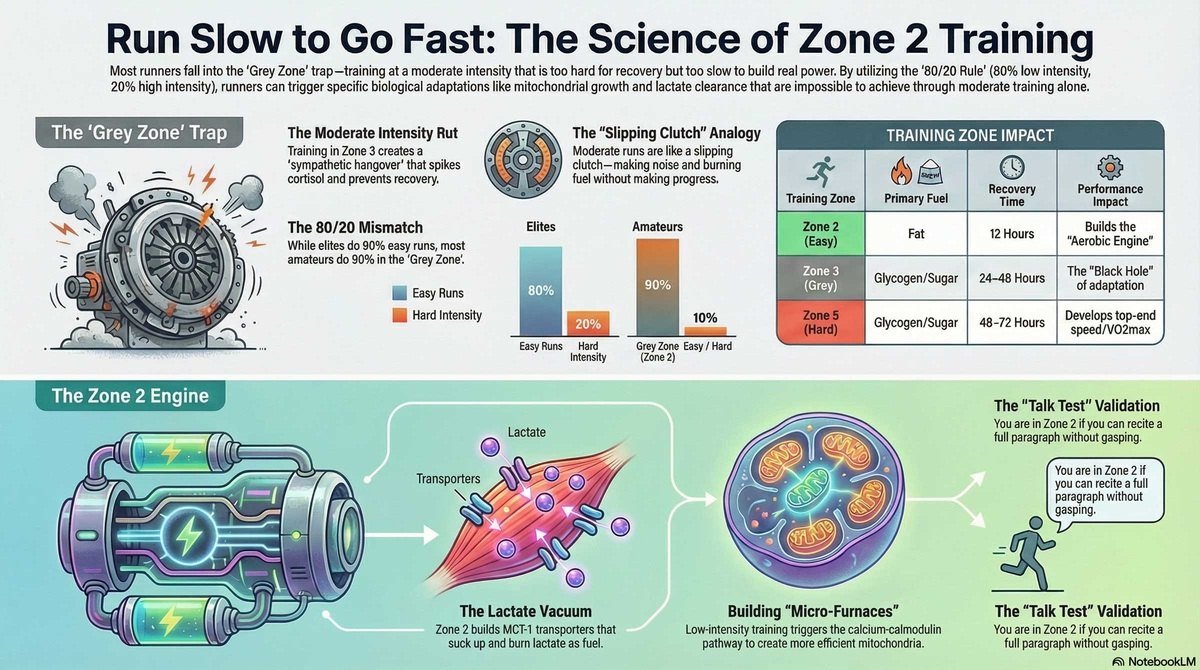
But here is the kicker: that "Grey Zone"—or what we call Zone 3—is actually garbage yardage. It’s too hard to let your body recover, but too easy to actually force your heart and lungs to level up. If you’re still training this way, you’re building a high-performance engine on a cardboard chassis. The reality is, if you want to run fast, you have to have the courage to run slow.
The Evolution of the Persistence Hunter
For you to understand why your body responds so well to slow running, firstly you have to look at our ancestors on the African savannah. Humans aren't the fastest sprinters—a cheetah will leave you in the dust—but we are the world's greatest persistence hunters.
We evolved with two massive advantages: uncoupled respiration (we can breathe at a different rhythm to our stride) and exceptional thermoregulation (we are the "sweating ape"). We were built to run slowly for hours until our prey literally collapsed from heatstroke. This ancestral "hybrid engine" prefers burning fat for the long haul and saving its limited glycogen (sugar) for the kill. When you spend all your time in Zone 3, you’re ignoring your biological blueprint and trying to run a diesel engine on racing fuel. You'll run out of oomph exactly when you need it.

The Three-Zone Model: Escaping the Black Hole
To get the 80/20 rule right, you have to ditch the complicated 5-zone charts on your watch for a second. For you to understand the physiology, firstly you have to look at the 3-Zone Model used by world-class coaches.

Training for a triathlon? Get a bespoke plan on WhatsApp now.
From focused foam rolling tips to mental visualisation techniques, Raye coaches the whole athlete, not just the miles. Talk to Raye about your performance goals now.
-
Zone 1 (The Easy Pole): Everything below your first Lactate Threshold (LT1). This is where the magic happens. It feels "deceptively easy."
-
Zone 2 (The Grey Zone): The middle ground between LT1 and your Anaerobic Threshold (LT2). This is the "Black Hole" that sucks in your recovery and gives you very little in return.
-
Zone 3 (The Hard Pole): Everything above LT2. This is the "red zone" where you’re gasping for air and your legs are screaming.
The 80/20 rule is simple: 80% of your runs should stay in that first zone (which aligns with "Zone 2" on most commercial 5-zone watches). The reality is, most runners do 90% of their work in the Grey Zone, leaving them too tired to ever truly smash a hard session.
The Biochemistry of "Slow"
For you to understand why running slow builds the engine, firstly you have to look at Mitochondrial Biogenesis. These are the microscopic power plants in your muscles. When you run hard, you trigger growth through a stress pathway called AMPK. It works, but it trashes your nervous system.
But here is the kicker: when you run in Zone 2, you trigger the Calcium-Calmodulin pathway. Because you can run for much longer at this low intensity, you’re flooding your cells with calcium signals for hours on end. This tells your body to build a massive network of mitochondria without the "sympathetic hangover" of a hard workout.
You’re also building the Lactate Shuttle. Everyone thinks lactic acid is the enemy, but the reality is that lactate is a high-octane fuel. Zone 2 training builds the MCT-1 transporters in your slow-twitch fibres. These act like a "vacuum," sucking up the lactate produced during your fast runs and burning it as energy. You run slow to build the vacuum that allows you to run fast.

Finding Your Zone 2: The Talk Test
The biggest challenge is knowing when you’ve crossed the line. If you’re relying solely on a wrist-based heart rate monitor, you’re living in the past—they’re notoriously finicky.
The Talk Test is the gold standard field test. If you can't recite a full paragraph or hold a proper conversation without gasping for air, you’ve crossed into the Grey Zone. At that point, your body starts buffering acidity with bicarbonate, which produces excess CO2 and makes you huff and puff. If you can’t talk, you aren’t in Zone 2. It’s that simple.
For you to understand why Zone 2 is the ultimate catalyst for speed, firstly you have to look at the "Grey Zone" trap. Most recreational runners believe that if a run doesn't leave them gasping for air and trashing their legs, it hasn't "counted." They spend every day in Zone 3—that stagnant middle ground that’s too hard to be recovery but too slow to build real power.
Let’s be honest: training in the Grey Zone is like trying to drive a car with a slipping clutch. You’re making plenty of noise and burning through fuel, but you’re not actually going anywhere. You’re building a high-performance engine on a cardboard chassis, and eventually, the whole thing is going to fall apart.
The reality is, to run fast, you have to have the discipline to run slow. Here are 10 reasons why Zone 2 is the "insurance policy" your running career needs.
Top 10 Benefits
Build Micro-Furnaces
Zone 2 drives mitochondrial biogenesis, building a whole power station instead of just running on generators.
The Lactate Vacuum
Builds MCT-1 transporters in slow-twitch fibres to create a vacuum that sucks up lactate and burns it as fuel.
Max Fat Oxidation
Teaches your body to prioritise fat, saving your precious glycogen stores for the final sprint.
Avoid the "Hangover"
By staying slow, you avoid the sympathetic "fight or flight" response, allowing you to stack more training days.
Build a Bigger Pump
Maximises stroke volume to build a larger heart, upgrading your engine to pump more oxygen-rich blood.
Strengthen the Chassis
Accumulate time on your feet to build bone density and tendons without the massive mechanical strain of speedwork.
Capillary Expansion
Stimulates the growth of new capillaries, building the road network to get more oxygen in and waste out.
Metabolic Flexibility
Improves your ability to switch between burning fat and carbs, pushing your crossover point higher to delay the "bonk."
Hormonal Health
Zone 2 is "parasympathetic" training that encourages rest and digest mode, maintaining a healthy hormonal balance.
Earn the Right to Go Fast
Slowing down 80% of the time ensures you arrive at your hard sessions fresh and ready to trigger top-end speed adaptations.
1. Building the Micro-Furnaces
Zone 2 is the primary driver of mitochondrial biogenesis. These are the microscopic power plants in your cells where fat and oxygen are converted into energy. By running at a conversational pace, you activate the calcium-calmodulin pathway. This signals your body to build more (and more efficient) mitochondria. If you’re constantly sprinting, you’re trying to run a factory on two generators; Zone 2 builds you a whole power station.
2. The Lactate Vacuum
We’ve all felt that "burn" in the final mile of a 5K. That’s lactate and hydrogen ions flooding your system. For you to understand how to beat that burn, firstly you have to look at your slow-twitch (Type I) muscle fibres. Zone 2 training builds the MCT-1 transporters in these fibres. This creates a physiological "vacuum" that sucks up the lactate produced by your fast-twitch fibres and burns it as fuel. You run slow to build the vacuum that allows you to run fast.
3. Maximum Fat Oxidation
Zone 2 is the metabolic sweet spot where fat oxidation is at its peak. Your body carries tens of thousands of calories in fat, but only a tiny amount of "high-octane" glycogen (carbs). Training in Zone 2 teaches your body to prioritise fat. This saves your precious glycogen for the final sprint or that brutal hill at the end of a race. If you're always training hard, you're a sugar-burner; Zone 2 turns you into a fat-burning furnace.
4. Avoiding the Sympathetic Hangover
Training is stress. High-intensity runs trigger your sympathetic nervous system—the "fight or flight" response. This spikes cortisol and trashes your Heart Rate Variability (HRV). The reality is, a Zone 3 run might take 48 hours to recover from, while a Zone 2 run takes 12. By staying slow, you avoid the "sympathetic hangover," meaning you can stack more training days back-to-back without burning out.

5. Building a Bigger Pump
Every time your heart beats, it pushes a specific amount of blood—this is your "stroke volume." At Zone 2 intensities, your heart reaches its maximum stroke volume. Over time, this makes the heart chamber larger and the walls stronger. You’re essentially upgrading from a 1.0-litre engine to a V8, allowing you to pump more oxygen-rich blood to your muscles with less effort.
6. Strengthening the Chassis
Running is a high-impact sport. Every step sends forces through your joints that are several times your body weight. Zone 2 allows you to accumulate time on your feet—building "bone density" and strengthening tendons—without the massive mechanical strain of speedwork. You’re reinforcing the chassis so it doesn't snap the moment you finally put your foot on the floor during a race.
7. Capillary Density Expansion
Think of capillaries as the road network for your blood. Zone 2 stimulates the growth of new capillaries (angiogenesis) around your muscle fibres. This means you can get more oxygen in and more waste products out. Without this network, your "super-shoe" tech and fancy intervals are basically useless—you’ve got no roads to deliver the fuel.
8. Metabolic Flexibility
If you’re still "hitting the wall" at mile 20 of a marathon, you’re living in the past. Zone 2 builds "Metabolic Flexibility"—the ability to switch effortlessly between burning fat and carbs. By improving your fat-burning floor, you push your "crossover point" higher. This means you can run at a faster pace while still staying in a fat-burning state, delaying the dreaded "bonk."
9. Protecting Your Hormonal Health
Chronic moderate-intensity training is a recipe for Overtraining Syndrome. It keeps your cortisol levels chronically high, which actively hinders muscle repair. Zone 2 is "parasympathetic" training. It encourages rest and digest mode, helping you sleep better and maintain a healthy hormonal balance. It’s not just about speed; it’s about metabolic longevity.
10. Earning the Right to Go Fast
But here is the kicker: the biggest benefit of Zone 2 is that it allows the "20%" of your hard training to actually work. If you’re tired because you ran your "easy" days too fast, you won't have the "oomph" to hit your 400m repeats at the right intensity. By slowing down 80% of the time, you arrive at your hard sessions fresh and ready to trigger the adaptations that actually produce top-end speed.


