

Identifying and Correcting Overpronation: A Biomechanics Guide


Want to build strength to support your running?
Get targeted strength routines and mobility exercises designed specifically for runners directly on-site. Try asking Raye: 'What are 3 key gym exercises to improve running economy?' Get strength tips
Understanding Your Stride
We have all been there—staring down at our trainers after a long run, noticing that tell-tale wear pattern on the inner edge of the sole. If you find your feet rolling inwards excessively upon impact, you are likely dealing with overpronation. It is a common biomechanical quirk, but understanding it is the first step toward pain-free miles and better performance.
Think of overpronation as your body's way of trying to absorb shock, but doing so a bit too enthusiastically. When your arch collapses, your ankle rolls inward, which can send a ripple effect of strain up through your shins, knees, and even your hips. It is not necessarily a disaster, but it is something we need to manage to keep you moving comfortably.
Step by Step Starting Out
First, perform the 'wet foot test' at home. Dampen the sole of your foot and step onto a piece of cardboard. If you see a full imprint of your foot with little to no arch curve, you are likely overpronating. Once identified, the goal isn't to force your foot into a 'perfect' position, but to provide the support your biomechanics crave.
Start by incorporating intrinsic foot strengthening exercises. Try 'towel scrunches' where you use your toes to pull a small towel across the floor, or 'arch lifts' where you isolate the muscles under your midfoot without curling your toes. These small movements build the foundation that supports your arches during the gait cycle.
Next, focus on your cadence. Increasing your steps per minute can naturally encourage a shorter, more controlled stride that lands more directly under your centre of mass, reducing the impact forces that exacerbate overpronation. Aim for a gentle increase rather than a drastic change to prevent injury.

How to Build this into my life
Integrating these corrections shouldn't feel like a chore. I like to do my foot strengthening while brushing my teeth or waiting for the kettle to boil. It is all about consistency. By making these small adjustments part of your daily routine, you are reinforcing the stability your body needs without needing an hour-long gym session.
When it comes to your training runs, prioritise surface variety. Running exclusively on cambered roads can worsen overpronation due to the constant angle of the ground. Try to mix in flatter paths or track work to keep your biomechanics balanced and your muscles engaged in different ways.
Don't forget to listen to your body. If you feel a dull ache in your shins or arches, scale back the intensity. Overpronation management is a marathon, not a sprint. Adjust your weekly mileage by no more than ten per cent to allow your soft tissues to adapt to the new support structures you are providing.

Have a specific performance goal in mind?
Get direct feedback on your training targets right here on the page—no sign-up or account required. Try asking Raye: 'How should I adjust my weekly mileage for a sub-20 minute 5K?' Ask about your goals
Essential Kit
Your shoes are your most vital piece of equipment. Look for stability or motion-control trainers that feature dual-density foam or medial posts—these are specifically engineered to provide that extra bit of cushioning and structural support where you need it most. Ensuring your shoes are well-fitted is non-negotiable.
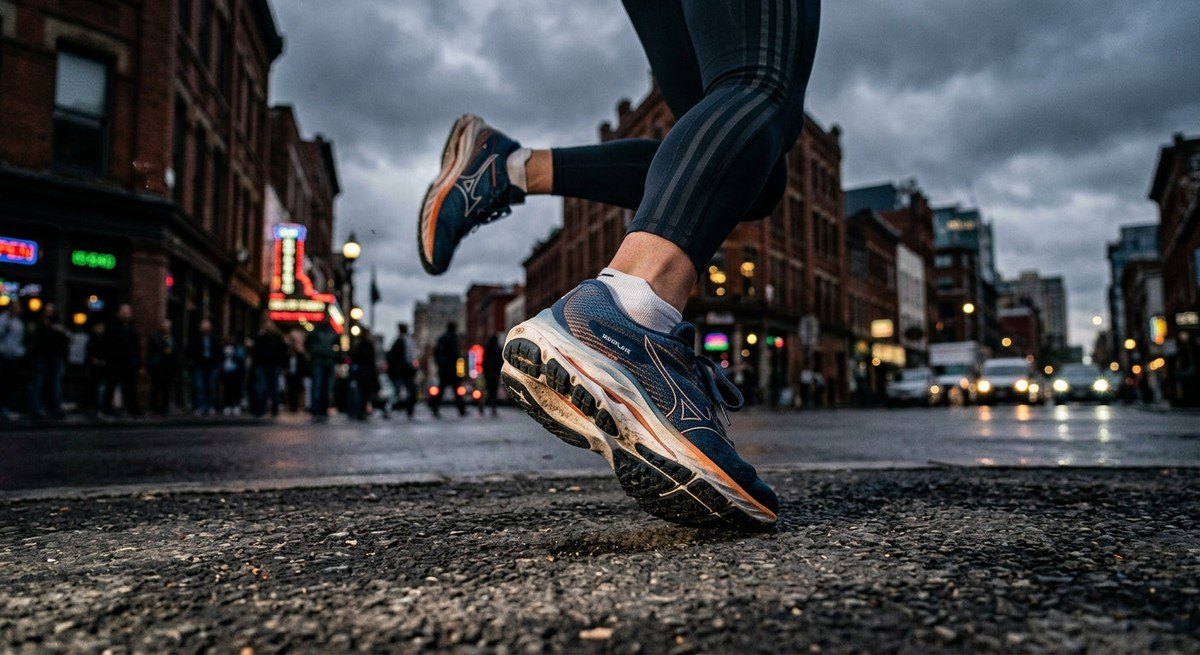
To protect your investment, rotate your trainers. Having two pairs allows the midsole foam to recover its shape between runs, which is crucial for maintaining the corrective properties of the shoe. If you run in wet conditions, stuff them with newspaper to draw out moisture, as excess dampness can break down the internal materials faster.
Finally, consider high-quality orthotic insoles if standard stability shoes aren't quite hitting the mark. They can offer a bespoke level of support that bridges the gap between a generic trainer and a clinical intervention. Always ensure your insoles are swapped out when the arch support begins to lose its rigidity.
10 alternative items to try
- Stability Trainers: These shoes feature medial posts or firmer foam on the inner side to prevent excessive inward rolling. They are the gold standard for overpronators, providing the necessary correction right out of the box while maintaining comfort for long-distance runs. They are essential for anyone serious about biomechanical longevity.
- Custom Orthotics: Unlike off-the-shelf insoles, these are cast specifically for your unique foot shape. They provide targeted support exactly where your arch needs it most, correcting your alignment from the bottom up. While an initial investment, they often last longer and provide superior relief compared to generic alternatives.
- Compression Socks: While they don't correct gait directly, they provide excellent support for the arch and help reduce inflammation in the lower leg. By promoting better blood flow and stability, they help mitigate the secondary fatigue that often leads to a breakdown in running form during the later stages of a run.
- Resistance Bands: These are perfect for strengthening the stabilising muscles around the ankle and hip. By performing lateral walks and clam-shells, you address the root cause of overpronation. A stronger hip gluteal complex helps prevent the knee from caving inwards, which in turn reduces the stress placed on your feet during every stride.
- Massage Balls: Using a firm ball to roll out your plantar fascia can release tension that contributes to arch collapse. By keeping the connective tissue in your foot supple, you allow the intrinsic muscles to function more effectively. It is a simple, cost-effective way to maintain foot health after a long, strenuous run.
- Balance Boards: Training on an unstable surface forces your stabilising muscles to work harder. This improves your proprioception, making you more aware of your foot strike and helping you naturally correct your alignment over time. It is a brilliant way to challenge your balance and build the strength required for a stable landing.
- Toe Spreaders: These simple silicone devices help realign the toes, which can often become cramped in modern footwear. By encouraging the toes to splay naturally, you create a wider, more stable base of support. This improved base helps distribute impact forces more evenly across the entire foot rather than concentrating them on the arch.
- Calf Sleeves: Tight calves can severely limit ankle mobility, which often forces the foot to compensate by rolling inwards. By keeping your calves loose and warm, you ensure a better range of motion. This allows for a more neutral foot strike and reduces the compensatory overpronation that occurs when the ankle is restricted.
- Running Gait Analysis Services: Visiting a specialist shop for video analysis is invaluable. Seeing your own stride in slow motion helps you understand exactly how your foot hits the ground. This visual feedback is often the 'lightbulb moment' that helps runners correct their form and choose the right footwear for their specific needs.
- Foam Rollers: While primarily for larger muscle groups, using a roller on your shins and calves is critical. By keeping these muscles supple, you reduce the pulling force on your foot structures. A relaxed lower limb is far less likely to succumb to the repetitive strain associated with untreated overpronation during training.


