

Smart Trainers 2026: Wahoo Kickr vs. Tacx Neo 3M – The Battle for the Indoor Crown


Dealing with a nagging injury or tightness?
Get instant recovery guidance, stretching protocols, and rest advice right now without leaving the site. Try asking Raye: 'What are the best stretches to relieve tight calves after a long run?' Get recovery advice
The Quest for Indoor Supremacy
For the modern cyclist, the line between indoor training and outdoor reality has blurred into non-existence. As we enter 2026, the battle for the premium smart trainer market has reached a fever pitch. At the centre of this struggle are two titans: the Wahoo Kickr and the Tacx Neo 3M. Both units represent the pinnacle of cycling engineering, designed for athletes who refuse to compromise on data accuracy, road-feel realism, or connectivity.
Investing in a high-end smart trainer is no longer just about maintaining fitness during the winter months. It is about marginal gains, physiological testing, and immersive digital racing. Whether you are prepping for a Gran Fondo or competing in the professional e-sports circuit, your trainer is your most vital piece of kit.
Evolution and History
To understand where we are, we must look at the trajectory of the indoor cycling market. A decade ago, fluid trainers were the gold standard. Today, the Wahoo Kickr and Tacx Neo have transformed the category into a software-driven ecosystem. The Kickr revolutionised the market by being the first to offer a seamless 'direct drive' experience, while the Tacx Neo challenged the industry by introducing electromagnetic resistance and virtual flywheel technology.
The 2026 models are the cumulative result of years of consumer feedback and iterative design. Wahoo has refined the axis movement and internal cooling, while Tacx has focused on its patented 'Motion Plates' to simulate real-world movement. These machines are not just trainers; they are sophisticated laboratory-grade devices.
What are the press saying?
Industry critics have been universal in their praise for both units, though their loyalties are often divided. The consensus suggests that the Wahoo Kickr remains the 'everyman’s pro' choice—reliable, robust, and compatible with almost every bike geometry imaginable. It is the unit most frequently seen in the warm-up areas of UCI WorldTour races.
Conversely, the Tacx Neo 3M is often heralded by reviewers for its sheer technological audacity. Journalists frequently highlight its ability to simulate different road surfaces—such as cobblestones or gravel—as a game-changer for those who find the static nature of indoor cycling tedious. The verdict is consistent: you cannot go wrong with either, but the 'feel' will dictate your final preference.
Comfort & Fit
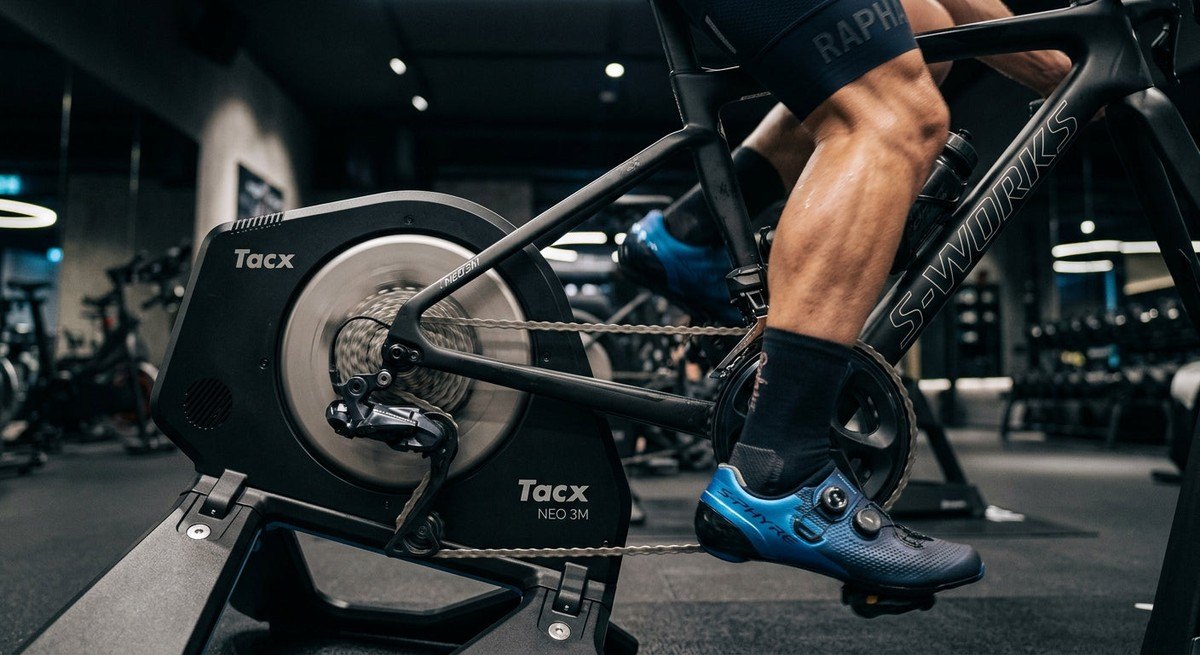
When we talk about comfort in 2026, we are really talking about natural movement. Static trainers can cause excessive saddle pressure, leading to discomfort during long, three-hour endurance sessions. The Tacx Neo 3M’s built-in motion plates are a masterclass in ergonomics, allowing the bike to rock slightly underneath you, engaging your core and mimicking the natural sway of outdoor climbing.

Have a quick training or recovery question?
Get fast expert advice right here on the page—no sign-up, account, or app needed. Try asking Raye: 'What's the best way to relieve tight calves after a run?' Ask a question now
The Wahoo Kickr, while inherently more rigid, has countered this with their 'Axis Feet' system. These adjustable caps provide a subtle side-to-side tilt that, while less pronounced than the Neo 3M, offers enough compliance to keep the joints fresh. For the athlete prioritising pure power output, the rigidity of the Kickr is often preferred, but for those focused on longevity, the Neo 3M is the superior comfort choice.
Features to Look out For
Connectivity is non-negotiable in 2026. Both trainers now feature Bluetooth FTMS and ANT+ FE-C protocols, allowing for instantaneous handshakes with apps like Zwift, Rouvy, and MyWhoosh. The Wahoo Kickr boasts a simplified 'Direct Connect' port for a hard-wired Ethernet connection, which is a significant advantage for those racing in high-stakes virtual events where a dropped signal means a lost race.
The Tacx Neo 3M distinguishes itself with its 'Virtual Flywheel' and the capacity to generate power without being plugged into the mains—a niche, yet welcome feature for pre-race warm-ups in the car park. Furthermore, the Neo’s silent electromagnetic motor remains the quietest on the market, ideal for those living in flats or training in the early hours.
What to Expect in the future?
As we look toward 2027 and beyond, the integration of Artificial Intelligence will likely be the next frontier. Imagine a trainer that doesn't just adjust resistance based on a course profile, but actively tweaks your cadence or pedalling efficiency in real-time based on your biometric feedback from wearable devices.

Furthermore, we anticipate deeper integration with haptic feedback systems. The lines between 'gaming' and 'fitness' will continue to blur, making the indoor experience more indistinguishable from the real world. Expect frame designs that allow for even greater degrees of lean, further reducing the 'static bike' fatigue that plagues even the most dedicated athletes.
Final Verdict
Choosing between these two is a luxury problem. The Wahoo Kickr is the ultimate tool for the disciplined, data-driven athlete who values reliability above all else. It is a workhorse that handles high-wattage sprints with unparalleled stability. It is the choice for the racer.
The Tacx Neo 3M, however, is the choice for the enthusiast who values immersion. Its road-feel technology, coupled with the integrated motion plates, makes long rides feel significantly less monotonous. If you have the budget and you value a refined, quiet, and motion-heavy experience, the Neo 3M is the premier choice. Ultimately, both trainers represent the best that 2026 has to offer.


