

Mastering Downhill Running Mechanics: A Blueprint for Quad Durability


Trying to beat your local Strava segment goals?
Fine-tune your training strategies to hit your target stats without downloading another app. Try asking Raye: 'How can I structure hill repeats to build short-segment power?' Ask how to hit your target
The Physiology of Downhill Descent
Downhill running remains one of the most challenging aspects of trail and ultra-endurance racing. While gravity provides free momentum, the physiological cost is significant, primarily manifesting as eccentric muscle damage within the quadriceps. Unlike concentric contractions, where muscles shorten, eccentric loading occurs as the muscle lengthens under tension to stabilise the body against impact. This creates micro-trauma in muscle fibres, leading to the delayed onset muscle soreness (DOMS) frequently experienced after long, technical descents.
For the serious athlete, the goal is to transform the quadriceps into shock absorbers capable of sustaining force over thousands of metres of vertical gain and loss. By focusing on neuromuscular durability, runners can mitigate fatigue and maintain speed even in the final stages of a race. This requires a systematic approach to training, where mechanical efficiency is prioritised over sheer aerobic capacity.
How can I start out?
To begin, you must integrate hill repeats that focus specifically on the descent. Many runners neglect the downhill phase of training, treating it as a recovery period rather than a skill-building opportunity. Start by finding a moderate gradient with stable footing. The focus should be on a high cadence and short, quick steps rather than long, bounding strides. Landing with your centre of mass aligned over your feet reduces the breaking force that causes damage.
Utilise Sundried compression leg sleeves during these sessions to provide targeted pressure that supports muscle stability and blood flow. These sleeves help minimise the vibration of muscle tissue upon impact, which is a key factor in reducing exercise-induced damage. Pair these with high-traction trail shorts designed for a full range of motion, ensuring your stride remains unrestricted during technical foot placements.
Tips for Improving
Improving your downhill technique requires a shift in mindset. You must learn to trust your equipment and your neuromuscular response. Grip is essential; wearing specialised grip socks will prevent your feet from sliding inside your shoes, which is a common cause of blisters and instability on steep terrain. When you feel your feet remain locked in place, you can focus entirely on your line choice and body posture.
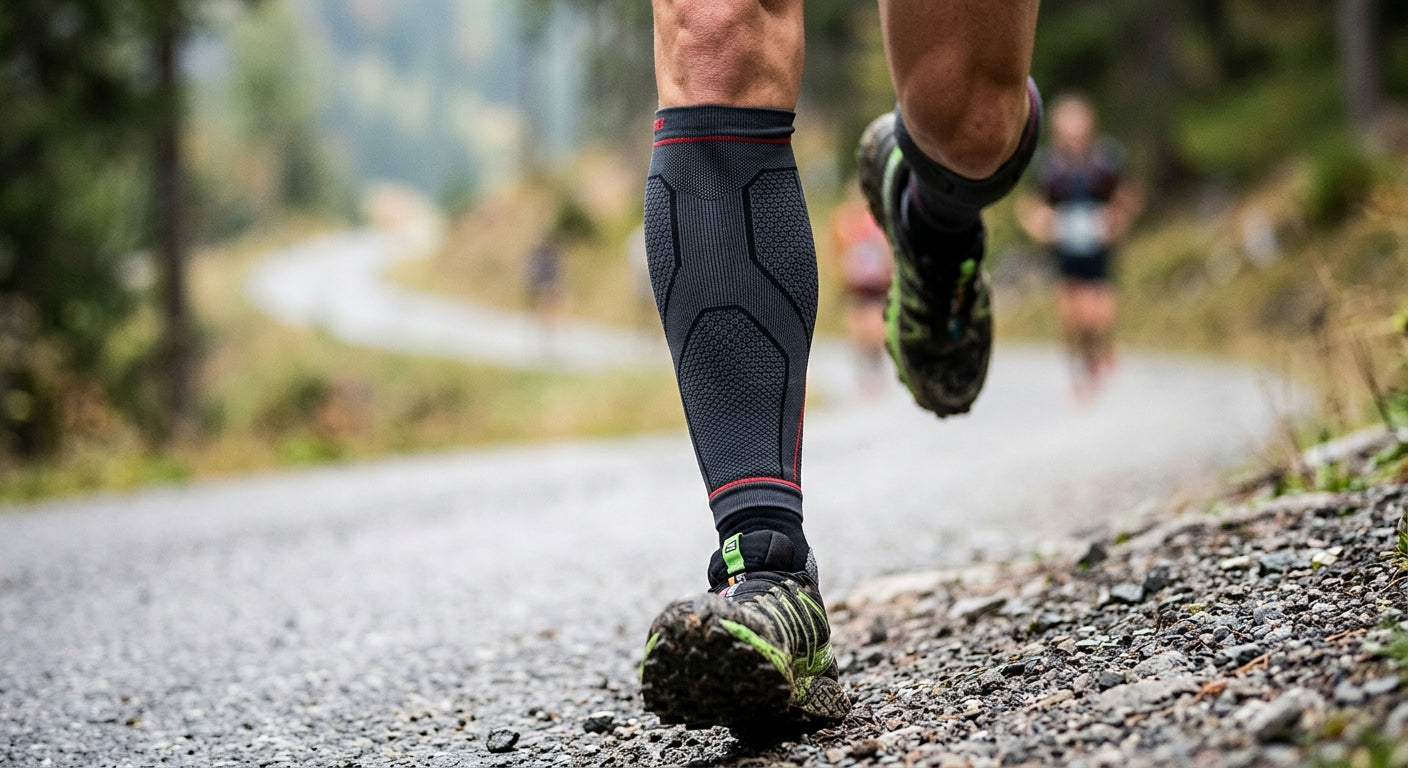
Focus on your core engagement throughout the descent. A slight forward lean—not from the waist, but from the ankles—will maintain your momentum. Avoid the common tendency to lean back, as this shifts the load onto the knees and increases the risk of injury. Instead, treat the descent as a series of controlled falls, using your ankles and hips to absorb the energy rather than locking your joints.

Hit a wall with form, pacing, or fatigue?
Skip searching forums. Chat directly on this page with our performance coach to solve training issues in seconds: 'How do I prevent side stitches on long runs?' Troubleshoot your run
Incorporate eccentric-focused strength training into your weekly routine. Exercises such as slow-tempo squats, Bulgarian split squats, and eccentric-only step-downs will condition your muscle fibres to handle the high-impact loads encountered on the trail. Consistency is the key; even small, deliberate sessions dedicated to downhill mechanics will produce measurable gains in your race-day performance.
Special Features & Technical Specifications
Material Composition
The Sundried range utilises advanced synthetic blends, integrating high-denier polyamide fibres for extreme abrasion resistance on rocky trails. The compression sleeves feature a graduated weave pattern designed to target the vastus lateralis and medialis, providing structural support during high-impact eccentric loading.
Physical Dimensions and Weight
The compression sleeves are engineered with a multi-panel construction to mirror anatomical contours. Total weight is kept below 60 grams per pair, ensuring zero interference with natural gait mechanics. The trail shorts feature an 18cm inseam, providing an optimal balance between coverage and unrestricted movement.

Engineering Evolution
Compared to previous generations, this iteration incorporates a revised silicone grip pattern on the socks to enhance lateral stability. The fabric tension has been increased by 15% to provide superior proprioceptive feedback, allowing athletes to react faster to uneven terrain and shifting ground conditions.
By integrating these technical components with a rigorous training protocol, you can effectively harden your legs against the rigours of mountain racing. Downhill running is not merely about surviving the descent; it is about mastering the transition from impact to propulsion. With the right gear and a disciplined focus on mechanics, you will find that your capacity to navigate steep, technical terrain will improve exponentially, ultimately leading to faster race times and a more robust athletic profile.
