

Nike ACG Zegama 3 Preview


Dealing with a nagging injury or tightness?
Get instant recovery guidance, stretching protocols, and rest advice right now without leaving the site. Try asking Raye: 'What are the best stretches to relieve tight calves after a long run?' Get recovery advice
Note: This page is a preview based on early news and info and will be updated with a full hands-on review upon launch.
For you to understand why the Nike ACG Zegama 3 is currently the most talked-about mountain weapon for 2026, firstly you have to look at the "All Conditions Racing Department." For years, Nike’s trail division felt like a secondary thought—basically road shoes with a bit of extra rubber glued to the bottom. They were fine for a light Sunday stroll through the woods, but the moment you hit technical limestone or deep Basque mud, they tended to fall apart.
The reality is, the Zegama 3 represents a massive "vibe shift" for Nike. By moving this silhouette under the ACG (All Conditions Gear) banner, Nike has finally stopped playing it safe. They are no longer building lifestyle shoes with trail "vibes"; they are building high-performance engines designed to survive the most hostile environments on the planet. This isn't just an update; it’s a total structural overhaul aimed at the ultra-marathoner who needs to survive 100 miles of technical mountain terrain without their feet, or their sanity, falling apart.
The Legacy: From K2 to the Basque Country
For you to understand the DNA of the Zegama 3, firstly you have to look at the history of Rick Ridgeway and John Roskelley on the slopes of K2 in 1978. They didn't wear heavy, traditional leather boots; they wore the Nike LDV—a lightweight road trainer. It was flexible, breathable, and it proved that "light is right" even in the world's harshest mountains. That spirit of "functional minimalism" is what birthed the ACG division in 1989.
The "Zegama" name itself is a tribute to the Zegama-Aizkorri Mountain Marathon in Spain. If you’ve never seen it, imagine 42 kilometres of vertical ridges, mist, and thousands of screaming fans. As Kilian Jornet famously said, "Zegama is Zegama." It is a brutal environment that demands a specific type of tool. The Zegama 3 is engineered for exactly that—the steep Sancti Spiritu climb and the high-impact descents into the village. It is a dedicated mountain tool designed for technical supremacy.
The Architectural Shift: ZoomX Unleashed
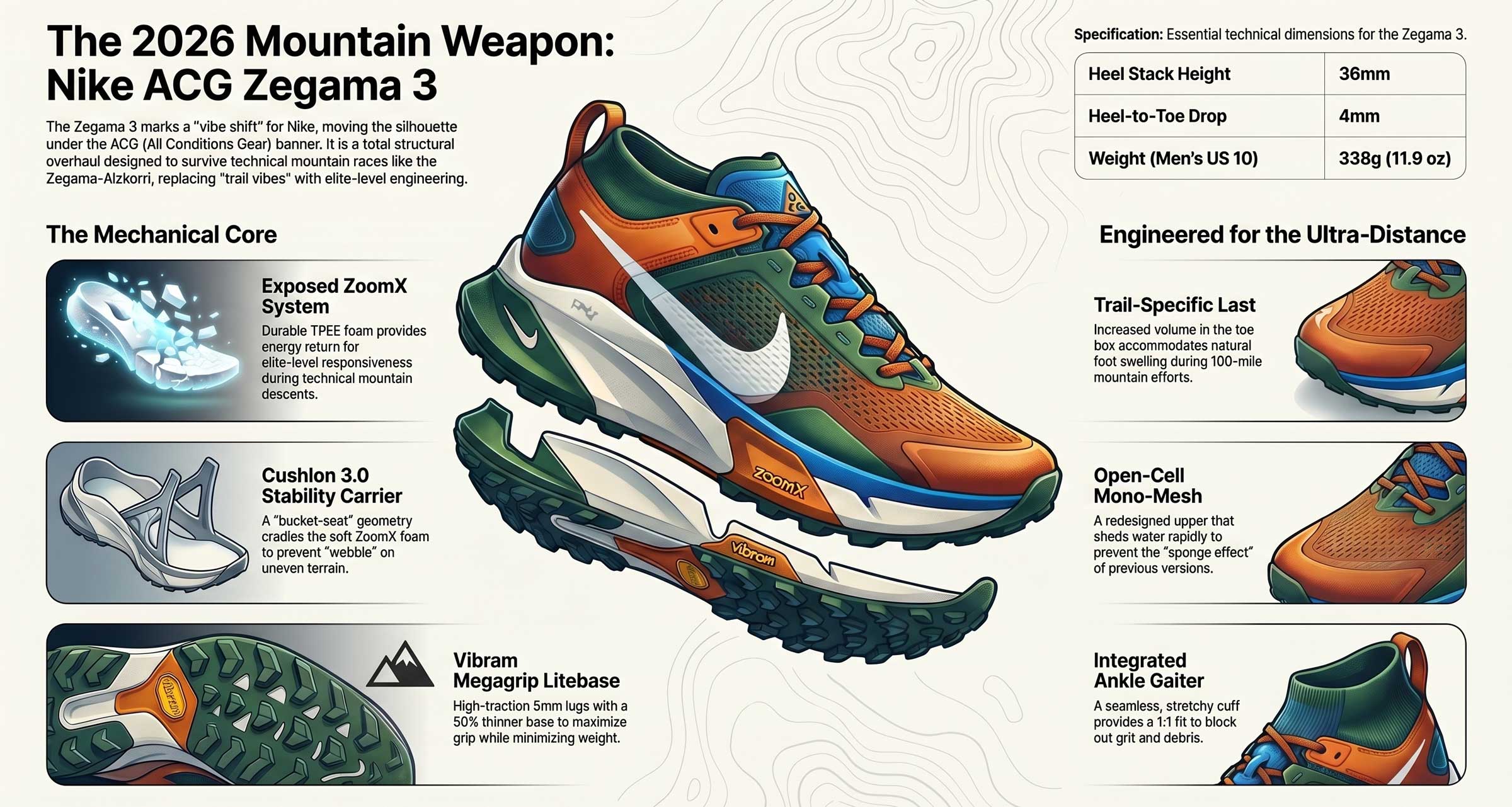
Let’s be honest: the previous Zegamas had a bit of a "wobble" problem. For you to understand how Nike fixed this, firstly you have to look at the Exposed ZoomX System.
In the first two versions, Nike often encapsulated the ZoomX foam—the same high-energy PEBA foam used in world-record-breaking marathon shoes—inside a firmer carrier. The reality is, this encapsulation was like putting a Ferrari engine inside a tractor chassis. It protected the foam from rocks, but it killed the "magic" of the rebound. It felt dampened and, frankly, a bit sluggish.

Have a quick training or recovery question?
Get fast expert advice right here on the page—no sign-up, account, or app needed. Try asking Raye: 'What's the best way to relieve tight calves after a run?' Ask a question now
For the ACG Zegama 3, Nike has engineered a newer, more durable version of the TPEE (Thermoplastic Polyether Block Amide) ZoomX. They’ve finally "exposed" the foam. This allows it to travel further during compression and snap back more effectively. When you’re plummeting down a technical descent at mile 80 of an ultra, you want that foam to absorb the shock and hurl you into the next stride.

The "Bucket Seat" Stability: Cushlon 3.0
But here is the kicker: how do you stop a 36mm stack of "super foam" from being a wobbly mess on uneven ground? The answer is the Cushlon 3.0 Stability Carrier.
Nike has created what they call a "bucket-seat" effect. The soft ZoomX sits directly under your foot for comfort, but it is cradled by a denser, more protective Cushlon 3.0 base. This base features a "four corners" geometry—a massively widened platform under the heel and forefoot. This increases your contact patch with the ground, providing the "planted" feel you need when scrambling over wet limestone or technical boulder fields.
| Dimension | Specification | The "Why" |
| Heel Stack Height | 36mm | Maximum impact protection for long-distance fatigue. |
| Forefoot Stack Height | 32mm | Consistent cushioning through the push-off phase. |
| Heel-to-Toe Drop | 4mm | Promotes stability and midfoot striking on uneven trails. |
| Weight (Men's US 10) | 338g (11.9 oz) | Balanced durability with high-tech foam protection. |
The Grip: Vibram Megagrip Litebase
For years, Nike’s proprietary outsole rubber was notoriously slippery on wet rock. It was like running on ice. For you to understand why the Zegama 3 is finally trustworthy, firstly you have to look at the partnership with Vibram.
The Zegama 3 utilizes Vibram Megagrip with Litebase technology. Megagrip is the industry benchmark for "sticky" traction on wet stone. The Litebase tech is the secret sauce here—it reduces the thickness of the outsole rubber by 50%, allowing Nike to keep the aggressive 5mm lugs while significantly dropping the overall weight.
But here is the kicker: the lug geometry has been completely redesigned. They’ve introduced "Traction Lug" technology—micro-textures on the sides of the lugs that increase surface area. This provides massive braking power on descents and maximum friction on those steep, muddy climbs. The reality is, if you’re facing "the Zegama treatment" (mud and slick rock), this is the grip you want.
The Ultra-Fit: Engineering for the "Swell"
If you’ve ever run an ultra, you know that after six hours, your feet aren't the same shape they were at the start. For you to understand the fit of the Zegama 3, firstly you have to look at the Trail-Specific Last.
Nike has significantly increased the volume in the toe box and forefoot. This allows for natural toe splay, which is your best defence against friction-induced blisters and helps with balance on technical terrain.
The upper is a lightweight, durable engineered mesh. Let’s be honest: the Zegama 2 mesh acted like a sponge. It held onto water and became a heavy mess in wet races. The Zegama 3 uses a more open-cell structure designed for rapid drainage. You aren't carrying an extra 200g of water five hours into your race.
-
Integrated Ankle Gaiter: The cuff is stretchier and provides a 1:1 fit around the heel, effectively blocking out sand, grit, and small pebbles.
-
Midfoot Lockdown: A fit band is connected to the lacing system, ensuring your foot doesn't slide forward inside the shoe during those toe-crunching descents.
Specialized Evolution: The Zegama Hike
For the first time, Nike is also launching the ACG Zegama Hike. This is a mid-cut performance boot that adapts the Zegama DNA for heavy-duty trekking and fast-packing.
The Hike version features a reinforced rip-stop upper and rubberized overlays for extra protection against sharp scree. While the trail runner is built for speed, the Hike is tuned for load-bearing. It’s for the 10-hour days in the Swiss Alps or the Oregon wilderness where you’re carrying a full pack but still want the "pop" of ZoomX foam underfoot.
Performance Review: What the Pros Are Saying
The Zegama 3 has been through the most rigorous testing protocol in Nike's history, involving 22 elite athletes from the All Conditions Racing Department.
Caleb Olson, the 2025 Western States winner, has been vocal about the prototypes. He noted that while the shoe maintains that "plush" comfort for 100 miles, the exposed ZoomX adds a level of responsiveness that was missing in previous versions. Tyler Green, another elite podium finisher, reported that the traction is finally "stellar" right out of the box. The reality is, Nike has stopped guessing and started listening to the people who actually suffer in these shoes for 20 hours at a time.
Comparative Analysis: The Competition
To understand the Zegama 3's value, firstly you have to look at the "Super-Trail" landscape of 2026.
-
vs. Hoka Speedgoat 6: The Hoka is still the king of "pure plush." It has a higher 40mm stack and is lighter, but it lacks the energy return of ZoomX. The Speedgoat is a cruiser; the Zegama 3 is a racer.
-
vs. Saucony Xodus Ultra 4: The Saucony is a very balanced alternative and uses a similar PEBA foam. However, reviewers often point out that the Zegama’s Vibram Megagrip is superior on the slick, technical limestone where Saucony's proprietary rubber can struggle.
-
vs. Nike ACG Ultrafly: The Ultrafly is the carbon-plated speedster of the ACG line. It’s faster on flat, runnable trails, but for technical mountains where you need flexibility and protection, the Zegama 3 is the better chassis.
Launch Dates and Pricing: UK & USA
The rollout is a coordinated global event, intended for the peak of the 2026 mountain racing season.
-
UK Launch: 30 June 2026. Expect a retail price of £185. It will be available on the SNKRS app and specialized trail retailers.
-
USA Launch: July 2026. The retail price is set at $190. Some retailers like Running Warehouse may offer early ordering as soon as late April.
But here is the kicker: if you’re on a budget, keep an eye on the Zegama 2. As the ACG Zegama 3 lands, the previous version is being heavily discounted to around £85. It’s still a solid road-to-trail option if you don't need the technical supremacy of the version 3.
The Verdict: The Good and The Bad
Let’s be honest: no shoe is perfect, even when it’s developed by an "All Conditions Racing Department."
The Good:
-
Elite Energy Return: The exposed ZoomX provides a "trampoline" effect that actually preserves your leg muscles over ultra-distances.
-
Reliable Traction: The move to Vibram Litebase has finally given Nike a shoe you can trust on wet rocks.
-
Upper Drainage: They’ve solved the "sponge" problem. The new mesh sheds water rather than holding it.
-
Volume for the Swell: The wider toe box is an absolute necessity for 100-mile efforts.
The Bad:
-
The Weight: At 338g (M10), it is still a heavy beast. If you’re used to nimble, low-profile shoes, this will feel like a tank.
-
Breathability in Heat: The thick padding in the heel and tongue can still hold a lot of heat during summer races in the desert.
-
Stack Stability: Even with the Cushlon base, a 36mm stack can feel "tippy" on extreme off-camber technical trails.
Top 10 Features
Exposed ZoomX Foam
High-energy TPEE foam for 85% energy return on every stride.
Cushlon 3.0 Stability Carrier
A denser base foam that "cradles" your foot for a wobbly-free ride.
Vibram Megagrip Litebase
Sticky traction on wet rock with a 50% thinner rubber base to save weight.
5mm Multidirectional Lugs
Aggressive teeth designed specifically for the "Zegama treatment" of mud and scree.
4mm Heel-to-Toe Drop
A lower, more natural offset for stability in the mountains.
36mm Heel Stack
Maximalist protection to save your joints during high-impact descents.
Trail-Specific Last
Increased volume in the toe box to accommodate natural foot swelling over 20+ hours.
Engineered Mono-Mesh
A new upper that prioritises drainage and structural lockdown over plushness.
Integrated Ankle Gaiter
A seamless cuff to stop grit and pebbles from interrupting your race.
Forefoot Rock Plate
A flexible barrier that protects against bruising without making the shoe feel like a plank.
The Nike ACG Zegama 3 is more than just a seasonal update; it’s a declaration of intent. Nike has finally stopped guessing and started building a legitimate mountain tool. If you value "leg preservation" and want a shoe that rewards high-speed descending, the June 2026 launch is the one you’ve been waiting for.
Don't Fancy the Nike ACG Zegama 3?
Exploring Alternatives to the Nike ACG Zegama 3
While the Nike ACG Zegama 3 packs an impressive arsenal of trail technology with its high-energy ZoomX foam and Vibram Megagrip outsole, it might not be the flawless match for your specific mountain needs. If you find integrated ankle gaiters overly restrictive or irritating, or if the low 4mm heel-to-toe drop places too much strain on your Achilles tendon, you might want to consider other options. On the other hand, you might be looking to push the boundaries further by seeking out advanced features like a full carbon-fibre propulsion plate rather than a simple rock plate for maximum race-day efficiency. If you are hunting for an alternative ultra-distance trail companion that solves these issues or ramps up the performance technology, here is a hand-picked list of alternatives to try.
10 Trail Running Shoe Alternatives
1. Hoka Speedgoat 6 If you are searching for a high-stack, maximally cushioned trail shoe but want a more traditional lockdown without an integrated gaiter, the Hoka Speedgoat 6 is a legendary alternative. It shares the same commitment to tackling technical terrain and features a similar Vibram Megagrip outsole with aggressive traction lugs. However, instead of a dual-density ZoomX setup, it utilises a lighter, highly resilient CMEVA foam that provides a wonderfully balanced, responsive ride over ultra distances.
-
The Good Point: Its incredibly accommodating woven upper wraps the foot securely while remaining breathable, ensuring long-lasting comfort without the potential constriction of a seamless ankle cuff.
Check Live Price for Hoka Speedgoat 6
2. Saucony Xodus Ultra 3 For runners who love the idea of a bouncy, premium foam core but want a slightly higher drop to ease calf strain, the Saucony Xodus Ultra 3 is a superb choice. It boasts a core of incredibly energetic PWRRUN PB supercritical foam surrounded by a more durable PWRRUN frame, echoing the dual-density stability carrier concept of the Zegama 3. It also features a flexible rock plate to guard against sharp stones.
-
The Good Point: It has an exceptionally roomy toe box tailored specifically for ultra-marathon distances, giving your feet even more space to naturally splay and swell, preventing blisters during long days.
Check Live Price for Saucony Xodus Ultra 3
3. The North Face Summit VECTIV Pro 2 If you want to step up the technology from a basic rock plate to serious propulsive power, this is your ultimate racing alternative. Designed for elite ultra-trail performance, it features a massive stack of proprietary DREAM foam that rivals ZoomX for energy return. Instead of just protecting the foot, it incorporates a forked carbon-fibre plate that maximises forward momentum and stability on uneven terrain.
-
The Good Point: Its aggressive rocker geometry combined with the carbon plate drastically reduces leg fatigue and practically rolls you forward, making it an absolute powerhouse for highly efficient, fast-paced running.
Check Live Price for The North Face Summit VECTIV Pro 2
4. Altra Olympus 6 If the 4mm drop of the Zegama 3 is not quite natural enough for your biomechanics and you want to fully embrace a zero-drop platform, the Altra Olympus 6 is a rugged, heavily cushioned alternative. It features a towering stack of compression-moulded EVA foam to protect your joints during brutal descents, paired with an industry-leading Vibram Megagrip outsole for flawless traction on wet, slippery rock.
-
The Good Point: It features Altra's signature Original FootShape fit, providing an exceptionally wide toe box that allows your toes to relax and spread out completely naturally, offering unmatched comfort over massive distances.
Check Live Price for Altra Olympus 6
5. Asics Trabuco Max 3 For those who want maximalist protection but prefer an alternative to Vibram rubber, the Asics Trabuco Max 3 is a phenomenal ultra-distance cruiser. It features a colossal stack of FF Blast Plus foam, delivering an incredibly plush, shock-absorbing ride that eats up miles of hard-packed dirt and rocky paths. It foregoes a rock plate, relying entirely on the sheer volume of foam for underfoot protection.
-
The Good Point: The proprietary AsicsGrip outsole is widely considered one of the stickiest and most durable rubber compounds on the market, offering supreme confidence on wet terrain without adding unnecessary weight.
Check Live Price for Asics Trabuco Max 3
6. Brooks Caldera 7 If you find the narrow waist of many modern trail shoes too wobbly despite stability carriers, the Brooks Caldera 7 offers a beautifully stable alternative. It utilises nitrogen-infused DNA Loft v3 foam to provide a highly cushioned, lively, and incredibly comfortable ride for long days out. Instead of a rock plate, the shoe uses its sheer midsole volume and a uniquely widened base to keep you planted.
-
The Good Point: Its dramatically flared midsole walls act like a bucket seat for your foot, providing a highly stable, secure platform that prevents ankle rolls even on highly technical, uneven surfaces.
Check Live Price for Brooks Caldera 7
7. Salomon Genesis If you love the Zegama's focus on technical mountain terrain but want a more dynamic, precise fit without the bulk of a 36mm stack, the Salomon Genesis is a brilliant alternative. It uses Energy Foam to provide a highly responsive, cushioned ride that still allows for excellent ground feel. The outsole features highly aggressive lugs tailored for deep mud and loose scree.
-
The Good Point: The incredibly durable Matryx upper, woven with Kevlar threads, provides an exceptionally secure lockdown and almost bulletproof resistance to tearing on sharp rocks and dense mountain brush.
Check Live Price for Salomon Genesis
8. NNormal Tomir 2.0 For runners drawn to the Vibram Megagrip Litebase technology but seeking a slightly firmer, more hard-wearing shoe, the NNormal Tomir 2.0 is a fantastic, sustainable option. It upgrades to a supercritical foam for improved energy return and bounce while maintaining a highly durable, structured feel. The 5mm lugs are meticulously spaced to shed mud instantly.
-
The Good Point: Its remarkable longevity and eco-conscious construction mean the shoe is meticulously stitched directly to the midsole, drastically increasing its lifespan and preventing delamination over countless brutal mountain miles.
Check Live Price for NNormal Tomir 2.0
9. Merrell Agility Peak 5 If you want a dependable, high-traction trail shoe that includes a rock plate but comes at a slightly more accessible price point than premium tier racers, the Agility Peak 5 is a proven workhorse. It pairs a thick slab of FloatPro foam with a flexible rock plate to guard against underfoot bruising on harsh descents. It also shares the exceptional Vibram Megagrip outsole with 5mm lugs for elite traction.
-
The Good Point: The highly structured heel cup and padded collar offer a very traditional, locked-in, and reassuringly supportive feel for runners who dislike minimal or gaiter-style ankle collars.
Check Live Price for Merrell Agility Peak 5
10. La Sportiva Prodigio If you want a shoe built by mountain purists that incorporates modern super-foam tech, the La Sportiva Prodigio is a spectacular alternative. Moving away from their traditionally firm mountain running shoes, this model features XFlow supercritical foam for a deeply cushioned, highly energetic ride that excels on ultra-marathon courses. It offers a slightly higher 6mm drop and a highly breathable, fast-draining mesh upper.
-
The Good Point: Its incredibly precise midfoot wrap secures your foot perfectly on steep, off-camber technical descents, ensuring you never slide around inside the shoe when navigating treacherous, uneven alpine ridges.


