

Hoka Skyward X 2 Preview


What's your next big fitness goal?
Whether you're aiming for a local Parkrun or an Ironman, getting the right advice is crucial. We built our AI coach, Raye, to answer anything about your training and goals. No account needed—just dive in. Ask Raye: 'Can you create a basic 12-week training plan for a half Ironman?' Ask Coach Raye anything about your goals.
Note: This page is a preview based on early news and info and will be updated with a full hands-on review upon launch.
Hoka Skyward X 2 Preview: The Next Level of the Super Trainer
If you’ve been keeping a close eye on the world of running gear lately, you’ll know that things are moving fast. We’ve seen a massive shift in how we think about our trainers. It wasn’t that long ago that you had two choices: a heavy, cushioned shoe for your long weekend runs, or a thin, flimsy racing flat for when you wanted to go fast. But those days are long gone. We are now firmly in the era of the "Super Trainer."
As we look toward the middle of 2026, the buzz is all about one shoe in particular: the Hoka Skyward X 2 . This isn’t just another update; it’s a big moment for Hoka. They’ve taken everything they learned from the first version—the good, the bad, and the slightly painful—and refined it into something that looks set to change the game for anyone serious about their fitness and training.
Get Price Alerts for the Hoka Skyward X 2
Don't overpay for the Hoka Skyward X 2. We track 50+ retailers and will email you the best prices as soon as they are available.
The Story So Far: From Bondi X to the Skyward Legacy
To understand why the Skyward X 2 is such a big deal, we have to look at how we got here. Hoka has always been the king of "maximalist" shoes—those big, chunky soles that look like you’re walking on clouds. For years, they used a foam called EVA, which was great for comfort but didn't always give you that "pop" or energy back.

Does running feel harder than it should?
Poor running economy could be causing unnecessary fatigue. Our dedicated AI coach is loaded with technical knowledge to help fix your cadence, breathing, and form. Chat instantly with no sign-up. Ask Raye: 'How can I improve my arm swing to waste less energy?' Find out how to improve your form.
Then the "Super Shoe Wars" started. Suddenly, every brand was putting carbon plates and high-tech foams into their shoes. Hoka tried to keep up with the Bondi X back in 2021. They put a carbon plate into the classic Bondi, but it didn't quite hit the mark. The foam was a bit too traditional, and the plate felt more like a stiff board than a spring. It was a good lesson: if you want a carbon plate to work, you need the right foam to go with it.
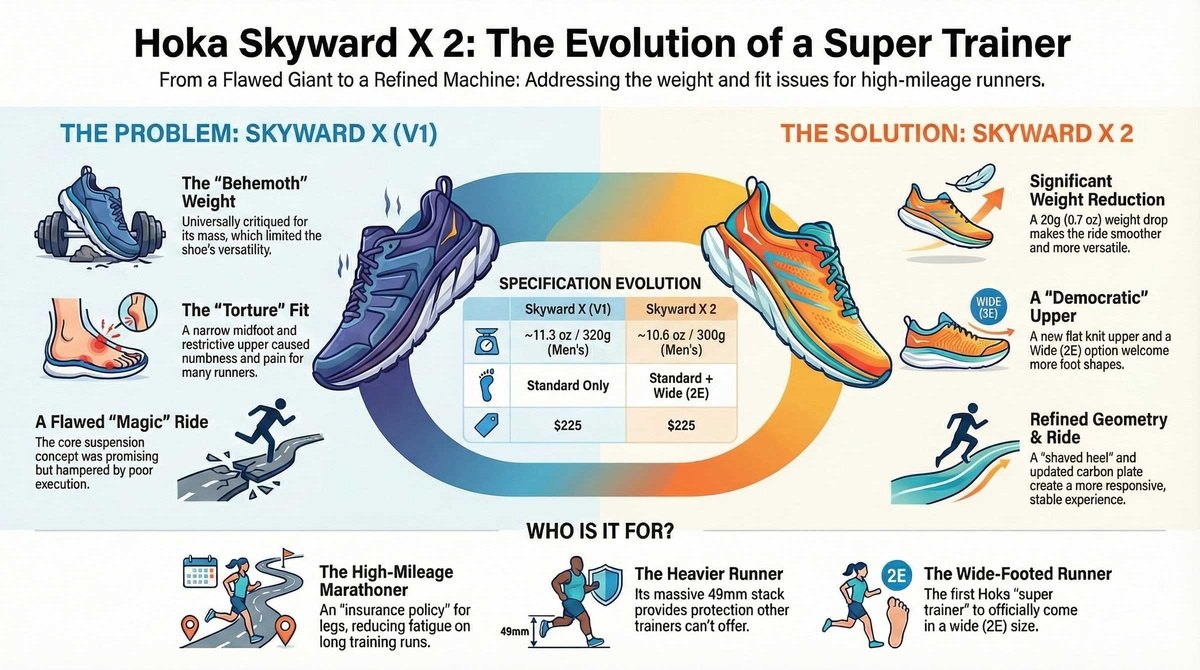
Enter the original Skyward X in 2024. This was Hoka’s "moonshot" project. They threw everything at it: a suspension system, a convex carbon plate, and a top layer of incredibly bouncy PEBA foam. People loved the feeling of "floating on air," but it wasn't perfect. It was a bit of a heavy beast, and the fit was notoriously tight in the midfoot, leading to some runners complaining about numb toes after a few miles.
The Skyward X 2 is Hoka’s answer to all of that feedback.
What’s New? The TRE 2025 Reveal
At the end of 2025, the running world gathered in San Antonio for "The Running Event" (TRE), and the Skyward X 2 was the star of the show. The main takeaway? Hoka hasn't started from scratch; they’ve performed a bit of surgery. They kept the soul of the shoe but fixed the bits that were holding it back.
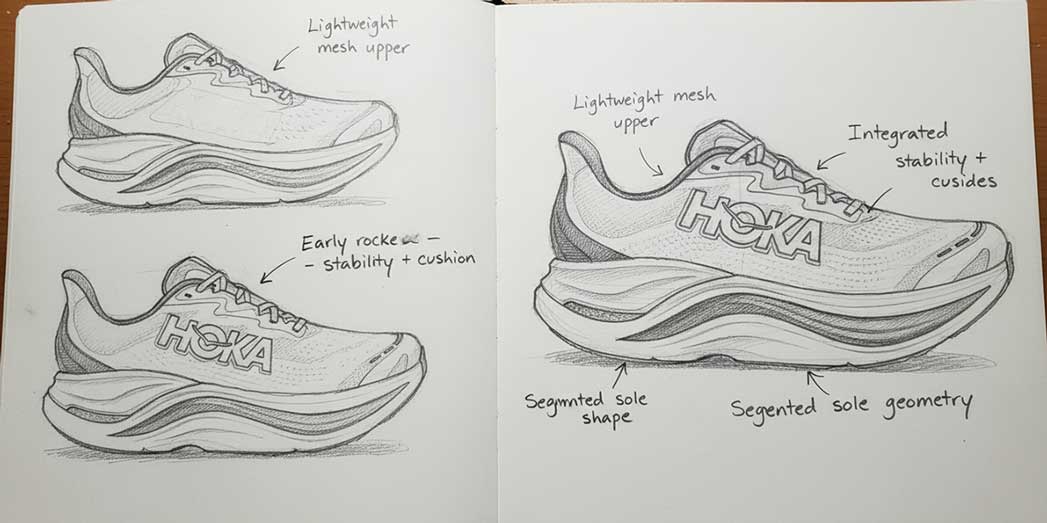
The first thing people noticed was that the shoe looks "downsized." Now, don't worry—the massive stack of cushion is still there (it’s actually still tall enough that it’s technically "illegal" for elite racing), but it looks sleeker. The first version was often compared to a "moon boot," but the V2 has a more streamlined, aerodynamic profile.
One of the biggest changes is the "shaved heel." In the first version, the heel stuck out quite far at the back. It made the shoe very stable, but it could feel a bit clunky. By trimming this down, Hoka has made the transition from heel to toe feel much more natural and faster. It’s about being more "engaged" with the ground, even when you’re sitting on 50mm of foam.
The Tech: Foams, Plates, and Physics
Let’s talk about what’s actually happening under your foot. The Skyward X 2 uses a "sandwich" construction that is seriously clever.
-
The Top Layer (PEBA Foam): Right under your foot is a thick layer of PEBA foam. This is the "super foam" used in top-tier marathon racing shoes. It’s incredibly soft but has a very high energy return. When you land, it doesn't just squash; it wants to bounce back immediately.
-
The Carbon Suspension: In the middle of that foam is an H-Frame carbon fibre plate. Most racing shoes use a plate that’s shaped like a spoon to flick you forward. The Skyward is different. Its plate is "convex"—it bows upwards in the middle like a leaf spring. When you put your weight on it, it flattens out, storing energy, and then it snaps back to propel you.
-
The Bottom Layer (Supercritical EVA): The foundation is a frame made of Supercritical EVA. This is created by injecting gas into the foam to make it lighter and tougher. This layer acts like a protective shell for the softer PEBA foam and keeps the shoe stable.
Even though it looks a bit smaller, the stack height is actually a tiny bit taller than before. We're looking at about 49mm in the heel and 44mm in the forefoot . That gives you a 5mm "drop," which is classic Hoka. It encourages a more natural midfoot strike, which is generally better for your joints during long training sessions.
A Fit for Everyone: The "Wide" Revolution
The most exciting news for many will be the update to the upper part of the shoe. The first Skyward X was a bit of a nightmare for anyone with wider feet. It was narrow, the toebox was tight, and that stiff plate could sometimes cause a bit of a squeeze.
Hoka has listened. The Skyward X 2 features a brand-new Engineered Flat Knit upper. It’s designed to be more breathable and to stretch a bit as your feet naturally swell during a long run. But the real headline is that they are finally offering a Wide (2E) option . This is a huge win for inclusivity and means that more people can enjoy the tech without feeling like their feet are in a vice.
Shedding the Weight
In the world of running shoes, every gram counts. The first Skyward X weighed in at around 320g (for a men’s size 9.5). While it was comfortable, that’s quite a lot of weight to carry around for 10 or 20 miles.
The new Skyward X 2 has managed to drop about 20g , bringing it down to roughly 300g (10.6 oz) . It might not sound like a lot on paper, but when you’re thousands of steps into a run, that reduction makes a massive difference. It transforms the ride from feeling a bit "heavy" to feeling like a smooth "cruiser." It allows you to pick up the pace a bit more easily, making the shoe much more versatile for different types of training.
How Does It Feel on the Road?
While we are waiting for the full release to do a complete hands-on review, we can tell a lot from the design. You should expect a ride that feels like a "trampoline." Some shoes feel like a "wedge"—they push you forward aggressively. The Skyward X 2 is more about that vertical bounce. It’s designed to soak up the impact of the pavement and turn it into upward momentum. This is fantastic for those long training runs where you want to protect your legs. The goal here isn't necessarily to break your 5k PB (though you certainly could); it’s about finishing a long run feeling fresh enough to get back at it the next day.
The "numb toe" issue from the first version should also be a thing of the past. By increasing the volume of the upper and offering the wide fit, your toes will have the room they need to splay out naturally as that carbon plate flattens under your weight.
Competition: How Does It Stack Up?
The Skyward X 2 isn't alone in this "Super Trainer" category. It has some stiff competition:
-
Vs. New Balance SC Trainer v3: The New Balance is also very bouncy and uses a carbon plate. Historically, New Balance has been the go-to for comfort and width. But with Hoka adding a wide option and refining their plate, the Skyward X 2 is making a very strong case for itself. The Hoka tends to feel a bit more stable and structured, whereas the New Balance can sometimes feel a bit "mushy."
-
Vs. Asics Superblast 2: The Superblast is incredibly popular because it’s very light (around 250g). However, it doesn't have a carbon plate. It relies purely on the foam geometry. If you want the absolute lightest shoe, you might look at Asics, but if you want that extra "spring" from a carbon plate and maximum joint protection, the Skyward X 2 is the clear winner.
-
Vs. Adidas Prime X Strung 2: The Adidas is another "illegal" giant with a 50mm stack. It’s fast but can be very unstable—some runners find it a bit "tippy." The Hoka Skyward X 2 is designed with a much wider base and a "bucket seat" for your foot, making it a far safer and more stable choice for most people.
Launch Details and Pricing
So, when can you get your hands on them? The global rollout is strictly timed.
-
USA Launch: Expected in Spring 2026 (likely late April).
-
UK Launch: We expect to see them hitting shelves in May 2026 . Major UK retailers like SportsShoes and ProDirect Running will be the places to watch.
-
Price: The price is expected to hold steady at £185 ($225) .
In a world where some "hyper-shoes" are now costing upwards of £250 or £300, keeping the price the same as the first version is a smart move by Hoka. You're getting a lighter, better-fitting, and more advanced shoe for the same money.
Who Is This Shoe For?
This is a premium piece of kit, but it’s perfect for a few specific types of people:
-
The High-Mileage Hero: If you are training for a marathon or just doing a lot of miles every week, this shoe is like an insurance policy for your legs. It reduces the wear and tear on your muscles and joints.
-
The Larger Runner: If you’re a bit heavier, you tend to compress foam more quickly. The 49mm stack height and carbon suspension provide a level of protection that standard trainers just can't match.
-
The Wide-Footed Runner: Finally, Hoka has made a top-tier super trainer that actually fits! If you’ve struggled with Hoka’s narrow fit in the past, this is the one to try.
Final Thoughts
The Hoka Skyward X 2 looks like the "grown-up" version of the original concept. The first one was a bold experiment—it was impressive, but it had its flaws. The V2 feels like a refined product that respects the anatomy of a runner. By cutting the weight and opening up the fit, Hoka has removed the biggest hurdles that stopped people from loving the original.
It remains a specialised tool, but for those long, steady miles where you want to feel protected and energised, it’s going to be very hard to beat in 2026. It's a shoe that understands that for most of us, the goal isn't just to be fast today; it’s to be able to run again tomorrow.
Top 10 Features
49mm Heel Stack
Maximum cushioning that goes beyond racing limits for ultimate protection.
Dual-Density Midsole
A clever mix of bouncy PEBA foam on top and durable Supercritical EVA on the bottom.
Convex Carbon Fibre Plate
An H-shaped plate that acts like a leaf spring for a unique, "trampoline" feel.
Significant Weight Drop
Roughly 20g lighter than the previous version, making it much more versatile.
Wide (2E) Fit Availability
Finally, a high-performance trainer designed for more than just narrow feet.
"Shaved" Heel Geometry
A trimmed-down heel for a smoother, less clunky transition during your gait.
Engineered Flat Knit Upper
A premium, breathable material that adapts to your foot as you train.
Active Foot Frame
Your foot sits inside the midsole, not on top of it, providing incredible stability.
Durable Outsole Placements
Strategic rubber in high-wear areas to ensure the shoe lasts through high-mileage training.
5mm Drop
A natural-feeling slope that works perfectly with the rockered sole for effortless forward motion.
Let us find the best price on the Hoka Skyward X 2
We will find the lowest price for the Hoka Skyward X 2 and email you as soon as we get them for you.


