

The Ultimate Morning Routine for Runners: How to Fuel, Stretch, and Perform


Trying to beat your local Strava segment goals?
Fine-tune your training strategies to hit your target stats without downloading another app. Try asking Raye: 'How can I structure hill repeats to build short-segment power?' Ask how to hit your target
For you to understand how to turn a groggy morning jog into a high-performance session, firstly you have to look at the transition from your bed to the road. Most people treat their bodies like a light switch—they want to flip from "sleep mode" to "sprint mode" instantly. The reality is, your body is more like a massive diesel engine; it needs a proper warm-up sequence before you can start redlining it.
If you’re rolling out of bed and hitting the pavement within five minutes, you’re essentially trying to drive a car with frozen oil. It’s clunky, it’s inefficient, and eventually, something is going to snap.
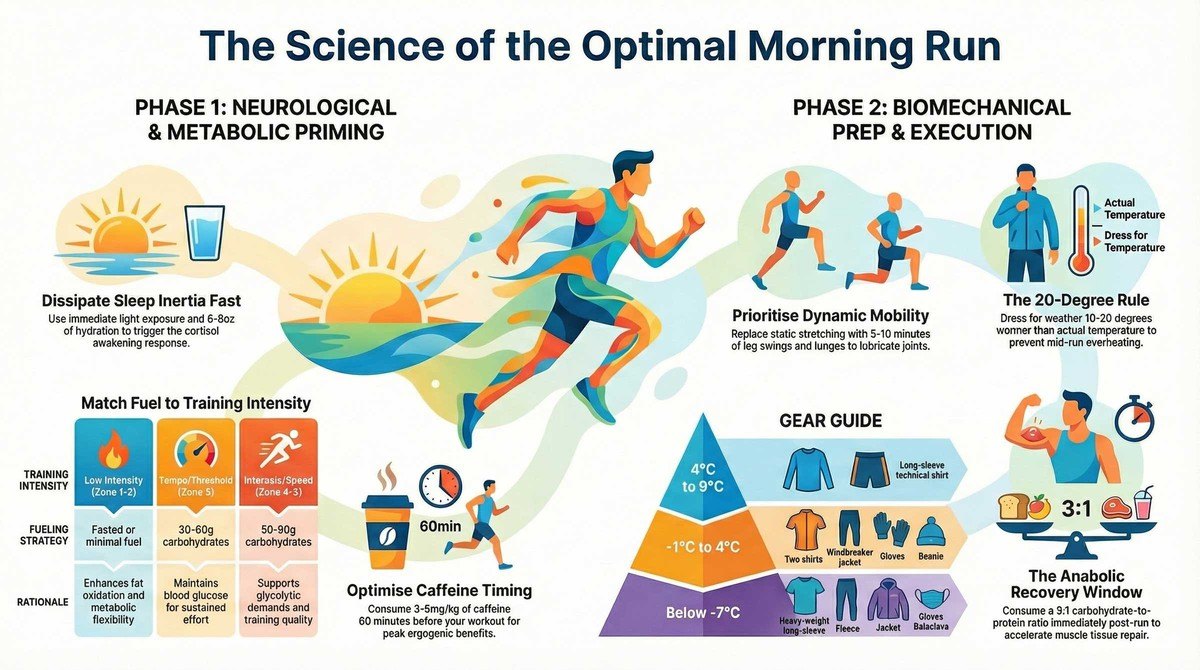
Waking Up the System: Light and Cortisol
Let’s be honest: the "snooze" button is the enemy of the morning runner. For you to understand why that first 20 minutes is so vital, firstly you have to look at your internal clock. Your body needs a signal that the night is over.
Ready to turn your groggy morning jog into a high-performance session? Hit play on the podcast episode below to learn how to wake up your engine properly.
The quickest way to do this is through light exposure. Natural light hits your eyes and tells your brain to stop producing melatonin (the sleep hormone) and start pumping out cortisol. This isn't the "stress" cortisol people complain about; this is your natural "get up and go" juice.
-
The 20-Minute Window: It takes about 25 minutes for your brain to shake off "sleep inertia."
-
The Hack: If it's dark outside, turn on bright indoor lights immediately. It primes your metabolism and gets your head in the game.

Metabolic Foundations: The Fasted-Fed Paradox
For you to understand whether you should eat before you run, firstly you have to look at what you’re actually trying to achieve today. If you’re building a high-performance engine, you need to match the fuel to the work.
Are You Running in the Wrong Shoes?
Research shows rotating shoes can reduce injury risk by 39%. Find out exactly which 3 shoes belong in your locker based on your weekly mileage. Take the Free Gear Diagnostic.

Hit a wall with form, pacing, or fatigue?
Skip searching forums. Chat directly on this page with our performance coach to solve training issues in seconds: 'How do I prevent side stitches on long runs?' Troubleshoot your run
| Training Intensity | Fueling Strategy | The "Why" |
| Low Intensity (Zone 1-2) | Fasted or minimal fuel | Teaches the body to burn fat for fuel. Good for metabolic health. |
| Tempo / Threshold | 30-60g Carbohydrates | You need glucose to keep the pace high without "hitting the wall." |
| Intervals / Sprints | 50-90g Carbohydrates | High-octane fuel for high-power output. Don't skimp here. |
But here is the kicker: your legs are already full of fuel. While your liver glycogen (brain fuel) drops overnight, your muscle glycogen (leg fuel) is usually still topped up from last night’s dinner. If you're just doing a slow 30-minute plod, you don't need a three-course breakfast. However, if you're doing speed work on an empty stomach, you’re basically building a Ferrari and putting lawnmower fuel in it. You'll run out of "oomph" exactly when you need it most.
Fluid Homeostasis: The Waking Deficit
You wake up dehydrated. Period. You’ve spent eight hours breathing and sweating out moisture without taking any in. Starting a run in this state is a recipe for a thumping headache and a skyrocketing heart rate.
The Daniel Protocol:
-
Immediate Rehydration: Drink 250ml of water the moment you stand up.
-
The Sodium Secret: If you’re running for over an hour, plain water isn't enough. You need electrolytes—specifically sodium—to actually pull that water into your cells.
-
Caffeine Timing: Caffeine is a brilliant tool, but it takes about 45 to 60 minutes to peak in your system. If you take it the second you wake up, it'll hit its stride just as you're hitting yours.

Biomechanical Activation: Ditch the Static Stretch
For you to understand why your shins or knees might be hurting, firstly you have to look at your warm-up. Or lack of one.
The old-school method of standing still and touching your toes is dead. Static stretching before a run is like trying to stretch a cold rubber band—it doesn’t get more flexible, it just gets closer to snapping. You need dynamic movement to lubricate the joints.
The 5-Minute "Engine Check"
-
Leg Swings: 15 per side. Gets the hips moving.
-
Walking Lunges: 15 per side. Wakes up the glutes (your primary "drive" muscles).
-
Heel and Toe Walks: 30 metres each. This is your insurance policy against shin splints and Achilles issues.
-
Bird Dogs: 20 reps. This stabilises your core so your back doesn't take the brunt of the impact.
Environmental Mastery: The 20-Degree Rule
If you're training in the cold, the biggest mistake you can make is overdressing. The reality is, your body temperature is going to climb significantly within the first mile.
The Golden Rule: Dress as if it is 10 to 15 degrees Celsius warmer than the actual temperature.
-
Base Layer: Synthetic and moisture-wicking. No cotton. Cotton is a sponge that holds cold sweat against your skin.
-
The Extremities: If it's below 10°C, wear gloves and a hat. Your body will prioritise keeping your core warm by pulling blood away from your fingers.
Sustainability and Form: The 10% Rule
The "Daniel" approach to longevity is simple: don't be a hero in week one. Most injuries happen because people cram six months of training into six days.
| Common Error | The Result | The Fix |
| Overstriding | Massive joint impact / Knee pain | Shorten your stride, increase your cadence (steps per minute). |
| Cramming Miles | Stress fractures | Never increase your weekly distance by more than 10%. |
| Ignoring Strength | Muscle imbalances | Two sessions a week of squats and planks. It's non-negotiable. |
If you're still thinking you can run every single day at 100% intensity, you're living in the past. 80% of your runs should be "conversational"—meaning you can talk while you move. Save the "lungs on fire" feeling for the other 20%.

Top 10 Tips
Prioritise Light
Get natural or bright light in your eyes within 5 minutes of waking to shut down sleep hormones.
The 250ml Rule
Drink a glass of water before you even think about putting your shoes on.
Match Your Fuel
Eat carbs for speed work, but stay fasted for short, easy aerobic recovery runs.
Time Your Coffee
Drink your caffeine 45 to 60 minutes before you start for maximum performance gains.
Move, Don’t Hold
Use dynamic leg swings to prep muscles; save the static stretches for the post-run cool down.
Glute Activation
Spend two minutes on "bird dogs" or glute bridges to ensure your "engine" is actually firing.
The 20-Degree Rule
Dress for the second mile. If you’re warm standing on your doorstep, you’re wearing too much.
Follow the 10% Rule
Never increase your total weekly mileage by more than 10% to keep your chassis from breaking.
Master the 80/20 Split
Keep 80% of your runs easy. If you can’t hold a conversation, you’re going too hard.
Refuel for Repair
Consume a 3:1 ratio of carbs to protein within 45 minutes of finishing to kickstart muscle recovery.

Run Pain-Free. Forever.
Stop the cycle of "Run, Injure, Rehab, Repeat." Get a structural integrity plan tailored to your specific goals and injury history. Get Your Resilience Score.
The Daily Drivers: For Your 80% "Conversational" Runs
These shoes are built for those easy, low-intensity (Zone 1-2) morning plods where you are teaching your body to burn fat. They prioritize comfort and shock absorption to protect your joints from the cold, early-morning pavement.
-
1. Hoka Clifton 9: The king of plush cushioning. If you are worried about the "massive joint impact" mentioned in the article, this shoe’s thick foam base absorbs the shock of the road brilliantly, keeping your legs fresh.
-
2. Brooks Ghost 16: The ultimate reliable workhorse. It doesn't overcomplicate things; it just provides a smooth, consistent ride that is perfect for rolling out of bed and getting your morning miles in safely.
-
3. ASICS Novablast 4: If you want your easy runs to feel a bit more fun and energetic, this shoe has a bouncy, trampoline-like feel. It's highly cushioned but still responsive.
-
4. Nike Air Zoom Pegasus 40 or 41: The quintessential daily trainer. It's versatile enough that if your "conversational" run accidentally turns into a slightly faster tempo, the shoe will easily keep up.
The Speed Demons: For Your 20% "Lungs on Fire" Runs
When you are doing interval or tempo work and filling your body with 50-90g of carbohydrates, you are building the "Ferrari" engine. These shoes are the high-octane tires you put on that Ferrari.
-
5. Saucony Endorphin Speed 4: Features a nylon plate that gives you a snappy, propulsive roll forward. It’s exactly what you need for those threshold runs where you need to keep the pace high without your legs completely dying.
-
6. Adidas Adizero Boston 12: A brilliant tempo shoe that uses glass-fiber rods to give you a stiff, aggressive toe-off. It’s perfect for the speed work the article mentions.
-
7. Nike ZoomX Vaporfly 3: The ultimate race-day and high-interval shoe. It has a full carbon-fiber plate and ultra-light foam. This is the shoe you wear when you are "redlining" the engine.
The Support Squad: For Protecting the "Chassis"
The article rightly points out that building a high-performance engine on a flimsy chassis leads to injuries. If you are prone to the knee pain or shin splints mentioned in the text, you might need a shoe that offers biomechanical support.
-
8. Brooks Adrenaline GTS 23: Features "GuideRail" technology, which essentially acts like bumpers on a bowling alley to keep your knees aligned and prevent them from collapsing inward when you get tired.
-
9. ASICS Gel-Kayano 30: One of the most technologically advanced stability shoes on the market. It provides a wide, stable base and adaptive support to keep your stride structurally sound, even when your core gets fatigued.
The All-Weather Warriors: For "Environmental Mastery"
If you are dressing for a 10-degree morning and dealing with cold, wet roads, your standard mesh shoes might leave your toes freezing and slipping.
-
10. Nike Pegasus Trail 4 GORE-TEX: While technically a light trail shoe, it is a phenomenal "road-to-trail" hybrid. The Gore-Tex upper keeps the morning dew, rain, and cold air out, and the grippy rubber outsole ensures you don't slip on slick, early-morning tarmac.


